
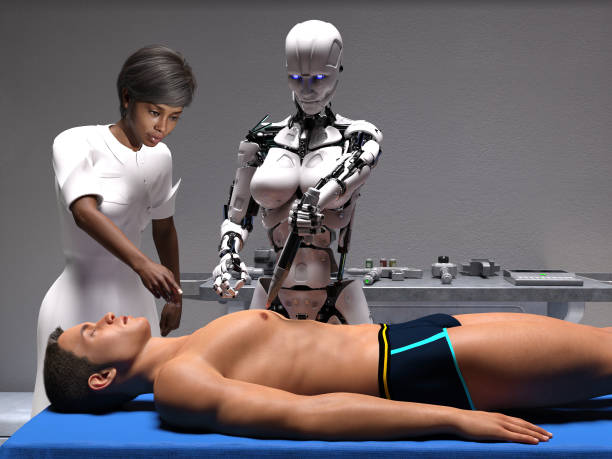
Distalmotion has developed a robot that can carry out surgery independently. The self-governing operative technology is called Dexter. Transforming how healthcare treatments can be prepared, implemented, and expanded throughout healthcare systems internationally. The concern of whether or not a robot can perform surgery without human intervention is no longer speculative.
Scarcity of surgeons, the need for less invasive medical treatments,. And elderly demographics are driving healthcare facilities to discover novel approaches. Distalmotion’s Dexter system uses detectors, artificial intelligence, and accurate operating devices to perform operations in the operating room. With a standard of reliability that human intervention alone cannot always assure.
Distalmotion is a Swiss medical robotics company established in Lausanne, Switzerland. The company originated from the École Polytechnique Fédérale de Lausanne (EPFL), one of Europe’s leading technical universities. Its lead product, the Dexter surgical robot, is a robot-assisted framework developed specifically for micro-invasive laparoscopic surgery.
Instead of developing a large, costly platform intended for operating rooms. In leading healthcare institutions, Distalmotion’s philosophy concentrated on creating a mobile, lightweight, and budget-friendly technology. The system is crafted to be moved into any conventional operating room, not demanding considerable structural modifications. This flexibility tackles a major obstacle to robotic surgery acceptance, which is expenses and setup challenges.
The Dexter system characterizes two robotic arms that can be paired with conventional laparoscopic instruments. A surgeon regulates the robot through a custom control panel with a 3D imaging dashboard and movement-adjustment features. The system converts the surgeon’s hand movements into accurate device operations. Screening out vibrations and reducing movement, permitting more precise control than is achievable with standard technique.
Comprehending the way a robot is capable of performing surgical procedures without a surgeon executing each specific action demands a closer examination of the meaning of autonomy in this situation. Distalmotion’s Dexter does not function independently as a completely self-governing system would. Rather, it incorporates organized automation within specific aspects of a surgical procedure.
The surgeon outlines the strategy and observes the operation. The robot then carries out precise movements with accuracy and consistency that go beyond what unsupported surgeons can consistently generate. Movement adjustment permits the surgeon to make large, comfortable movements at the control panel. This convert into much smaller, more precise movements at the tip of the instrument inside the patient’s body.
Furthermore, the system also captures operational data throughout each operation. This information contributes to a more thorough educational system. Enabling the platform to detect patterns, signal irregularities, and gradually contribute to a more precise understanding of what ideal surgical implementation appears to be for a particular operation. This is where AI in healthcare plays a key function. Not in substituting the surgeon’s decision-making, but rather in implementing that decision more reliably and quantifiably.
Self-governing robotic surgical platforms take up different performance levels. On the basic level, robots help with camera positioning, instrument monitoring, or consistent tissue retraction. At the advanced level, completely automated platforms can carry out predefined surgical actions. Without instantaneous clinician guidance. leveraging imaging information and pre-surgery plans to maneuver through the body structure on their own.
Distalmotion’s Dexter sits in the supported independence class. The solution is intended to improve surgeon capability instead of substituting for it. The difference is important because it influences the compliance pathway, the training prerequisites, and the clinical assertions the company can make. The system obtained CE approval in Europe, which permits its application in clinical environments throughout European countries.
Automated surgical technologies like Dexter are not attempting to copy a surgeon. The goal is to make specific surgical actions more consistent. When a robot carries out the same stitching action throughout numerous operations with little variation, the results become more certain. When a surgeon executes the same action throughout a lengthy surgery session, exhaustion can bring in unpredictability. Automated surgery systems tackle that problem clearly.
Operations performed with the Dexter system have featured laparoscopic cholecystectomy, hernia repair, and other abdominal surgeries. Clinical teams using the system have observed decreased physical stress on doctors, enhanced instrument accuracy, and shortened training times relative to alternative commercial surgical robots.
Image: Unsplash
The global surgical robotics market has evolved reliably for more than ten years. Numerous factors are fueling that expansion. Minimally invasive surgical procedures result in enhanced recovery in multiple operation categories: smaller openings, minimized hemorrhage, shorter recovery periods, and speedier recuperation in contrast with conventional operations. Machine-assisted technology allows micro-invasive techniques to be available to a broader group of medical professionals, compensating for less-experienced clinicians in laparoscopic methods.
The concern of whether or not it is less risky if a robot performs an operation is an issue that scientists and healthcare professionals are actively researching. The research foundation for automated surgical procedures is increasing. In genitourinary operations, women’s health operations, and certain colorectal(intestine)operations, robotic-assisted techniques have shown equivalent or enhanced outcomes compared to standard minimally invasive techniques. The benefits are most noticeable in operations that demand extreme accuracy in restricted physiological regions.
Hospitals in Europe, North America, and countries in Asia are investing in robotic surgical infrastructure as a future-oriented planned commitment. The initial expenses of these systems remain substantial, but the practical advantages are becoming more apparent. Shorter admissions, reduced complication rates, and less after-surgery attention requirements result in noticeable financial and clinical advantages in the long run.
Distalmotion’s strategy as a budget-friendly, compact solution to recognized market leaders like Intuitive Surgical tackles a different group of this increasing market. Smaller hospitals, community surgical centers, and healthcare systems in developing countries indicate a significant unexplored market for robotic surgery. Dexter was established targeting those institutions in mind.

Image: Unsplash
AI in healthcare has been evolving speedily throughout diagnostic tools, pharmaceutical research, and medical decision-making. Its arrival into this operating room is a recent development and more structurally complicated. Medical robotics technology incorporates AI into a real-world environment where the consequences are immediate and the room for mistakes is extremely small.
Distalmotion incorporates AI into its system by means of data collection, procedural analysis, and movement optimization. The system improves from its experiences. Gradually, that knowledge base can be utilized to detect effective approaches, signal irregularities, and supply surgeons and hospital administrators with understanding into workflow efficiency that were formerly inaccessible.
This is aligned with a wider pattern in medical robotics technology where the hardware and software components progress together. The robot is not unchanging. It is a platform that improves as clinical evidence accumulates. This interaction is crucial to why financiers and healthcare systems are considering robotic surgery not as a specialized tool but as a basic building block of future operating suites.
Distalmotion has drawn investment from European venture capital firms and healthcare-focused investors. The company’s development path demonstrates a realistic and methodical approach which includes developing a system that fits into established healthcare practices, secure regulatory approval, create clinical evidence, and subsequently broaden market presence grounded in established effectiveness.
Operating theaters are transforming in ways that are systematic, not surface-level. The incorporation of robotic platforms like Dexter reshapes how procedures are operated, how surgeons develop skills, and how performance is evaluated. Groups that formerly depended on hands-on technique and seasoned expertise presently are collaborating with platforms that measure performance and minimize inconsistencies.
Regulatory agencies in the US, EU, and other significant markets are designing structures to examine independent surgical innovations. The inquiry into what level of independence a surgical robot space at which point increased independence implements without immediate space at which point increased independence, clinicians, and technology innovators are collaborating with. That process will influence the space at which point increased independence capabilities get to the clinic.
For healthcare centers, the pressing concerns involve incorporation. How does a robotic system align with established surgery coordination, equipment sanitization processes, and team training programs? For medical professionals, the question is which additional competencies are required to collaborate together with robotic assistance and how those skills are developed. For patients, the most relevant concern is if robotic surgery at their hospital results in improved outcomes.
Distalmotion’s solutions to these challenges, a compact system, a budget-friendly alternative, a Certified platform with increasing research, demonstrates a realistic and growing ambition of how robotic surgery benefits more individuals, not merely those at prestigious research centers.
Self-governing surgical robots are being developed given that healthcare systems are under pressure. Scarcity of Surgeons, increasing procedural demand, and the human error margins in high-precision environments are all generating circumstances where medical robotics technology addresses a pressing and rising need. Distalmotion is one of the companies developing the tools that addresses these circumstances.
Robotic surgery can enhance reliability and broaden access to healthcare. A hospital that does not have a highly experienced laparoscopic(robotic-assisted) surgeon now has the ability to conduct an operation with the assistance of a robot that produces results equivalent to those reached in better-equipped, better-equipped hospitals. That is the current reality. It is what platforms like Dexter are intended towards supplying in the short term.
Medical robotics in operating rooms is a recognized and increasing aspect of advanced surgical infrastructure. Surgery is transitioning into technology-supported and mechanized systems not because human surgeons are being replaced, but because properly-designed computerization makes their work more accurate, more dependable, and more attainable to the patients who benefit most from it. Distalmotion is a facet of that transformation.