
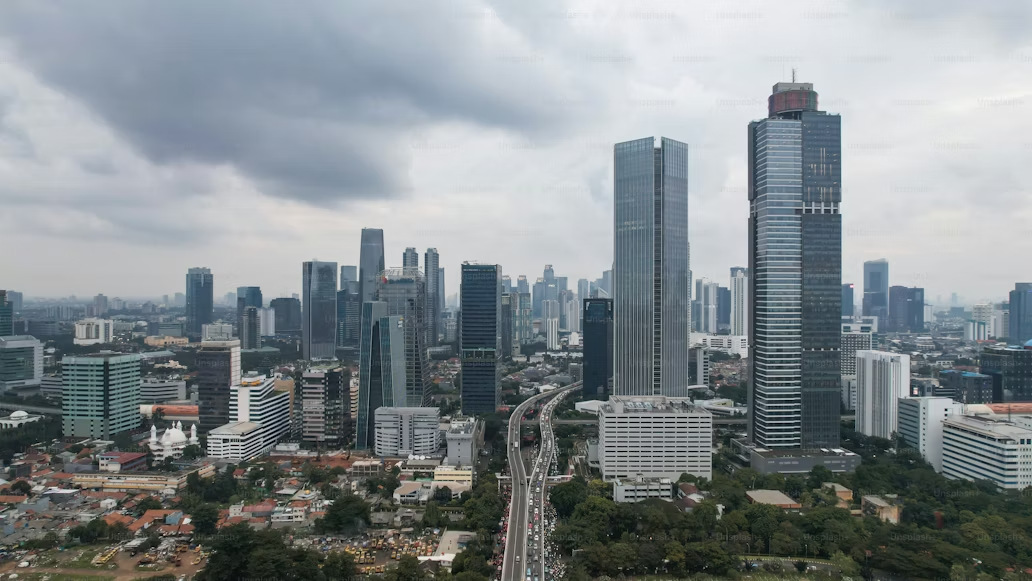
From logistics to technology, Asian entrepreneurs are redefining the structure of commerce globally with the right infrastructure that allows modern economies to thrive.
Across the continent, platforms now serve hundreds of millions to over a billion users, processing trillions of dollars in transactions annually and reshaping how payments, logistics, and services operate at scale. Their leading companies have influenced global markets beyond their continent’s borders as they continue to build the future of global infrastructure.
Infrastructure used to be a predictable topic of conversation and was connected to the government. They built roads, banks, and schools, and they also gave people jobs and safety. Today, infrastructure is no longer strictly government-controlled. All over the continent, many companies are changing the definition of infrastructure and designing it to suit their taste.
This change is important because infrastructure itself is important. It has a say in how fast businesses can grow, how markets can operate, and how customers can access services. To understand Asia’s global influence, you have to look at what is being built, and how differently it’s being approached.
When people discuss global infrastructure, they typically focus on the “bigger” sectors; logistics is rarely mentioned. However, only a few sectors are as sensitive to inefficiency as logistics.
Asia is home to some of the world’s most complex supply chains. Goods travel through many networks, including industries, seaports, warehouses, and bus delivery systems. Small efficiency gains that accumulate over time can have a positive economic impact. Any minor error caused by delays, theft, poor visibility, or poor coordination results in economic loss. Common issues that need attention in the logistics sector include:
Instead of starting a new style of logistics system from scratch and to reduce the negative impact these challenges are putting on the economy, a couple of Asian companies have taken it upon themselves to fix these problems.
Consider Alibaba Group. Many people are familiar with Alibaba because of its global online marketplace, which has millions of users. However, Alibaba’s influence extends even deeper into the logistics infrastructure. Cainiao serves as Alibaba’s logistics arm, which processes millions of parcels daily across China and international markets. The company is heavily invested in data-driven shipment tracking, warehouse optimization, and cross-border fulfillment systems to ensure that logistics run smoothly and effectively.
At $10.3 billion, the architectural features of this Cainiao project are quite fascinating. Instead of seeing logistics as a back-end function, Alibaba takes a new approach, integrating its data into the commerce workflows. Data flows seamlessly between merchants, consumers, and service providers, turning logistics into a shared, intelligent layer.
This shift transformed logistics from a human-coordinated process into a computational system capable of optimizing itself. As cross-border e-commerce continued to expand, the need for logistics systems that could handle high-volume traffic became a priority in the market. Speed, transparency, and predictive delivery dates then became easily accessible features for its users.
Grab, founded by Antony Tan and Tan Hooi Ling, started as a taxi service company before it pivoted into a logistics and delivery Asian infrastructure provider. They can link drivers, traders, and consumers to people who need their services, and payment can be made from several countries around the world.
What makes Grab stand out from the others is how it utilizes its resources superbly. Drivers and cars are assigned to customers across transport, food delivery, and delivery services. That same network supports multiple economic functions simultaneously, leaving little room for idleness. In places like Manila, Singapore, and Tokyo, Grab’s multi-use infrastructure approach is essential because of their dense environments. With a market cap of $17.46 billion, Grab has proven to be a leading light in the logistics sector.
For many Western markets, fintech is improved for smoother interfaces, better lending experiences, or specialized financial tools. In Asia, things are much different. A large number of people in Asia have zero access to any financial services. Banking, standard credit histories, and no means to engage in commerce. To make plans for building any type of financial products without looking for solutions to bridge the gap between the masses and finance will be a suicide mission.
Technology in Asia has risen to the challenge, and they have responded by building the right kind of infrastructure to solve the problem.
In its early days, it was an Asian startup focused on growing as a digital wallet platform, but as it grew, it eventually expanded into a broader financial access platform. Paytm made it possible for payments, bill settlements, services, and banking integrations to exist together in one system. In economies that are still heavily cash-dependent, digital wallets are very important. They link people and serve as a stepping stone to the financial services they can’t get.
Look at it this way: if transaction histories accumulate, the possibility of users being introduced to new services like credit, insurance, and wealth management becomes increasingly likely.
Ant Group, known as Ant Financial, was launched in 2004. It is also an affiliate of Alibaba. They oversee Alipay, the largest digital wallet and mobile payment platform in China.
Ant Group isn’t just a payment platform. What they do is more than that. They are involved in credit scoring, assessing risks, and offering financial services. They make it possible for small-scale traders and individuals to have access to financial services that were predominantly for just larger companies.
Ant Group, through Alipay, serves over a billion users, making it one of the largest financial platforms globally. It is part of the daily business life in China, making it possible for payment to be done in physical stores or online platforms. It can also be used to transfer money and pay utility bills.
The healthcare sector in Asia has always been facing a persistent problem: there are not enough resources to address the demands placed on it.
Asia is the most populous continent in the world, and it is difficult for the system to solve the problems hospitals and health clinics are facing. Challenges with uneven distribution of medical supplies and costly medical treatment pose a structural problem. Healthcare systems across Asia operate under varying degrees of resource pressure. Population size, geographic distribution, and workforce limitations shape delivery models. Asian health-tech companies have frequently emphasized:
All of these hint at the need for a digital means of getting health services. When there’s an overwhelming number of patients assigned to a particular doctor, you know it is not a good look. Especially in remote areas. The death toll rises and people keep falling sick or their conditions worsen while they wait for the doctor to attend to them.
This is why the need for an app-based doctor appointment became crucial. Alongside assessment tools and feedback from doctors.
To solve this problem, Ping An came into the scene with its innovation focused on reach, efficiency, and digital mediation.
Ping An has been around since 1988 as the first joint-stock insurance company in China. Known for being an insurance and financial services company, in 2014, they expanded into healthcare with the birth of Ping An Healthcare and Technology Company Limited and later rebranded to Ping An Good Doctor. The flagship platform of the company’s venture into healthcare.
Ping An decided to design a system that is capable of integrating patients, doctors, payments, and medical records on the same platform. With over 400 million users, over 49,000 internal and external doctors, and over 1.3 billion cumulative consultations. Ping An Good Doctor has been able to provide solutions to persistent problems simultaneously:
Halodoc, founded by Doddy Lukito and Jonathan Sudharta, who is currently the CEO, is one of the top healthcare platforms in Indonesia. It is a 24-hour secure healthcare platform that brings patients, doctors, insurance, labs, and pharmacies together on one app. The platform removes the stress of location and logistics. This is particularly important when you realize that Indonesia is defined by archipelagic geography, and it is difficult for the citizens to move around regions seamlessly.
Halodoc is essential because when getting physical healthcare seems impossible, digital healthcare becomes an option. Consultations, prescriptions, and everything else that happens in a hospital happen on the app. With over 20,000 licensed doctors and 40 million users on the platform, Halodoc has been consistent in remaining the number one healthcare provider for Indonesians.

Image: Unsplash
One of the many specialties of innovation in Asia is the emphasis they place on ecosystem platforms. Asians companies prefer to integrate a lot of services into one environment instead of having one service for one environment.
Founded in 1998 by five co-founders: Pony Ma, Zhang Zhidong, Xu Chenye, Chen Yidan, and Zeng Liqing. Tencent is a multinational technology conglomerate that designs innovative products and services, with WeChat alone supporting over a billion active users.
They have created some of the world’s most popular video games, like Call of Duty: Mobile, Naruto, and Honor of Kings, amongst others, through different studios like TiMi Studio Group, Lightspeed Studios, Morefun Studios, and Aurora Studios, all under Tencent Games.
Through WeChat (Weixin) and Tencent QQ, Tencent created an interface that can serve as a communication chat box, a means of payment, and a service marketplace simultaneously. There’s also WeCom, a management platform for enterprises, and Tencent Meeting, which is cloud-based for audio and video conferencing.
Tencent fintech services use advanced technology and its vast ecosystem resources to connect millions of people around the world. Using apps like Weixin Pay, QQ Wallet, We Tax Refund, TenPay Global, etc., Tencent provides services that include mobile payment, wealth management, utility payment, and financial support for people and businesses alike.
Tencent also has utility tools like Tencent PC Manager, QQ Browser, and Tencent Mobile Manager that address issues regarding network, security, internet, and so much more.
With a market cap of $607.75 billion, Tencent has been able to achieve success for decades with its ecosystem that has positively affected millions of lives around the world.
When you closely examine these three sectors: logistics, fintech, and health. You’ll notice a familiar trend. The majority of Asian companies are focused on designing systems that solve the practical needs of the people. They make it easier for people and businesses to make and receive payments, get financial assistance, transport goods and services, and have access to healthcare and utility services that proved difficult.
Asia has a population of over 4 billion people, and the older systems do not have the capacity to handle the ever-increasing demands from its fast-growing cities. Asian tech companies that could address these challenges stepped in, and as a result, they not only improved the quality of life but also unlocked business opportunities as they grew. The lesson here for entrepreneurs and investors outside the continent is that the Asian market teaches a new way to create and grow businesses, mainly focused on infrastructure.
While Asia is a diverse continent, many of its sectors have the same problems.
Many Asian firms “love” the ecosystem models where everything is connected. Payment links to e-commerce. E-commerce links to logistics. Logistics to financing. And on it goes. What this model results in is an integrated system where users carry out all of their tasks on one platform without needing to shuffle between two or three apps simultaneously. This gives comfort and stability as well. There are no pauses, no confusion, and you can see everything happening in real time.
Digital systems pretty much have the same working format as physical ones. Deliveries can be optimized with the algorithm. Warehouses can make use of predictive analysis. Automated risk assessments can help with financial services.
Basically, infrastructure becomes a programmable tool. Companies don’t need to wait for manual upgrades anymore. Anything that has to do with goods, prices, and deliveries can be done through the system.
One thing with Asian markets is that they will regularly demand extreme cost efficiency. Innovations and products are coming into a populated market that has different classes, not everyone earns the same. So provisions must be made for them. This forces companies to build high-level solutions that align with the population.
A company can function in multiple sectors at the same time. For instance, a company that processes payments can operate as a marketplace, or give financial advice, and control logistics while branching into agrotech. When these possibilities emerge, boundaries lose their meaning.
Can the Asian infrastructure model be copied or duplicated elsewhere? The thing with replication is that it never ends up being the same thing. There are going to be slight differences no matter what. And considering that you may be suggesting taking a continent’s model into another continent. Well, that’s a different ballgame entirely.
Strategies are shaped by what they work with: population, consumer demand, capital, and other factors as well. What works for a densely populated megacity in China may suffer in a market that barely has up to a quarter of its population. Replication may be a headache, but considering parts of the lessons and developing a model to work in your specific region may work.
There are several takeaway strategies that global markets can take into consideration:
| It is possible for infrastructure to be privately funded and managed | Instead of folding your arms and waiting for the government to provide solutions, capable companies can drive the modernization of infrastructure by themselves, as long as incentives match. |
| Efficiency can be unlocked by integration | Building an ecosystem of infrastructure may be able to reduce problems and open up new opportunities to grow at the same time. |
| Software can improve physical systems | Software, when used with the right systems, can improve the functions of manual working systems like transportation of goods and services by air, road, and water. |
| Growth can reshape innovation economics | Coming up with innovations to address the problems faced by large, diverse populations improves resilience and reduces cost. |
Asia’s influence comes from the type of innovation it introduces into the market, not how many types of innovations it introduces. A lot of their companies operate at the ground level where payment, logistics, and tech begin. Traders can carry out fast business transactions. Logistics becomes less of a hassle. Software becomes normalized.
These are the layers that shape the market. So as they grow, their pattern influences the market.
Innovation in Asia is changing the future of global infrastructure across different sectors in the continent and beyond.
When platforms serve hundreds of millions of users and process economic activity at a a national scale, they stop being companies and start becoming infrastructure layers. A rising population leads to more urban growth, and what this means is that there will always be conditions that require the right infrastructure.
Wrapping up, understanding the impact of innovation in Asia goes beyond keeping track of how many companies are pulling their weight. It is about becoming familiar with the structure and strategies that these companies have used to achieve success.