Lead generation for Nigerian businesses is critical because many companies lose valuable opportunities every day. A Lagos vendor can miss 30 to 50 customer enquiries simply because they are too busy to respond, leading to potential monthly revenue losses of ₦5 million to ₦15 million. This often happens when businesses run advertisements without a clear system for capturing and managing leads.
This guide explains practical lead generation for Nigerian businesses, especially for SMEs and startups. It covers a workable framework, realistic cost-per-lead ranges, effective channels, an 8-week action plan, and key considerations under the Nigeria Data Protection Act 2023.
Why “Marketing” Isn’t the Same as Lead Generation
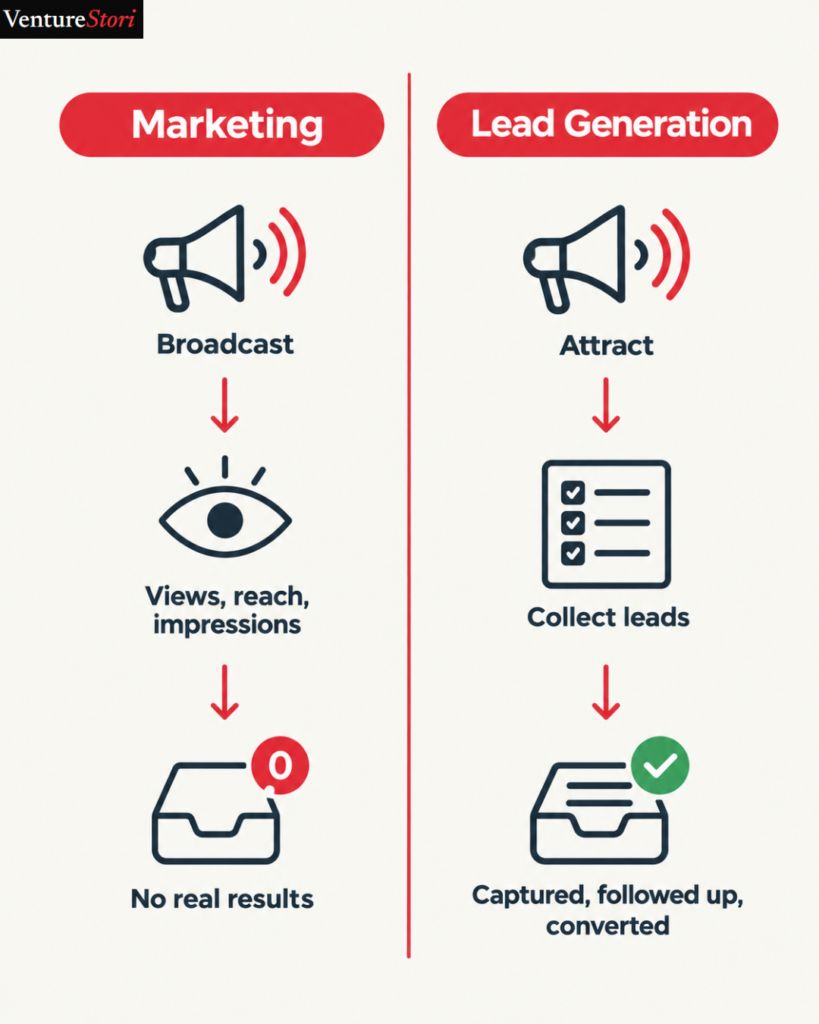
Your business becomes visible through marketing. But lead generation will give your business an established name, good numbers, and traction. A business can be successfully marketed but fail to have any lead generation. For instance, a Facebook ad with thousands or possibly hundreds of thousands of views can have zero comments asking “how can I buy this?” or “where can I get this from?” in the comment section.
This is an example of a marketing win—because of the number of views—but a lead generation failure— because of the lack of follow-up from viewers.
The businesses that are making it work aren’t necessarily the ones spending the most money on ads. They’re the ones able to stay organized to be aware of and follow up on the traction their marketing is bringing.
Two different businesses can have a budget of ₦100,000 for marketing and lead generation; while one business does one or two Facebook campaigns and ends up with a couple of sales, the other business spreads its budget across different channels with a proper nurture sequence and has a lot more sales than the first because it made sure that nothing fell through the cracks.
The Six-Stage Lead Generation Framework
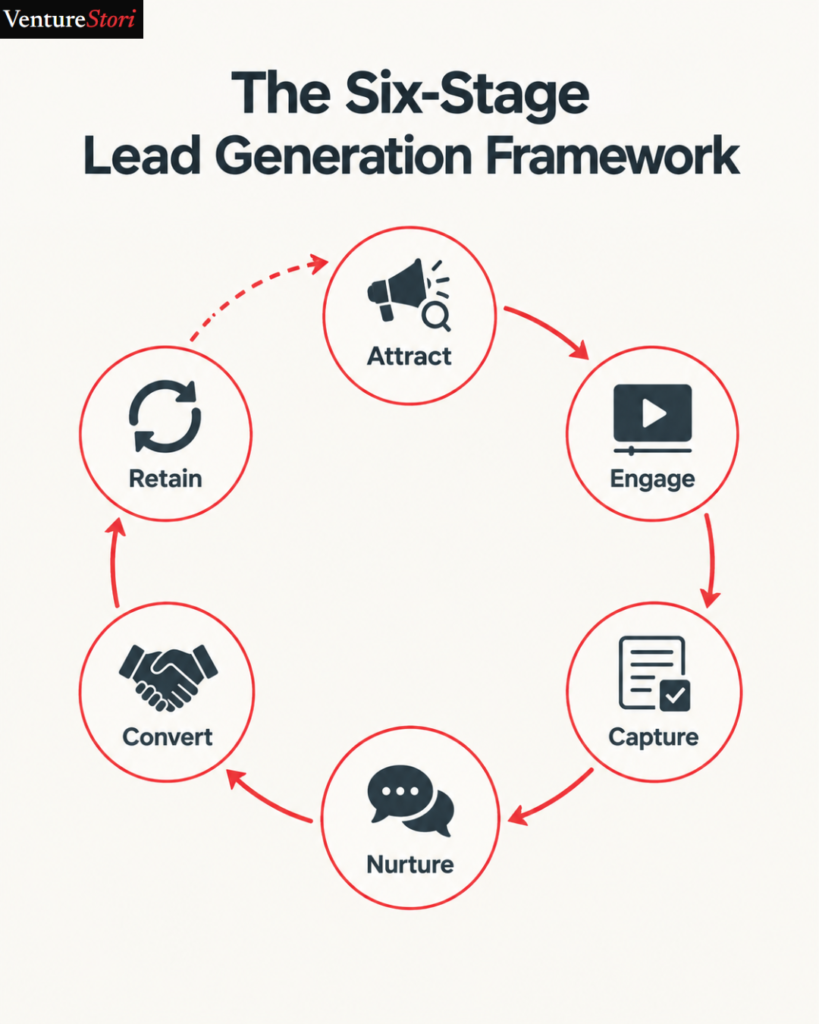
Many lead generation systems have different stages that are based on their marketing model, but there is a consistent process that connects them, starting from attracting customers to retaining them.
- Attract: Make sure you’re visible in places where your potential customers will be able to see you: Google search, paid ads, social media apps, referrals, and offline channels.
- Engage: You can do this through content videos, testimonials, case studies, and essential tips that will help your prospective customers determine if you’re trustworthy.
- Capture: Your potential customers need you to give them a worthy reason before they’re open to sharing their personal details with you. If you’re collecting data for marketing purposes, make sure you have explicit consent.
- Nurture: Getting a person’s personal data doesn’t automatically turn them into your customer. You need to follow up with them after getting their details.
- Convert: Trust has been built at this point, you should be able to convince a substantial number of them about your business.
- Retain: The relationship doesn’t end after the sale. It is cheaper to retain customers than spending money to get new ones. Retained customers can buy again and refer your business to others, which usually the cheapest leads a business can get.
The businesses that find it difficult to succeed with lead conversion aren’t always the ones short of leads. Their problems lie between what happens after they make first contact and what happens after the first sale.
Lead Generation Channels in Nigeria
One thing worth pointing out is that most of the channels important to the Nigerian business community are relationship-led. For instance, according to the PwC Nigeria MSME Survey 2024, WhatsApp is the most used business-marketing channel.
The PwC Nigeria MSME Survey 2024 most-used business-marketing channels include:
- WhatsApp Business: 23%
- Facebook: 19%
- Instagram: 15%
- Email marketing: 10%
- Bulk SMS: 9%
- Twitter: 9%
- Online store: 7%
Based on the survey results, Nigerian small businesses make use of these channels to communicate with their customers and provide for their needs.
This doesn’t mean that cold channels will not work. It will, but not like WhatsApp lead generation and the likes. And it is also important for businesses to be conscious of the fact that the Western markets and Nigeria are different, the strategies that worked there may not automatically work here.
Industry Cost-Per-Lead in Nigeria Benchmarks
Real estate, legal services, and B2B are some of the expensive industries. While the more affordable ones are e-commerce, retail, and hospitality. This is because the expensive industries have long sales cycles, a more competitive market, and a lower volume of qualified leads.
According to a 2026 Busnurd benchmark, the average real estate cost-per-lead is about ₦9,000 on Meta and ₦14,000 on Google Search, compared to the ₦1,200 price for e-commerce and ₦2,500 for hospitality on Meta.
Some other prices include:
- Real Estate: ₦9,000–₦15,000 per lead (high-value, competitive).
- Financial Services: ₦5,000–₦12,000 per lead.
- Education: ₦2,500–₦8,000 per lead (lower CPL, higher volume).
- Healthcare: ₦3,000–₦8,000 per lead.
- Legal Services: ₦4,000–₦10,000 per lead.
- Fashion/Retail: ₦800–₦5,000 per lead (volume game).
- Tech/SaaS (B2B): ₦6,000–₦20,000 per lead (longer sales cycle).
- Food/Hospitality: ₦1,000–₦4,000 per lead.
- Consulting/Professional Services: ₦5,000–₦15,000 per lead.
B2B lead generation in Nigeria is also quite expensive especially when you factor in the higher-value contracts, extra decision-makers, and longer sales cycles. Sabi Marketplace is a good example of a B2B platform that has risen to the pinnacle of commerce in Africa.
AI Lead Capture Agents: Why Nigerian Businesses Are Adopting Them
Including an AI voice or chat agent can be a positive addition for Nigerian businesses that receive a lot of enquiries during and after working hours. The power supply shortage has proven to be a thorn in the flesh of many businesses in the country and yet, Ariele Agency has grown its operations from Enugu to Europe.
According to a World Bank report, businesses in Nigeria face up to eight hours of power outages on a daily average and about 86% of businesses in Nigeria depend on a generator for power supply.
A World Bank report states that businesses in the country face an average of eight hours of power outages daily, and about 86% of businesses own or share a generator.
AI lead capture agents aren’t here to permanently replace salespersons but to assist them in handling bulk enquiries and calls, and to help reduce potential revenue loss as well. It responds to routine questions, collects basic information, qualifies an inquiry and passes complex sales conversations and high value sales to a human agent to handle them because the AI isn’t properly designed to handle them.
NDPA Compliance: The Requirement Most Businesses Skip
The Nigeria Data Protection Act 2023, says consent is a freely given, specific, informed, and unambiguous indication of agreement. The Nigeria Data Protection Commission (NDPC) 2025 implementation guidance says that consent is a requirement for direct marketing. People can either accept or decline the option of direct marketing. Under section 36 of the Act; once a data subject objects to processing for direct-marketing purposes, their data must no longer be processed for that purpose.
There have been cases where defaulters have been punished. In 2024, the NDPC imposed a major fine of ₦555.8 million against Fidelity Bank and a ₦766.2 million fine against MultiChoice Nigeria. In June this year, the Federal High Court in Abuja issued an order to GTCO to suspend any direct-marketing messages to a non-customer, and the bank was ordered to disclose the source of the person’s data, including any third parties or data brokers that may have been involved.
In practice, this means:
- Include a checkbox in your lead capture forms. For instance; “I agree to receive marketing messages.”
- Send WhatsApp broadcasts to contacts who engaged with you through inquiry, purchase, or referrals only.
- Email list only people who signed up specifically for email.
- Document consent (date, method).
Building the System: An 8-Week Plan
- Weeks 1&2 — Audit and strategy:
Your first line of action should be knowing where your current leads come from and which sources bring sales. Have a clear picture of the kind of ideal customer you need. Strategize around the channels where the customer is more active on. Set a target cost-per-lead and conversion rate.
- Weeks 3&4 — Google and local visibility:
Optimize your Google Business Profile, then you run tests on a small Google Ads budget, and have a landing page for the traffic that will be built.
- Weeks 5&6 — Lead capture infrastructure:
Have something worthwhile that will trigger people to give you their contact details but make sure to add a consent checkbox on a lead form and also make sure that WhatsApp and emails are set up in a way that it will be able to collect and sort out new leads.
- Week 7 — Nurture sequences:
Write a short email and WhatsApp follow-up sequences — three to five messages each. Give value first and sell later. Create a sales call script for closing.
- Week 8 — Launch and measure:
Go live, keep record of cost-per-lead and conversion rate for each channel. Take out anything that doesn’t work and put in more effort on the channels that show results.
Matching Channels to Your Business Type
- Local/retail (salon, restaurant, shop): Begin with a free Google Business Profile, run a small Google Ads test, and use WhatsApp — include Facebook or Instagram for more brand awareness if the basics start to work.
- B2B/professional services (consulting, law, accounting): Build your audience on LinkedIn and use WhatsApp for outreach to your contacts. Follow up with your potential clients via email and include Google Ads for people looking for specific service keywords.
- E-commerce: Google Shopping and Facebook or Instagram ads can attract potential customers, collect their emails, and follow up with essential information, plus you can improve your sales through referral or affiliate partnerships.
- Real estate: Run local Google ads, use AI for faster responses, then WhatsApp for broadcasts to your contacts. You can run listings on established Nigerian property websites like Nigeria Property Centre and PropertyPro.ng, and also convince your customers to refer others.
The Math: CPL and ROI
Calculating cost-per-lead is quite simple: your total marketing spend divided by your total leads. ROI is how much you’ve made compared with how much you spent.
What matter most is the number of leads that become paying customers. For instance, 20 leads with a 25% close rate and 50 leads with a 10% close rate can roughly generate the same revenue. Having more leads doesn’t necessarily mean it is a better system, especially if there’s a drop in quality in the extra leads.
The Bottom Line
The best lead generation strategies for Lagos SMEs or Nigerian SMEs in general tend to favor channels like WhatsApp, referrals, etc., that are based on relationships over cold emails that are used more frequently. Companies also need consent according to the Nigerian Data Protection Act. The businesses that keep missing 30-50 enquiries weekly are losing potential customers to competitors with organized systems in place.