Learning how to use project management tools in Nigeria starts with a scenario that many international articles never point to. A small agency in Yaba, Lagos, with six employees, might have an important client project that needs to be completed that day. But at 2 p.m., the transformer of the estate develops a problem. The power outage also takes down their internet connection. Three hours later, nobody can say who owns which task.
But the real question was never about which tool has the most features. Which tool survives an ordinary Lagos working week?
Why the International Advice for Project Management Tools Doesn’t Apply in Nigeria
Most reviews for project management tools are given under the most ideal conditions many Nigerian teams cannot relate to: steady power and steady bandwidth. If you stop assuming perfect electricity and internet, the order in which tools seem most suitable can change. A tool that depends heavily on powerful automation can become a liability if the internet goes off before it saves the work or synchronizes. You may reconnect later and discover that your latest changes weren’t saved, so that sophisticated tool becomes less useful.
| Different Nigerian conditions | The international pick | What actually happens | The better fit |
| Lagos team + unpredictable electricity | Asana, cloud-only | Changes may not synchronize properly, and reconnecting can take time. | A tool built to work offline and synchronizes the change when the power returns. |
| Five-person startup + tight budget | Asana Advanced | One seat can cost more than the team’s weekly data budget. | Using a genuinely free plan and an inexpensive tool. |
| Client-heavy social media agency | Trello, free tier | The free Trello version can help organize tasks, but as the agency gets more clients, updating can be time-consuming. | A paid version can eventually be used when the agency grows |
| Twenty-plus-person construction firm | Microsoft project | Costly, and part of the product line is retiring. | Planner paired with Project Desktop for whoever runs the schedule |
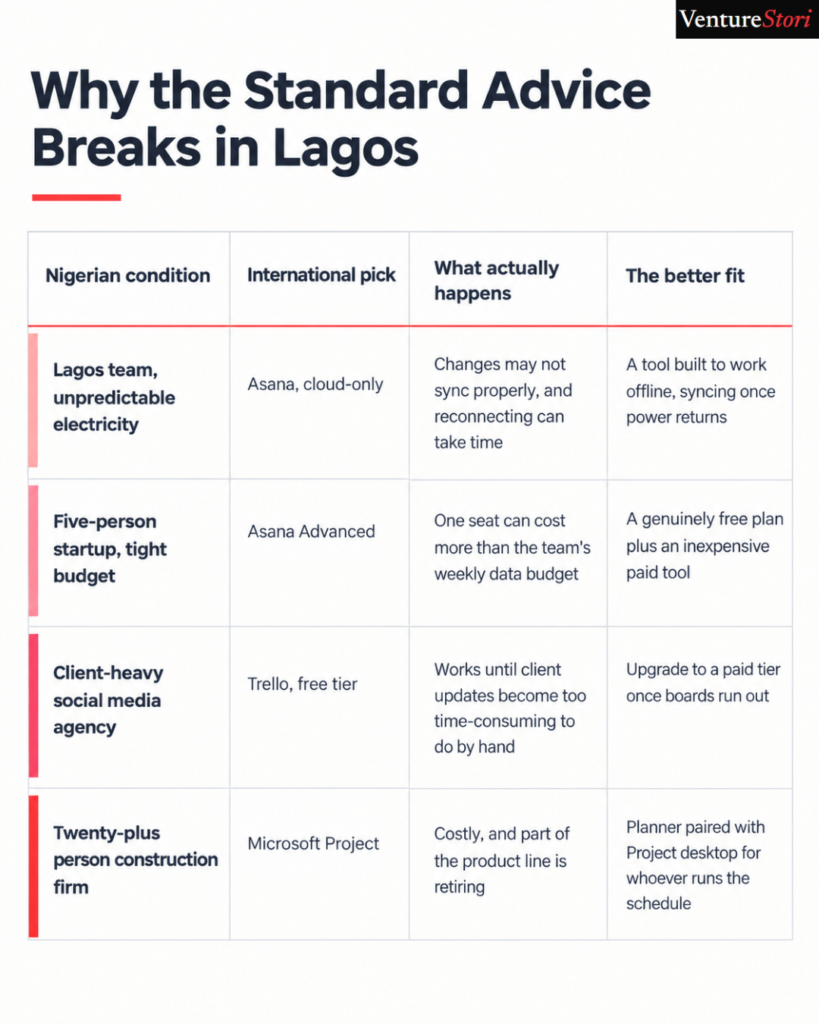
Before choosing a project management tool, it’s best to know the cost, if it can cope with poor connectivity, if it can be used on phones, and how difficult it is to learn. Do not choose project management software based on how impressive it looks on paper. Choose based on how well it works in your environment.
How to Use Project Management Tools in Nigeria When the Power Goes Out
Many people in Nigeria access the internet through their mobile phones and mobile data rather than through a fixed office connection. Fixed-line internet, like fiber connected to an office router, only accounts for a small portion of the country’s connections. Mobile data accounts for most of the recent growth in active subscriptions, according to Nigerian telecom regulators. Because of this, if you judge a project management tool just by how well it works on a desktop, you may be judging it based on the wrong device. When the office internet goes off either due to a power outage or otherwise, an employee may have to continue working from their phone using mobile data.
A June 2026 directive from NERC, the Nigerian Electricity Regulatory Commission, acknowledged that some Band A customers, who pay more for a target of twenty hours of electricity supply per day, were receiving less than expected. Band A feeders received less than eighteen hours in February and March 2026, and NERC attributed the problem to a shortage of gas for thermal power plants.
So it’s best to make the phone your main backup for managing projects, instead of treating the laptop as the default device.
Asana allows you to carry out offline actions through its Android and iOS app, though this can also be done with browser or desktop clients.
Trello‘s mobile app can also keep changes made when there is no internet and then synchronize them once the internet comes back on.
Zoho Projects, on the other hand, does not have a documented offline mode. Once your internet is gone, you can’t make any changes that will automatically sync later.
Five Questions to Ask Before Choosing a Project Management Tool
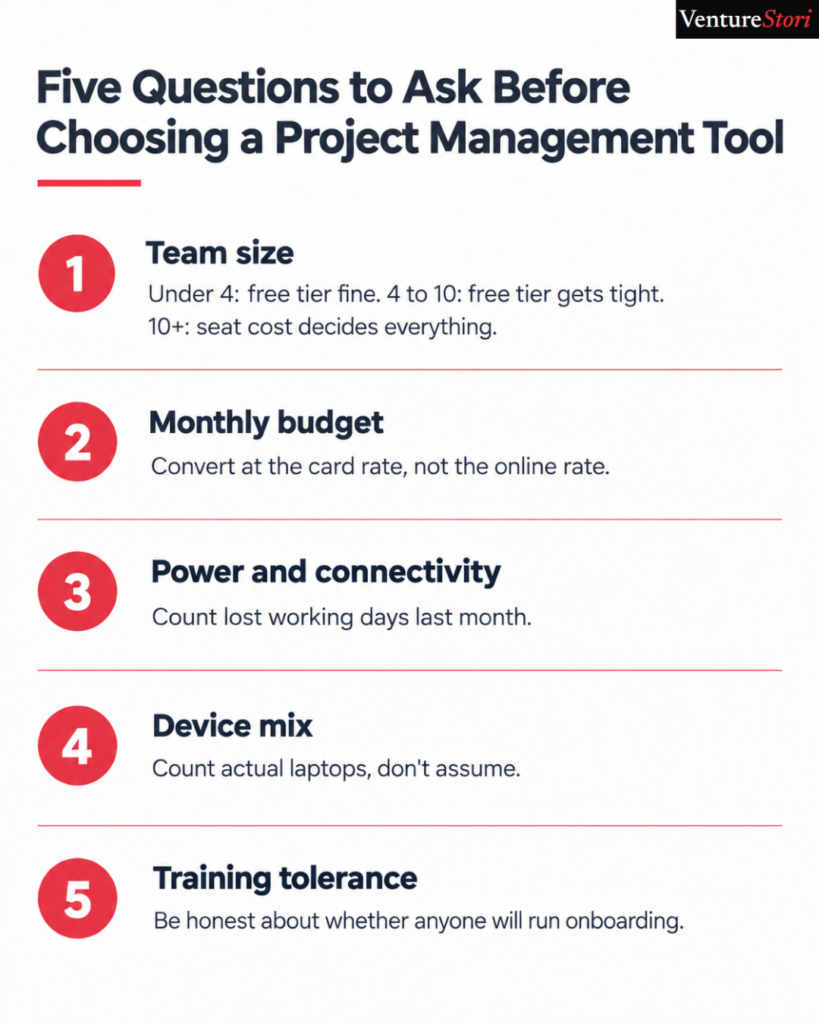
How many people are on your team? If you’re under four, a free plan may be enough. With four to ten people, a free plan may become restrictive. For more than ten people, the number of paid seats becomes very important.
How much can you afford every month? You should also convert foreign prices using the exchange rate your bank will actually use when charging your card, instead of just using the exchange rate you see online that morning.
How often does your team lose working time because of power or internet problems? If your team frequently loses access to office wi-fi or computers because of power problems, you may need a tool that works well on the phone and mobile data, instead of depending on the office router or wi-fi.
How many laptops do you actually have? Some project management tools are much more dependent on desktops or laptops than phones.
Will someone actually train your team? For complicated tools like Jira or Microsoft Project, someone may need to teach the team how to create tasks, assign tasks, update statuses, and how the team workflow should operate. If nobody is willing to take on that role, do not choose those complicated tools, even if they seem the most suitable.
Answering all five questions points you in the direction of the tool that is best for your team.
Cost of the Tools in Nigeria, Per person, Per month
They are the price per user, or per seat, for one month. All dollar prices are converted into naira using the central bank official rate of roughly 1,329 naira to one dollar, at the time the guide was researched. The actual amount your bank or card charges could be different, depending on the payment processing method.
| Tool | Plan | Per seat (USD/Per month) | Per seat (₦/per month) | Free tier |
| Trello | Standard | $5.00 | ₦6,645 | Yes, 10 boards |
| Zoho Projects | Premium | ~$4.00 – $5.00 | ~₦5,300 – 6,645 | Small team |
| ClickUp | Unlimited | $7.00 | ₦9,303 | Yes, uncapped |
| Jira | Standard | $7.91 | ₦10,512 | Yes, 10 users |
| monday.com | Basic | $9.00 | ₦11,961 | Yes, 2 users |
| Microsoft | Planner, Plan 1 | $10.00 | ₦13,290 | Not offered |
| Asana | Starter | $10.99 | ₦14,606 | Yes, capped |
| Asana | Advanced | $24.99 | ₦33,212 | Not offered |
| Microsoft Project | Planner + Project, Plan 3 | 30.00 | ₦39,870 | Not offered |
Asana’s current free plan is capped at two seats. For a team of five, the free plan won’t be enough. Teams that were on Asana before November 2025 can keep an older or legacy free plan that allows up to ten users. So if you already have an Asana workspace with a ten-user free allowance, don’t casually upgrade it, because you could lose the older free arrangement and end up with a newer plan that has smaller free user limits.
The Sum Most Founders Skip Before Signing Up
Before subscribing to a project management tool, it’s important to calculate the yearly cost for the whole team, not just for one person. Ten people on Asana Starter cost 1.75 million naira a year. But a project management tool from a local provider for that same ten people could cost 203,000 naira for the entire year.
So even if you’ve chosen a plan and calculated that your business can afford it, you still need a Nigerian bank card that can successfully pay for the international subscription, because many software companies charge in US dollars, even if you’re paying from Nigeria. Make sure your card can continue paying for the subscription throughout the year.
Three Nigerian-built software products and what they do
There are three Nigerian products worth considering
Sync! by Spurt! is a company founded in Lagos. It is designed for small teams of ten people or fewer, with major features like escrow-backed milestones and a talent marketplace. It now operates across six countries and costs much less than many of the international tools discussed earlier.
Workdora combines invoicing and project tracking instead of having a separate tool for each of these. Workdora’s own website also lists a free plan for small teams, which could be attractive for small businesses that want basic project management without immediately paying for software.
Pivotrio was built in Ibadan by Carmtheo Technologies, and according to its founder, Bosun Akinfolatimi, it was launched in June 2026. Unlike the other two, its purpose isn’t invoicing or payments. Instead, the product page describes it as being focused on staff goal setting and appraisal cycles, helping a company evaluate employees’ performance.
Its pricing is unusually low compared with the other tools discussed. It costs eight dollars per month for up to eighteen people, which, using the exchange rate applied in this article, works out to roughly ₦591 per person if the eight dollars is spread across eighteen people.
One thing most people mistake is assuming that if software is built by a Nigerian company, they’ll have to pay in naira, but this doesn’t apply all the time. Sync! and Pivotrio, for example, charge in dollars, even though they are Nigerian-built products.
Four Weeks from Decision to Adoption of a Project Management Tool
| Week | Focus | Deliverable | Time |
| 1 | Tool selection and setup | Workspace created, and Team invited | 10 hours |
| 2 | Process mapping | Templates built, automation tested | 15 hours |
| 3 | Training | Teams trained on the usage of project management tools on the phone, and a quick guide was written. | 10 hours |
| 4 | Monitoring | Adoption tracked and workflow adjusted | 5 hours |
The forty hours can either be spread across a month or be compressed into a week, depending on the availability of your team members.
Three Teams, Three Answers
We look at three different teams facing three different project management tool problems.
A social media agency in Lagos with six workers is already using the Trello free plan. The problem is that the business is growing, and the free plan is no longer enough to sustain what they have. The Trello free plan has ten free boards, but their business now requires more than that. Their client also wants proper reports about how the work is being done, instead of a copy-and-paste update.
So instead of abandoning Trello, they decide to move up to Trello Standard, which costs about ₦6,645 per person per month. Since there are six people, it costs about ₦39,870 per month for the entire team.
A 22-person construction company operating across Lagos and Abuja uses Microsoft Project Online to manage projects, track staff hours, and work with project data. The problem is that Microsoft is shutting down Project Online on September 30,2026, which means they will need to move all their important data and processes before that shutdown date. Since they’re using Project Online for timesheets and old data feeds, they need to export the information before the deadline.
To solve this, they moved to Microsoft Planner and Project Desktop, which together cost 39,870 naira a month per seat for those responsible for scheduling the projects.
A startup with no budget for a paid project management tool uses the ClickUp free plan. The free plan doesn’t limit how many people they can add, but it limits other things, like giving them only sixty megabytes of storage and one hundred automations per month. For three people, those limits may be enough at the moment, but as the company grows and starts storing more files or using more automation, they may need to pay for a bigger plan.
So the important question shouldn’t be which project management tool is the best. You should ask which problem your particular business has, and that will determine the type of tool you need for your business.
Six Mistakes that Waste the Subscription
Signing up without answering the five most important questions as discussed above could result in the following mistakes:
Calculating the price once and assuming it will stay that way. The naira price you calculate today may not be the amount you pay at the end of a billing cycle.
Ignoring what happens when normal connectivity and electricity are not available: can they still access the app, and is the update available?
Upgrading an older Asana workspace without checking whether it already works for their team. If the workspace was created before 12 November, 2025, they may still have a 10-seat allowance, but upgrading may mean they will lose it.
Missing the Project Online export deadline. Microsoft is shutting down Project Online on September 30, 2026. Some companies may have important information on it, and waiting until after the deadline could lead to the loss of the information
Paying for automation that no one in your team has been trained to use.
Key Takeaway
No project management tools are right or wrong. Tools like Asana, Trello, and Zoho Projects are mostly designed with stable electricity and internet in mind. The best approach for how to use project management tools in Nigeria is to choose a tool that works best for your working conditions.
Drive Digital Transformation Across Your SME
Ready to modernize operational workflows, adopt cloud systems, and scale digital sales channels in the Nigerian market? Learn how to select cost-effective tools, streamline backend business operations, and mitigate technology adoption risks in our complete framework on Digital Transformation for Nigerian SMEs.