When people talk about Nigeria’s creative exports, the usual suspects come up quickly. Music. Film. Fashion. Nollywood and Afrobeats have done what many thought was impossible, crossing borders without waiting for permission. But another industry is quietly following the same path. Gaming. Not as a hobby. But as a serious entertainment export with economic weight, cultural pull, and global relevance.
Like music and film before it, esports in Nigeria is beginning to move Nigerian culture, talent, and value across borders without requiring physical movement. Across the country, esports in Nigeria is moving from informal gaming centers into organized tournaments, educational partnerships, and institutional recognition. What once lived in the shadows is beginning to stand in the open. And it is happening faster than many people realize.
Community Before Industry
Before sponsorships, before federations, and before anyone talked about careers in gaming, there was community.
I saw this long before esports had a name in Nigeria. Growing up, I was an avid gamer. So obsessed, in fact, that my close friend Femi and I would sometimes starve ourselves just to spend entire days in gaming centers. We did not own games at home. And even if we did, our parents would have shut it down immediately. Being glued to a television screen was treated like a serious offense.
Gaming lived in shared spaces then. Dark rooms filled with the sound of video games, competition spilling into laughter, shouting, and arguments. We collapsed entire days into compulsive play, ignoring hunger and time. It was memorable, even if it came with constant scolding and disapproval. Femi lost to me more times than he would care to admit, though I will leave that claim unchecked.
What mattered was not winning. It was belonging. Those early gaming spaces were informal and unstructured, but they laid the foundation. Nigerian gamers were already organizing themselves long before there was money or recognition involved. Rivalries formed. Skills sharpened. Communities grew. That history matters. Balancing a professional gaming career with healthy relationship habits is becoming a key topic for young pros. It explains why esports in Nigeria feels durable. It did not arrive as a foreign concept. It grew from the ground up.
From Gaming Centres to National Attention
What has changed is scale. In recent years, esports in Nigeria have steadily gained traction in formal, cultural, and economic circles. Gaming hubs like Gamr Africa have launched dedicated spaces designed to nurture competitive play and digital skills. These hubs are becoming part of broader innovation stories in Africa, where youth culture, technology, and new industries intersect.
State-level initiatives, such as Ogun State’s adoption of esports through partnerships with gaming organizations, show that policymakers are beginning to pay attention. This shift became impossible to ignore when esports debuted at Nigeria’s National Sports Festival. That moment carried symbolic weight. It signaled that competitive gaming had crossed a threshold, from fringe interest to recognized sport.
Esports in Nigeria has also entered cultural spaces. Its inclusion at events like NAFEST reflects a growing understanding that gaming is not separate from youth culture. It is part of it. Progress has not been smooth. Infrastructure gaps remain. Power supply, internet reliability, and funding constraints continue to slow growth. But momentum has its own logic. Once it’s built, it’s hard to reverse.
Education, Banks, and Institutional Confidence
One of the clearest signals that esports is maturing in Nigeria is who is getting involved. Educational partnerships between esports organizations and financial institutions like Ecobank and FirstBank point to a shift in perception. Banks do not attach their names lightly. Their involvement signals confidence that esports in Nigeria is not just cultural but also economically relevant.
According to Akinwale Akintola, a coordinator within Nigeria’s esports development community, the biggest shift is legitimacy.
“Once banks and institutions get involved,” he says, “parents start listening, schools start asking questions, and young people stop feeling like they’re wasting time.”
These collaborations focus on esports education, digital skills, and structured pathways for young Nigerians who want to participate professionally, whether as players, analysts, content creators, or organisers.
This matters because entertainment exports only scale when institutions take them seriously. Music needed labels. Film needed distributors. Esports needs structure. Slowly, that structure is forming.
Esports in Nigeria as an Export, Not Just a Pastime
Entertainment exports succeed when they travel well. Gaming does. Unlike physical sports, esports in Nigeria does not require visas to compete globally. Nigerian players can participate in international tournaments from Lagos, Ibadan, or Enugu. Content can be streamed instantly. Audiences are global by default.
This gives esports a unique advantage.
Nigeria already has the population, the youth demographic, and the cultural fluency with digital platforms. What is emerging now is the infrastructure needed to convert participation into value.
International partnerships, such as the Nigeria Esports Federation’s collaboration with global game publishers, signal growing credibility. These relationships open doors to official tournaments, licensing, and global circuits where revenue, sponsorships, and visibility flow back home.
Not everyone agrees on how fast this can scale. But it is increasingly difficult to argue that esports in Nigeria is a dead end.
The Business Behind the Screens
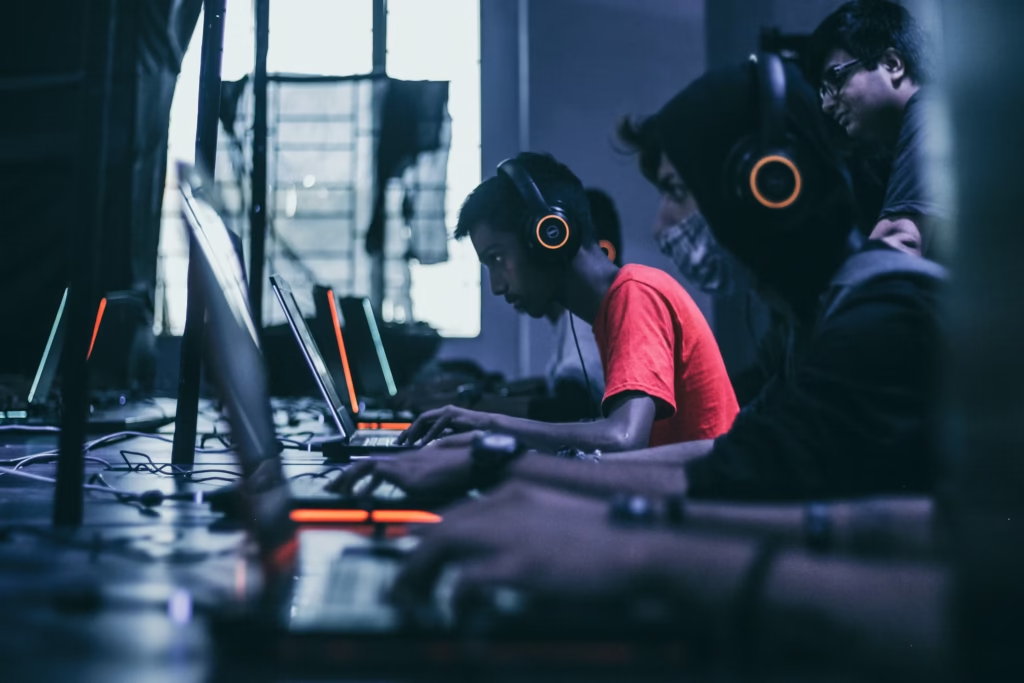
image: Unsplash
Esports is often misunderstood as just play. In reality, it supports an ecosystem. Professional players are only the most visible layer. Behind them are coaches, event organisers, broadcasters, shoutcasters, designers, marketers, and platform managers. There are sponsorship deals, advertising revenue, ticket sales, and media rights.
Countries that export entertainment understand this. They invest not just in talent, but in systems. Nigeria is not fully there yet, but the pieces are beginning to align. We are seeing a rise in problem-solving startups building infrastructure around payments, connectivity, and access, responding to the very constraints that have slowed growth in the past.
Why This Moment Feels Different
Nigeria has flirted with many digital trends. Not all of them last. esports in Nigeria feels different for one reason. Demand already exists.
In hindsight, what Femi, I, and every other kid who let their passion for gaming burn were really building was culture, long before it had an industry around it.
Young Nigerians are not being convinced to care about gaming. They already do. What is new is that institutions, investors, and policymakers are finally catching up.
There is also a generational shift. Parents who once dismissed gaming are beginning to see it as a legitimate path. Not always enthusiastically, but pragmatically.
That shift is subtle, but important.
Challenges That Still Need Solving
It would be dishonest to paint an entirely optimistic picture. Infrastructure remains a bottleneck. Power supply and broadband costs limit access. Funding is uneven. Regulatory clarity is still evolving. Many talented players and organisers operate without long-term security.
There is also the risk of premature hype. Not every tournament builds an industry. Not every partnership delivers value. Still, these challenges are familiar. Music and film faced similar barriers before finding their footing. The question is not whether obstacles exist. It is whether momentum can survive them.
So far, it has.
The Road Ahead
Esports is unlikely to replace Nigeria’s traditional entertainment exports. It does not need to. What it offers is diversification. A new lane for creative expression. A new route to global audiences. A new industry shaped by digital-first logic.
The next phase will depend on execution: better infrastructure, smarter partnerships, and sustainable funding models. For founders in this space, understanding the proven ways to secure funding for your startup may determine whether esports becomes an export industry or remains a promising subculture.
Concluding, Nigeria’s entertainment exports have always grown from the margins inward. Music moved from street corners to stadiums. Film moved from home videos to global streaming platforms. As the gaming community grows more diverse, we see a fusion of digital culture and personal expression through versatile and stylish fashion choices that cater to a new generation.
Esports appears to be following the same path. What began in cramped gaming centres and shared consoles is evolving into something larger. Not polished yet. Not perfect. But real. The screens may have changed. The ambition has not. If the past is any guide, the industries Nigeria exports to the world are often the ones it once underestimated. Gaming might be next.