
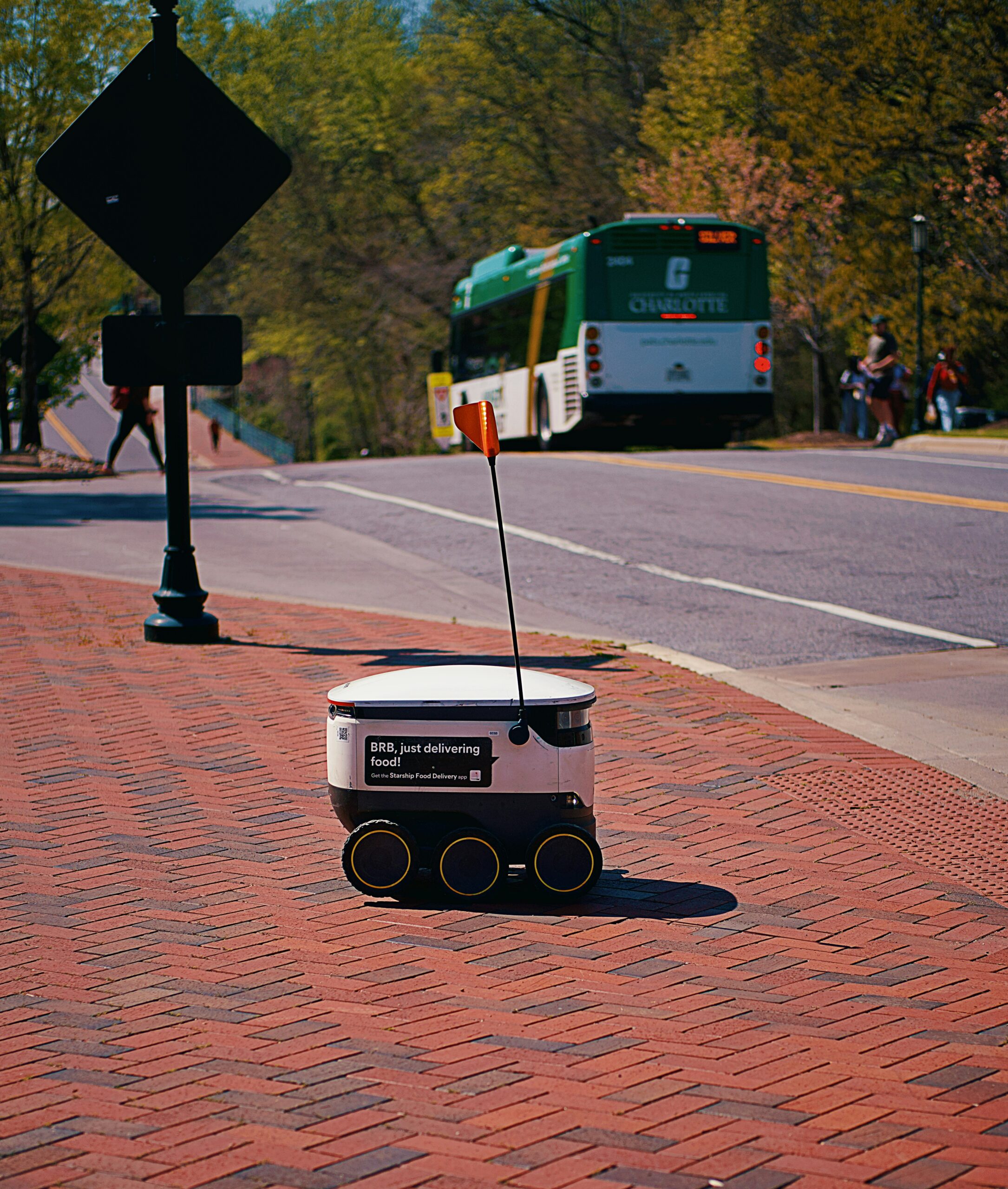
Gone are the days when you have to completely depend on deliveries to be done solely by humans. In Europe, delivery robots are slowly becoming part of everyday life. These small autonomous vehicles handle short trips, delivering groceries, meals, and parcels without a human driver.
Rising delivery demand, labor shortages, and crowded streets are pushing cities and businesses to rethink local logistics. Now, small, predictable robots carry out short deliveries efficiently, offering a glimpse of how urban streets and our daily routines are quietly changing. Let us explore how this actually works and how this technology is changing the world.
Starship Technologies has built its business around solving a very specific challenge, the last leg of a delivery journey, often called the “last mile.”
No, there was no attempt to replace trucks, vans, or long-haul logistics; rather, Starship niched down to short, predictable trips within neighborhoods, campuses, or city blocks. You know those kinds of deliveries that are too short to be efficient with a traditional courier but too frequent to ignore.
Starship Technologies designs, builds, and operates a fleet of autonomous, electric, sidewalk-traversing robots designed for local, last-mile delivery of food, groceries, and packages. As of October 2025, they have a fleet of over 2,700 robots that have completed more than 9 million deliveries in over 270 locations.
Each robot is about the size of a large cooler and can carry groceries, restaurant meals, or parcels weighing up to 20 kilograms. Once orders are placed through partner apps, a nearby robot is dispatched, and the delivery happens without a human driver. When the robot arrives, the customer unlocks it using their phone.
Instead of trying to automate everything at once, Starship operates within a narrow scope. It avoids long routes and unpredictable conditions.
This approach has allowed the company to operate in multiple cities and neighborhoods. They operate daily in real urban environments. They are not limited to small test programs or short-term experiments.
At a first glance, Starship’s robots might look like simple, rolling boxes on six wheels. But the system behind its working is quite complex.
Each robot is coupled with sensors, cameras, ultrasonic detectors, radar, and GPS that help it “see” its surroundings in real time.
So as the robot moves along the sidewalk, it is continuously scanning for people, pets, bicycles, curbs, and street furniture. It travels at walking speed, usually around six kilometers per hour, and this helps it blend naturally into pedestrian spaces without causing trouble.
The robots’ routes are mapped ahead of time, but the robots are programmed not to be rigid. Where there is a blockage on its way, the robot’s program lets it reroute itself or pause until the path clears. In more complex situations, a remote human operator takes over.
This hybrid model of autonomy and oversight is a key reason Starship has been able to operate safely in busy cities.
One of the most common questions people ask is how robots manage to navigate the roads, even busy ones. First, Starship robots are programmed to cross streets only at marked pedestrian crossings. Their system can recognize traffic signs, so they wait for the green light before stepping onto the road.
In more complex roads, like a multi-lane intersection or heavy traffic, remote human operators usually guide the robot across the roads. The best hack is that routes are strategically planned to fall mostly on pedestrian-friendly streets and to avoid high-speed roads entirely. With over 150,000 daily road crossings, you can agree this strategy has worked so well over time.
Starship already has a widespread presence in Europe, especially in Northern and Eastern regions where cities are open to testing new mobility technologies.
There have been active deployments in countries such as Estonia, Finland, Sweden, Germany, Denmark, and the United Kingdom. Cities like Tallinn, Helsinki, Stockholm, Hamburg, and Milton Keynes regularly see these robots making deliveries every day.
University campuses have also been a particularly fertile ground for expansion. The presence of layouts, predictable demand, and supportive regulations make them ideal environments for autonomous delivery. From there, operations easily expand into nearby residential neighborhoods.
A lot of European cities have approved test programs for the operation of robots in the cities, and this is why robot delivery is increasing in that region. For now, Europe stands out as a leading testing ground for autonomous sidewalk delivery.
Europe has become a natural testing ground for autonomous delivery, and several factors contribute to this. First, European cities are quite populated. So the short distances from one place to another make local deliveries more predictable and efficient. A robot can complete multiple trips in a small area.
Second, economics plays a big role. Labor and fuel are expensive in European cities. Hence, automation is an easier and cheaper alternative. By replacing small, repeated delivery trips with robots, businesses save time and money.
Also, environmental and regulatory pressures push cities to explore alternative solutions. With goals to reduce congestion, noise, and emissions, European cities are generally more open to trying innovative mobility solutions so long as safety rules are not violated. Together, these factors explain why European cities embracing new mobility solutions have become a natural testing ground for autonomous sidewalk delivery.
In a world where sidewalk robots, pedestrians, and vehicles now coexist, it is important to create new rules or adapt existing ones that would make their coexistence a cohesive one.
Speed limits around walking pace need to be regulated. Regulations on obstacle detection and the ability to stop instantly if something goes wrong need to be in place. Some cities also restrict areas where these robots are tested.
The key principle is simple: people first before robots. So, with these rules in place, safety is ensured. The robots can operate safely without disturbing daily life, and companies can still test and expand autonomous delivery.
Last-mile delivery is both expensive and labor-intensive. Many retailers lose their expected profits in last-mile delivery. The presence of Starship delivery robots addresses this problem. Once deployed, a robot can complete multiple deliveries per day at very low cost.
This is what makes autonomous delivery attractive, especially for grocery stores, quick-service restaurants, and campuses—places where demand is frequent and distances are short.
Sidewalk robots depend heavily on the quality of the spaces they move through. Smooth pavements, curb ramps, and consistent layouts generally help their efficiency. A small crack, an uneven curb, or a patch of construction can slow a robot down or even force it to pause entirely
The presence and efficiency of delivery robots in a place mirrors the infrastructure issues that affect pedestrians, wheelchair users, and parents with strollers.
Some city planners have started seeing robots as indicators and not obstacles because infrastructure inefficiencies that affect these robots are likely to affect humans too. In that sense, autonomous delivery intersects with broader conversations about accessibility and urban design.
For instance, sidewalks are no longer just for walking; they are now part of a logistical network, part of a broader wave of ideas reshaping the future of cities.
The reaction of the public to delivery robots has changed over time. Their early deployment was greeted with curiosity, skepticism, and concern. In recent times, the reaction has changed. Because starship robots are designed in such a way that they blend with existing environments and lifestyles, they feel less intrusive.
Moreover, as residents encounter them more and more, the robots fade into the background. They have become a part of the environment, no longer something to react to.
Autonomous delivery is a crowded field. Some companies focus on drones, others on self-driving vans or larger robotic vehicles. However, Starship has carved out its own niche. What makes Starship stand out is its novel direction. By concentrating on short, sidewalk-based delivery and avoiding high-risk environments, the company has been able to deploy widely with few or no test programs.
This approach has made Starship one of the most visible examples of autonomous delivery actually working at scale.
Replacing short van trips with small electric robots has a great impact on the environment. Robots consume less energy for delivery and contribute less to congestion and noise. Although they are not a complete solution to urban pollution, they help reduce the inefficiencies of last-mile logistics.
This aligns closely with Europe’s broader climate and mobility goals, where reducing vehicle traffic is already a priority.
Wrapping up, starship delivery robots exist because traditional last-mile delivery struggles to keep up with modern cities. Sidewalk robots are not replacing all delivery methods, but they are filling a gap that has long been expensive and inefficient. Sidewalks have slowly become part of logistics networks, integrated into everyday urban life. If the current trend continues, autonomous delivery will feel less like a glimpse of the future and more like a practical response to how cities already work.