
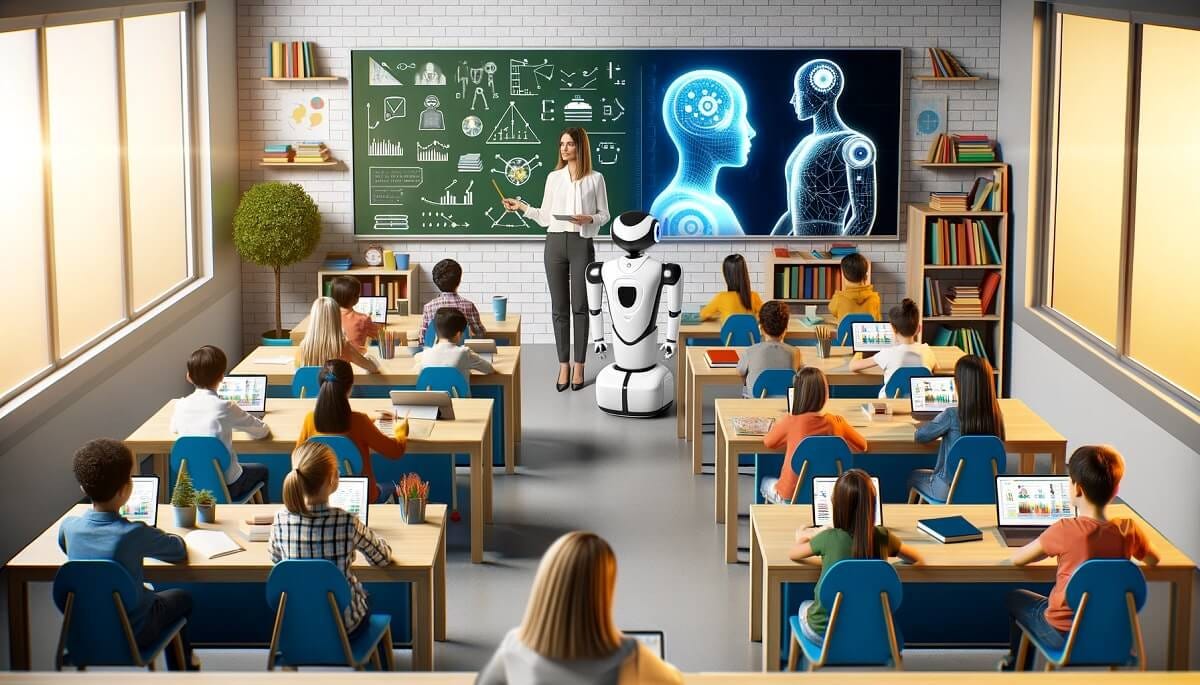
Have you had to learn in a crowded classroom before? Or have you ever thought there should be a way to make students learn at their own pace? AI is being used more and more to address issues in education, like resource constraints and packed classrooms.
According to the National Center for Education Statistics, classes should have between 13 and 17 pupils, but many have more than 30. This has a detrimental impact on learning. Smaller class sizes improve student results, according to the Educational Endowment Foundation. AI revenue in education is predicted to reach $10.8 billion by 2030, demonstrating its disruptive potential. The integration of AI tools, such as chatbots and adaptive platforms, promises to create individualized learning experiences.
Studies from the National Center for Education Statistics (NCES) describe overcrowding as a situation where a school exceeds its intended capacity by more than 5%. By that standard, many classrooms across Africa are far beyond what is considered manageable.
In several African countries, student numbers per classroom exceed recommended limits by a wide margin. In Chad, for example, the student-to-teacher ratio stands at 67. Research shows that when class sizes rise above 70 students, learning becomes significantly harder, especially for younger children at critical stages of development.
Teacher shortages make the situation worse. Nearly two million additional teachers are still needed across the continent. Rapid population growth means more children are entering school each year, but classrooms, teachers, and basic infrastructure are not growing at the same pace.
Overcrowded classrooms take a toll on both students and teachers. Noise and distractions increase, individual attention becomes nearly impossible, and disciplinary issues become more common. Many schools also struggle with poor infrastructure, including inadequate ventilation and sanitation, which raises health concerns for everyone involved.
There is a clear link between overcrowding and lower learning outcomes. In South Africa, for instance, low mathematics performance has been partly attributed to classroom congestion, where teachers are forced to focus on covering the basics rather than supporting deeper understanding.
While governments continue to invest in building more schools, demand still outpaces supply. As student populations keep rising, physical expansion alone has not been enough to close the gap.
The majority of AI used in African classrooms is accessible technology appropriate for low-resource settings. Chatbots and adaptive systems help students learn more effectively by delivering tailored academic support.
Take Siyavula in South Africa. Instead of treating every student the same, the platform adapts maths problems to how each learner is performing, meeting them where they are rather than where the curriculum assumes they should be. Elsewhere, multilingual learning tools are helping classrooms reflect the diversity already present within them, while teacher dashboards give overstretched educators clearer insight into who needs help and how to plan lessons more efficiently.
What’s striking is how differently AI is being used across institutions. In some schools, it handles the background work — grading, scheduling, basic administration — quietly freeing up teachers’ time. In others, it sits directly in the learning process, offering personalized tutoring and instant feedback. Many of these innovations are being tested through pilot programs backed by partnerships between governments and NGOs, where experimentation is guided by real classroom challenges rather than abstract theory.
Under the hood, familiar technologies are doing the heavy lifting. Natural Language Processing powers chatbots that help students understand lessons in plain language. Machine learning analyzes performance data to improve content delivery over time. AI tutoring systems provide one-on-one academic support at a scale traditional classrooms simply can’t match. Even robotics is finding its way into schools, giving students hands-on exposure to problem-solving and future-ready skills.
Mobile-first design is where much of this comes together. Platforms like Eneza send quizzes via SMS, reaching students without smartphones or reliable internet. Nigerian edtech companies such as Afrilearn and M-Shule use real-time performance data to adjust lessons dynamically, making learning more responsive rather than rigid. Some systems even work offline, helping to bridge connectivity gaps instead of deepening them.
Importantly, AI here isn’t about replacing teachers. It’s about reducing their load so they can focus on what matters most: teaching. From WhatsApp bots that answer questions instantly to automated tools that assist with lesson planning, AI is becoming a quiet partner in the classroom. It’s also expanding access, supporting learners with hearing or visual impairments, and offering content in local languages that reflect students’ everyday lives.
Beyond software, the commitment is visible in broader initiatives—distributing tablets, introducing robotics clubs, and teaching young Africans how to build with AI rather than just consume it. The bigger story isn’t just about technology, but intention. These tools are being shaped to fit African contexts, languages, and curricula, signalling a future where innovation is not imported wholesale but designed from within.
African contexts indicates an emphasis on relevance, guaranteeing compatibility with regional languages and curricula.
In many classrooms today, especially those with fifty students or more, teachers are stretched thin. This is where AI is beginning to make its quiet but meaningful entrance — not as a replacement for educators, but as support.
By automating routine tasks like grading and basic assessments, AI gives teachers back something precious: time. Time to explain concepts more clearly, notice struggling students, and build real connections that make learning stick. Instead of being buried in paperwork, teachers can focus on teaching.
For students, AI brings a more personal learning experience. These tools can spot gaps in understanding and suggest targeted practice, allowing learners to move at their own pace. This flexibility is especially valuable for students with learning or physical impairments, as AI-powered platforms can adapt content to different needs and abilities, making classrooms more inclusive by design.
AI also enables teachers to monitor their classrooms. Engagement-tracking tools identify students who are distracted or falling behind, allowing for earlier intervention rather than late corrections. In regions where schools are far apart or resources are limited—such as rural communities across Africa — AI-powered learning apps extend access to education beyond the physical classroom.
What emerges is not a story of machines replacing humans, but one of collaboration.
These includes:
Statistics show up to 200% improvement over traditional techniques.
Still, the rise of AI in education is not without concern. Bias and fairness remain major issues, as AI systems can mirror — and even amplify — the inequalities present in the data they are trained on. Without careful design, there is a real risk that these tools could widen existing educational gaps, especially for underserved communities that already lack access to reliable technology.
Adoption is another hurdle. Resistance to new tools can slow progress, particularly when teachers are not adequately trained or supported. The effectiveness of AI applications ultimately depends on the quality of the data and algorithms behind them. Poor or incomplete data can lead to misguided outcomes, making continuous monitoring, updates, and maintenance essential. For many institutions, especially those operating with limited resources, sustaining these systems remains a challenge.
Despite these challenges, AI edtech tools are being positioned not as replacements for teachers, but as reinforcements. By taking on data-heavy and administrative tasks, AI allows educators to focus more deeply on what matters most: students’ social-emotional development, growth, and understanding.
As teachers use AI to support curriculum delivery, partnerships with institutions such as ADQ and targeted government initiatives are helping push education toward greater equity — particularly in low- and middle-income communities. At the same time, exposure to AI-powered tools is equipping young people with skills that align with future job markets.
Conclusively, the story unfolding across Africa is not one of automation overtaking classrooms, but of technology being shaped to fit local realities, carefully, imperfectly, and with growing intention. When designed responsibly, AI has the potential to strengthen education systems while keeping teachers firmly at the center.