Nigeria started this year with strong growth prospects. GDP is projected to grow between 3.8% to 4.6%, the naira volatility is expected to become stable, and inflation is reducing too. The new tax laws and government-backed loans may benefit SMEs; efforts are underway to help entrepreneurs formalize their businesses at lower costs. All these are part of the Nigerian SME growth playbook on how to scale a small business in Nigeria because growth requires more than a good idea, and this guide shows how business growth strategies in Nigeria work.
From Survival to Scale: The Five-Pillar Framework
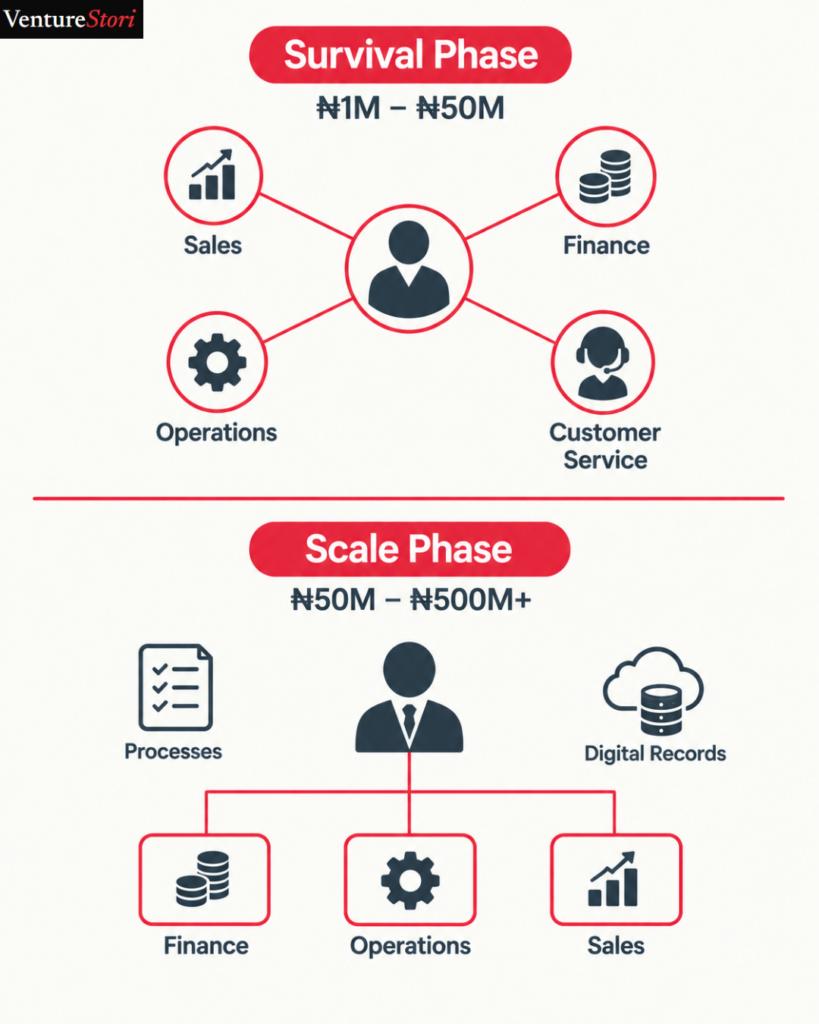
- The survival phase (₦1M–₦50M yearly):
Many SMEs in Nigeria need their founders/CEOs present to function; they also don’t have enough funds, and it is difficult for them to get bank loans. Although, NIRSAL Microfinance Bank has registered some success stories in handing out loans to small-scale farmers and enterprises.
These challenges make it hard for these SMEs to go from survival to scaling.
- The scale phase (₦50M–₦500M+ yearly):
These businesses do not depend on their founders/CEOs a lot anymore. They rely on documented processes, reliable financial records, digital software, and clear management structures. With these systems in place, it is a lot easier for these businesses to grow and show their credibility to lenders, investors, and business partners.
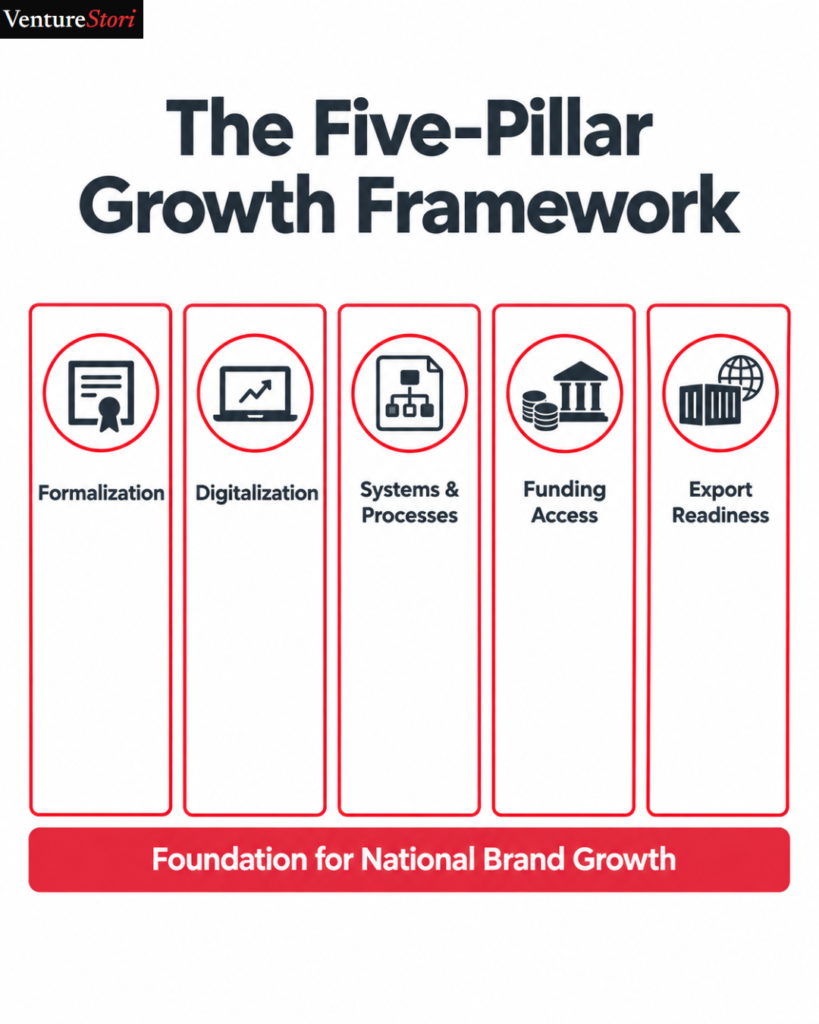
Below are five pillars that are key features of the business growth strategies in Nigeria that can move a business from the survival phase to the scale phase:
- Formalization: Register your business with CAC, get the required Tax ID, and meet statutory obligations. Formally registering your business will make it easier to get access to bank loans and other financial services from banks like Steering Coronation Merchant Bank that has become a Nigerian financial powerhouse, but it is not a guarantee.
- Digitalization roadmap: Introduce accounting, inventory, customer management, and workflow tools in stages. Having better digital records will improve your business’s financial visibility and make it easily accessible to potential investors and partners.
- Systems and processes: Documenting workflows, delegation, approval processes, financial controls, and governance.
- Funding access: Depending on the bank or government loan program, it may take weeks or months for the documentation to be completed before crediting happens.
- Export readiness: Make plans to penetrate international markets by completing your exporter registration, having a complete understanding of their market requirements and product standards. Also have a dependable logistics network.
A business that stops at just formalizing may get stuck when it finds out that it cannot get the necessary financial support from banks or government-supported programs that it needs to grow. But a business that formalizes and has structured financial management, digital tools, and documented processes will have access to bigger financial support. A business that ticks all the boxes can realistically look beyond the Nigerian market, and these are the businesses capable of generating a yearly revenue of ₦50M–₦500M. This encompasses the working business growth strategies in Nigeria and implementing them is essential.
Pillar 1: Formalization—The Hidden Blocker
Nigeria’s MSME sector is massive, but it is largely informal. A 2021 SMEDAN/NBS survey listed about 39.65 million MSMEs in the country, which makes up 96.9% of all businesses and 46.31% of the GDP. However, formalization remains a huge problem.
Registration is essential because a lot of government-sponsored financing programs require businesses to be registered with CAC and ticked on the formalization checklist before they can receive aid. Banks may also ask for tax records before giving out loans.
For instance, before a business can access the FGN/BOI MSME intervention loan, it has to be registered with CAC; the same requirement is needed for CBN’s Agri-Business Small Medium Enterprises Investment Scheme (AGSMEIS) as well—and this is the hidden blocker that a lot of businesses aren’t aware of.
2026 tax incentives—and the fine print:
Under the Nigeria Tax Act 2025 — which came into effect on the 1st of January, 2026, small companies pay zero Companies Income Tax, and they are also excluded from Capital Gains Tax and the 4% Development Levy.
Current PwC reports put the qualifying threshold for small companies at ₦100 million or less in annual gross turnover, with total fixed assets under ₦250 million. Under the previous tax-reform report from PwC, the qualifying threshold was set at ₦50 million, and it has provided some relief from the confusion over the new tax rules.
Professional-service businesses (legal, accounting, medical, and consulting) are not categorized under small businesses, but businesses hovering around the threshold should speak to an accountant or tax expert to confirm their bracket.
Formalization checklist:
- Prepare your identification, address, and business documents.
- Register your business with CAC. SMEDAN and CAC partnered to register up to 250,000 MSMEs for free through their formalization program.
- Retrieve and confirm your Tax Identification Number (TIN) on the official NRS portal with your CAC registration number.
- Open a business bank account strictly for business and keep your personal expenses in another account.
Pillar 2: Digitalization — the Biggest Productivity Multiplier
A lot of small Nigerian businesses make use of social media apps like WhatsApp, TikTok, etc., to promote their products, have a direct link to customers, and accept orders. Outside of this, very few of them have digitized their business’ finance, inventory, and customer records. According to IFC research, less than 7% of surveyed African MSMEs make use of smartphones and computers for their business activities, while 71% don’t see the need for them. The glaring gap is going from digital communication to digital operations.
A practical six-month sequence:
- First, start with accounting and financial records software like Wave, Xero, or SageNG.
- Then introduce a CRM for customer information
- Then introduce inventory management,
- Lastly, automate repetitive workflows.
The total cost depends on the particular software being used, number of users, implementation, and support.
Pillar 3: Systems & Processes — Scaling Beyond the Founder
The founder trap: If every business decision is based on the founder/CEO’s personal decisions and judgments, it will become difficult for that particular business to grow outside of the person’s vision. The solution is to keep a record of the processes that bring profit, deliver to customers, and handle the business operations. Then run tests of each Standard Operating Procedure (SOP) by assigning a team member to follow it without needing the founder/CEO’s help.
The goal is to pass down the ideas in the head of the founder/CEO so that a reliable employee can perform them in his absence.
Following a planning guide, budget six to 12 months for an in-house systems-building program. The time spent will be determined by a consultant, but implementation and cost depend on the size and complexity of the business.
Pillar 4: Funding Access — What’s Actually Available
There are many options in the funding landscape, but they’re not all of the same size, and it is important to match the source to your business stage:
- SMEDAN–Sterling Bank: According to SMEDAN, its facility has a ₦5 billion pool and is able to offer loans between ₦250,000 and ₦2.5 million at a 9% interest rate. SMEDAN funding is open to all SMEDAN-registered small businesses across Nigeria.
- FGN/BOI MSME Intervention Fund: The intervention fund has an allocation of ₦75 billion, with a 9% yearly interest rate for three years. Individual businesses can get up to ₦1 million.
- Bank of Industry: This institution has several financing programs in operation, so loans and pricing vary. For instance, BOI has a fund pool of ₦15 billion, with a 9% interest rate and 1% processing fee, for food and agro-processing businesses. Cooperatives can get up to a maximum of ₦10 million, while LLCs have a limit of ₦200 million.
- NACCIMA–ODDO BHF Corporate Expansion Facility: Its $150 million fund pool is for established Nigerian businesses looking to expand at a large scale. The minimum loan amount is $10 million, and applicants are expected to have a minimum of three years of audited financial statements and meet Environmental, Social, and Governance (ESG) requirements.
For many SMEs, the most realistic sequence is to formalize, have standard financial records, then apply for financing that matches the size and aim of the business.
Pillar 5: Export Readiness — the AfCFTA Opportunity
The African Continental Free Trade Area (AfCFTA) export opportunity makes it possible for Nigerian businesses to compete in markets spanning across 54 countries with a total of 1.3 billion people, and trade has already commenced.
According to Afreximbank’s African Trade Report 2026, Nigeria’s trade within Africa went up from $7.47 billion in 2024 to $9.02 billion in 2025. Nigeria exported ₦4.82 trillion worth of goods to other African countries in the first half of 2025, with 62% of the exports sent to West African countries.
Aside from oil, Nigeria has exported other products as well. According to the Nigerian Export Promotion Council (NEPC), it exported about 281 different non-oil products in 2025.
For SMEs, there’s a real business opportunity here, but exporting isn’t just about finding a buyer from another country. The exporting business has to be registered with NEPC, understand the market it is exporting to, prepare export documentation, meet packaging and labeling standards, and also meet the quality requirements for that particular product. This can include NAFDAC, SON, NAQS, or other competent authorities, depending on the product and where it is being exported to.
Pillar 6: AI as the Emerging Multiplier
A proper sequence would be to figure out where delays are happening manually, then start fixing them with cheap off-the-shelf tools that make use of AI. Give preference to the functions where automation has the biggest impact, automate repetitive tasks, and educate employees on how to use the tools properly.
What Separates the Businesses That Break Through
Gloria Michael, founder and CEO of Pennyshelters Group, said in a recent interview, “Nigeria’s next generation of national brands is already among us. The challenge is providing the vision, discipline, and support required for them to grow.”
She wasn’t speaking about a particular company’s revenue growth, it has more about the difference between ambition and a business that actually grows beyond the founder/CEO’s sole involvement.
This is the conclusion that this framework arrives at — the businesses that grow and become household names do not do it by only working harder, they also establish the structures that help them grow.
Your 24-Month Roadmap
- Months 1–3 (Foundation): Formalize your business if you’ve not done it yet. Next, set up accounting software, then open a strictly business account and audit the whole process.
- Months 4–6 (Systems): Apply CRM and inventory software. Keep a record of your top three processes. Apply for SMEDAN–Sterling or BOI MSME loans — depending on your business.
- Months 7–12 (Scale): Introduce a few key staff into documented roles. Deploy funding. The most recurring workflows should be automated. Keep track of revenue, margin, and retention as real metrics.
- Months 13–18 (Expansion): Pick a path; new location, new product, or export. If you decide on exports, apply for NAFDAC/SON certification and packaging redesign as early as possible.
- Months 19–24 (Brand & sustainability): Introduce AI tools for customer service and forecasting. Build a consistent brand identity across every channel. Have a proper structure to show lenders and partners you’re committed.
Common Mistakes That Stall Scaling
- Scaling before getting registered: Not registering your business with CAC means you’ll have no collateral and no access to loans.
- Digitising before creating systems: Having a CRM that no one knows right how to use cannot help.
- Hiring before documenting processes: If you don’t have defined SOPs, five employees may end up doing the same job in five different ways.
- Ignoring the numbers: You can have an increase in sales while profits take a negative hit if you aren’t keeping records of costs and margins.
- The founder is still doing everything: If the founder/CEO still handles everything even after hiring employees, there will not be room for growth.
- Not measuring performance. If you fail to track revenue, profit margins, and customer retention, you are growing without any idea of what is actually going on.
The Window Is Now
These pillars have been around for a while. Formalizing, digitizing, and delegation have contributed to the growth of many businesses. What is different now is the opportunity it presents. The new tax laws make it possible for registered small companies to keep all of their profits, while private or government-sponsored programs or loans give many SMEs the financial aid they need to grow. AfCFTA exports also contribute and help Nigerian businesses gain access to the African market. But with inflation, naira volatility, and the still-changing tax rules, the future isn’t quite certain.
However, the businesses that will end up becoming recognizable brands are being built already using the right pillars.
Formalize first, then digitize the part of the business that needs it. Next, have processes in place for other people to run the business in your absence. It is easier for businesses that have covered these three areas in the right order to get access to funding and export opportunities. Capital alone cannot fix a disorderly business.