
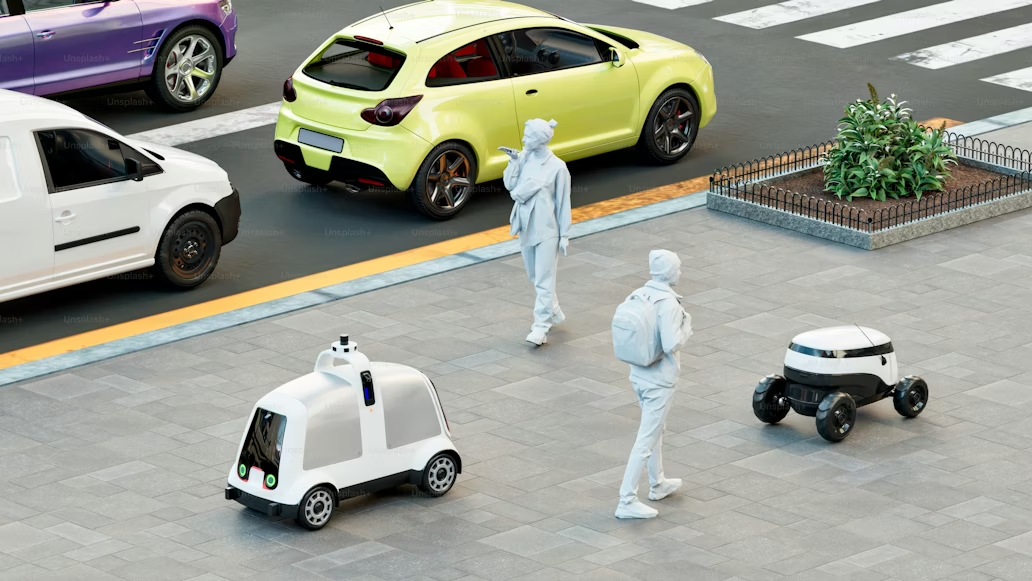
In many neighborhoods, the hardest part of getting groceries isn’t choosing what to buy or making a list. It’s getting out the door. For the aged, people living with disabilities, or those recovering from illness. Going to the store is more than a logistical challenge. This is where delivery robots in America come in. Not just as a new invention, but as a practical one.
Refraction AI is working on solving this problem by using its autonomous delivery robot, Rev-1x, to bring groceries and essentials to the doorsteps of people who can’t make the trip to the store. As a solution to one of today’s access issues, robots operate on real streets in real cities.
The final few miles between a store and a customer are perhaps the most difficult part of delivery. In many American cities and towns, it can be slow and expensive. Traffic jams, high fuel prices, and a scarcity of parking spaces can all have an impact. And for people who rely on home deliveries because they are unable to leave the house, delays or order cancellations can range from inconvenient to detrimental.
Certain companies are trying to come up with ways to sort out the problems of this “final step.” Human couriers are capable of doing this work, but it gets demanding, and deliveries or orders can be quite inconsistent. Routes can change; parks and weather are unpredictable factors.
Customers who rely on these couriers frequently bear the burden due to their immobility. This combination of high cost and high stakes is why robotics companies are now focused on the last mile.
Founded in 2017 by Matthew Johnson-Roberson and Ram Vasudevan, Refraction AI is a U.S.-based robotics company focused on one thing only: autonomous delivery.
The Rev-1 delivery robot looks more like a small electric car. The Rev-1 not only drives sideways, but it also uses roads and bike lanes to speed up its travel. This idea makes a lot of sense given the amount of pedestrian traffic in American cities. This allows the robot to travel much further than it would on the sidewalk.
The Rev-1 uses cameras, radar, and onboard sensors to automatically understand its surroundings. Using real-time software and mapping to understand lanes, obstacles, intersections, and signals rather than remote control.
Because of its size, it operates at slower speeds and only on routes already defined by the system. This makes it easier to deploy safely and monitor the cars on the radar.
The robots transport goods waiting to be delivered from a store, drive to the customer’s address, and deliver the package to the customer at the door. The robot is loaded at a store, travels to the customer’s address, and securely retrieves the delivery.
You place an order, track the delivery, and receive it at the right time, all without a physical driver. It mirrors the existing ordering platforms instead of asking its customers to learn something new.
Many delivery robot experiments focus on dense areas, but many Americans live outside of these environments. The suburbs and small cities are stretched out. There are longer distances to cover. Sidewalks are almost always congested. There is also a strong reliance on automobiles, and those who are unable to drive may feel isolated.
Using roads and bike lanes, Rev-1 can easily reach customers who live the farthest away from the stores. And they are frequently the ones who find it difficult to make the journey themselves. That is what makes this approach, autonomous delivery robots, so important in the American context.
People who have difficulties in moving around don’t see delivery as a luxury. It is part of daily independence. Some older adults may never drive again. People with disabilities and those recovering from illness or any form of medical condition may find it difficult to move around. Human couriers can be helpful, and rightfully so, but availability and cost are very inconsistent features.
On the other hand, Rev-1 offers the consistency that human couriers lack. They don’t need breaks. Neither do they do work set shifts. They do not make excuses. They can make multiple trips during the day without complaint. That dependability can make a significant difference for people managing their lives from home because they no longer have to rely solely on human availability.
Refraction AI works with local retailers, grocery stores, and delivery partners to make adoption easier for everyone involved, rather than operating its own delivery marketplace. This keeps the focus mainly on logistics and not on consumer behavior change.
For cities, road-based delivery robots are easier to use than sidewalk robots. They comply with traffic rules, use predictable routes, and don’t “compete” with humans for space. This collaboration with existing infrastructure is a major reason why Refraction AI has been able to transition from theory to application.
Any autonomous system operating in the open must earn trust. For delivery robots, that trust comes with having a predictable pattern. Rev-1 is designed to be cautious, and it avoids complex maneuvers. It places safety over speed. All of these decisions are more about fitting into the environment and less about showing off technology.
As the older populations in different areas and cities start to change their views on mobility, access becomes just as important as speed. Technologies that help people stay independent without them having to relocate or depend heavily on others will certainly have long-term value in the eyes of the public.
Delivery robots in America are emerging not because they are advanced technologies, but because they solve practical problems today. Public acceptance often depends on whether a technology feels supportive or suitable. Refraction AI’s approach leans towards both. Real-life applications of the REV-1 include:
Wrapping up, Refraction AI’s Rev-1 works on real roads, serving real people in real neighborhoods, and solving real access issues; delivery robots are fast becoming part of everyday life. For Americans who can’t easily leave home, that independent reliability matters more to them than anything else. As last-mile delivery continues to evolve, robots like Rev-1 are having a say on how groceries, medicine, and essentials are delivered to the people who need them most, one doorstep at a time.