Half of Nigerians cannot confidently navigate their mobile banking app or send a professional email without help. In rural areas, 70% of adults lack basic ICT skills, which makes activities like using mobile banking apps, applying for jobs online, and accessing government services online difficult. Alongside that gap sits a separate, equally real number: Nigeria’s employment picture.
Most jobs today require digital literacy, even entry-level roles. The good news is that there are free digital literacy programs in Nigeria. This guide serves as a map to show you where to find these programs and who they are for.
Understanding the Employment Context
Afrobarometer’s 2025 survey found that 23% of Nigerians between the ages of 18 and 35 are unemployed and actively seeking employment. 32% of Nigeria’s population in the same age range are unemployed but have stopped looking. Combined, they constitute 55% of the population.
NITDA estimates that in 2021, only 44% had basic digital skills. The value rose to 50% in 2025, an increase. NITDA’s numbers tell a more honest story than most headlines do.
Digital literacy and unemployment are not the same crisis, but a generation with inadequate digital skills is a generation with few opportunities in the job market today.
Government Initiatives for Digital Literacy
NITDA has developed a long-term plan to ensure that 70% of Nigerians are digitally literate by 2027, and 95% by 2030. This program targets people in the informal sector, small businesses, and those who require digital skills for daily life and work.
To achieve this, NITDA partnered with the National Youth Service Corps (NYSC) to recruit and train digital literacy champions. They are deployed across all 774 Local Government Areas (LGAs) in Nigeria to ensure that activities are not limited to major cities.
Every state, including FCT, is expected to have 460 champions. Each champion is expected to train 600 people per year. If this is achieved, more than 10.3 million Nigerians would be digitally literate in one year. In 2 years, over 20 million people could be trained.
In January 2026, a major initiative was launched. The initiative brought together NITDA, the Ministry of Youth Development, and civil society organizations. Their job is to train and certify one million Nigerians in digital literacy and development and emerging digital skills. This initiative is part of the Renewed Hope Agenda, one of the federal government’s development programs.
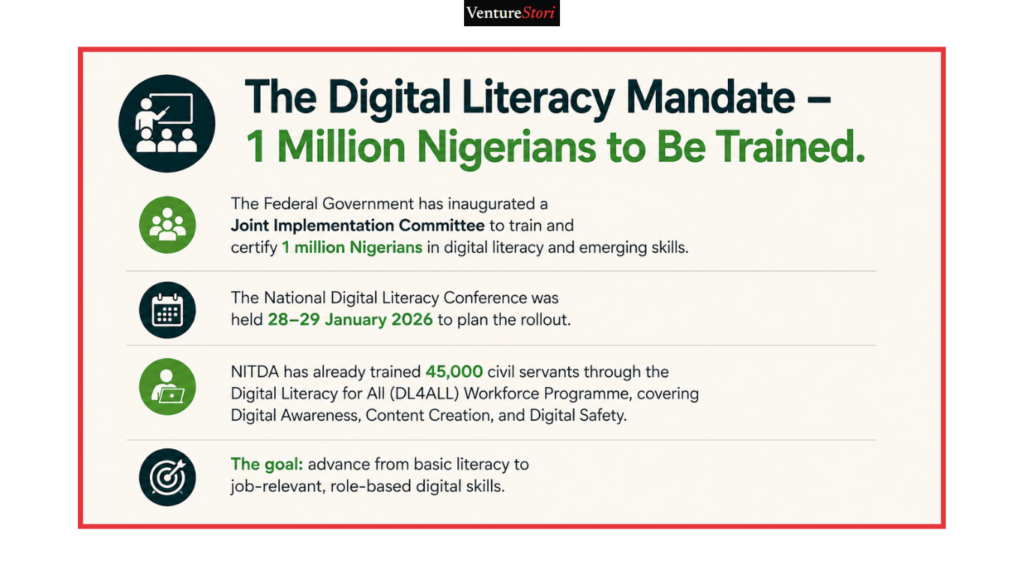
Free and Affordable Digital Skill Programmes in Nigeria
NiYA, a program created by the Federal Ministry of Youth Development. It was launched in March 2025. The training is completely free, but to apply, you must be between the ages of 18 and 35 years and possess at least a secondary school certificate. NiYA currently has 58 different courses spanning basic digital literacy, technical skills, entrepreneurship, and business. Beyond skill acquisition, it connects graduates to freelance opportunities and an ambassador program.
Next is 3MTT, a government initiative focused on technical skills. 3MTT has expanded into more advanced technology training. Its deep tech-ready track includes courses in high-demand fields like data science, artificial intelligence, and other advanced valuable skills. NITDA reports that the program has a 99.6% completion rate.
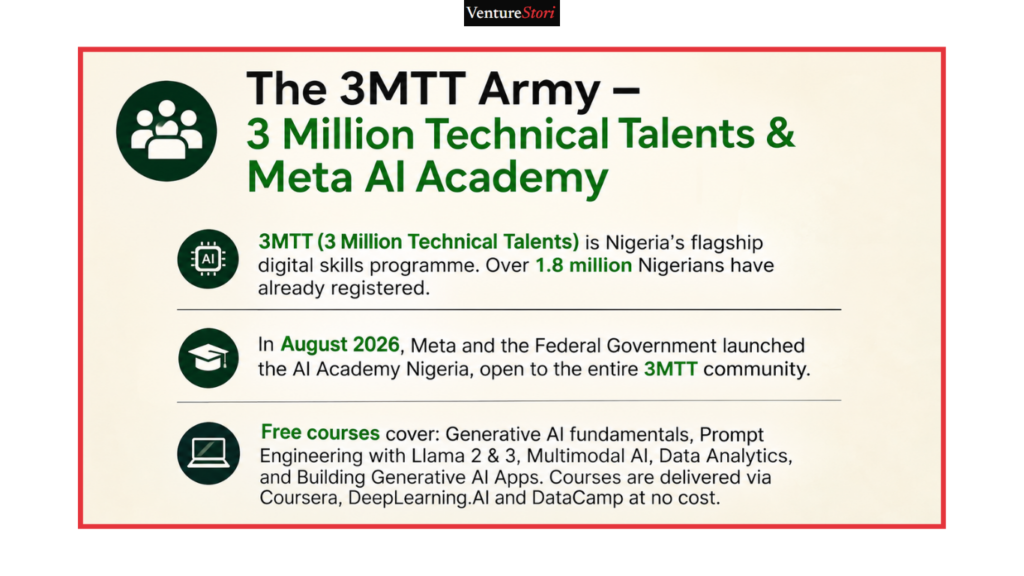
The 3MTT Army – 3 Million Technical Talents & Meta AI Academy.
The newest program is the Digital Training Academy, announced in May 2026 as a partnership between the federal government, Coursera, and Pluralsight. In the first year, the government is paying for 36,000 training licenses covering AI, cybersecurity, software engineering, data science, and cloud computing.
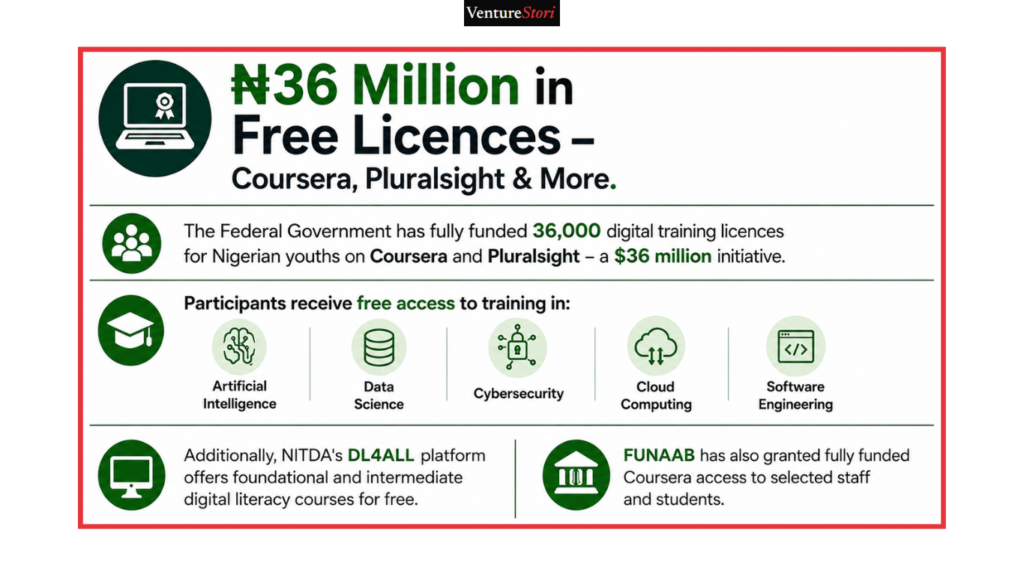
₦36 Million in Free Licences – Coursera, Pluralsight & More.
Apart from government programs, there are private training organizations with more structured learning. They include New Horizons, Skillworks, and Oxtech Academy.
Oxtech Academy has a program called INTROTECH. It allows learners to take a free introductory course, and then learners would have to decide if they want to continue with the paid training afterwards.
Leveraging AI for Career Growth
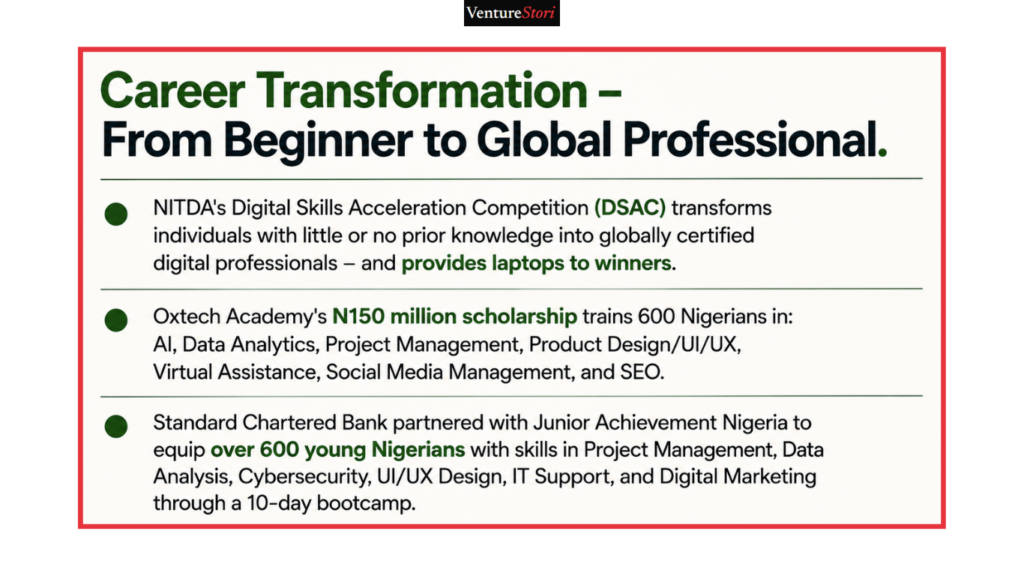
Career Transformation – From Beginner to Global Professional.
Formerly, when people referred to digital literacy, they talked about the use of computers and the internet. Now, understanding AI gives you more access to opportunities.
If you want to learn AI for free, you can start with 3MTT’s DeepTechReady program. It covers machine learning, artificial intelligence, and data science. NITDA’s reporting of the completion rate suggests the demand is real. How to make money with AI alongside this guide. The programs above are free, government-backed, and verifiable.
Learning a digital skill doesn’t just help you to apply for jobs; it gives you the skills to earn income independently. Skills like e-commerce, freelance services, and content creation only require the ability to set up a page, a payment link, and communicate with a client. These are the kinds of skills taught in NiYA, the Digital Training Academy, and 3MTT. These skills do not guarantee success, but they give you a better chance to get started.
Who still gets left behind?
Not everyone receives government support at the same time. Some people face additional barriers in the digital literacy push: women, people in rural communities, and those with disabilities.
The WIDEN project, a British Council-funded research study in collaboration with the National Open University of Nigeria, Brunel University of London, and Nasarawa State University, surveyed nearly 1,000 Nigerian women. According to the research, the problem is not a lack of motivation but a lack of training and opportunity. 13.7% of women surveyed had disabilities.
This shows that many learners have accessibility needs. Digital literacy programs should be designed to accommodate people with disabilities. Without these measures, people will still be excluded.
Some AI training programs have noticed fewer women participate in technology and AI education. Instead of trying to fix the issue later, they designed their program to attract and support women. Google’s Hustle Academy for instance, noticed that over half of the people who completed the training across afric were women. This shows that an outreach can work if it’s built into the program at the beginning rather than later.
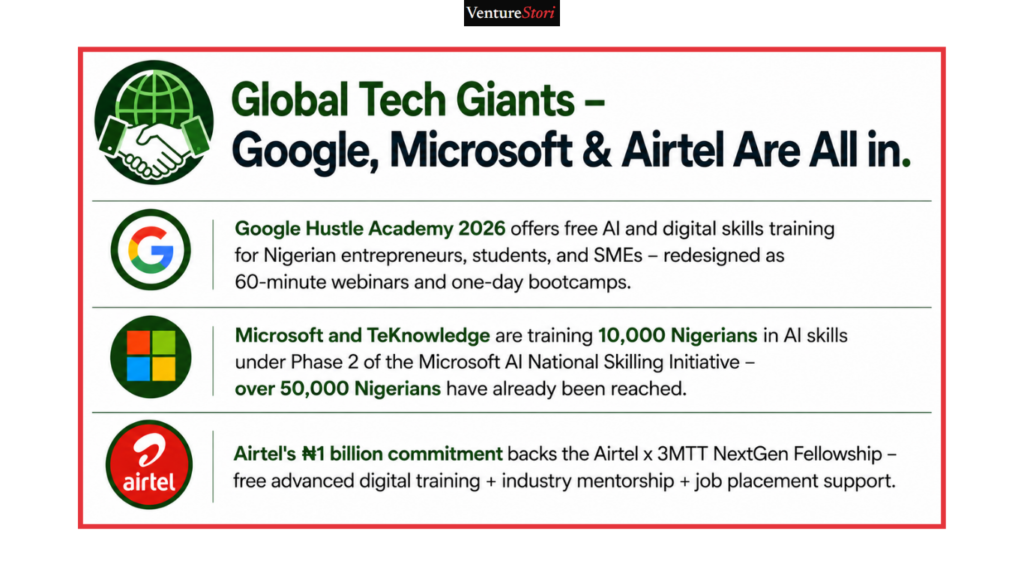
Global Tech Giants – Google, Microsoft & Airtel Are All In.
The digital skills gap in Nigeria is significant, but there are free, credible programs that help one close the gap. Some of the programs include NiYA, 3MTT, and the NITDA-NYSC Digital Literacy Champions scheme. Identify which of the programs you are eligible for and start building your skills.