
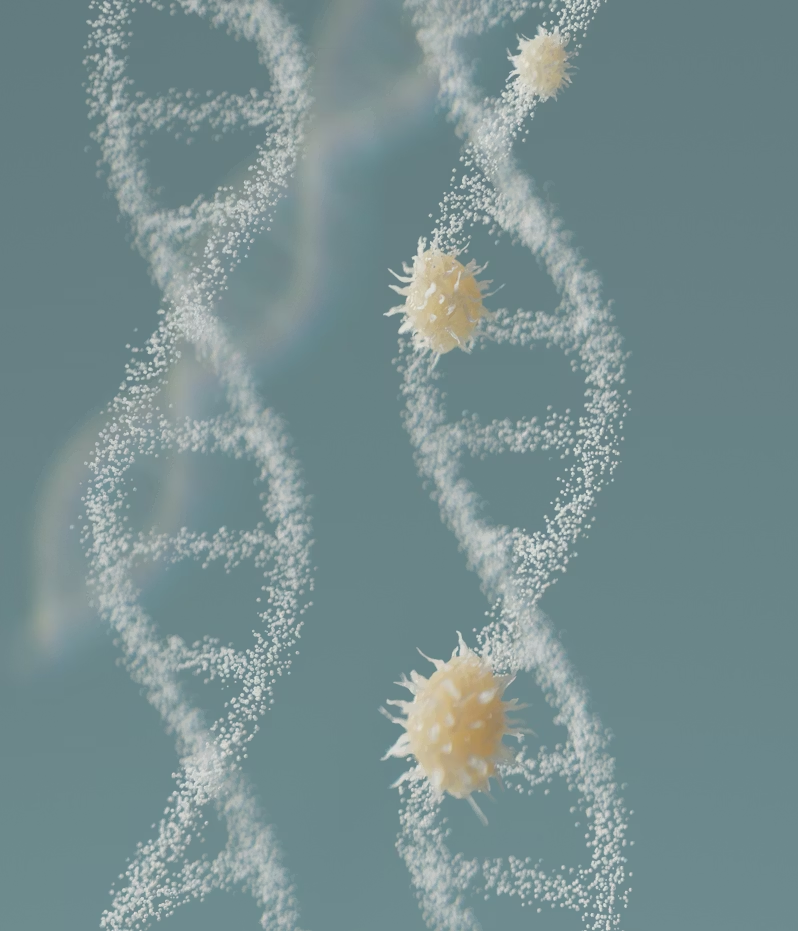
Tessera Therapeutics is developing a novel approach to genetic medicine that extends beyond gene editing. Instead of cutting DNA to disable or tweak genes, this novel approach to gene writing aims to insert new genetic instructions directly into the genome.
Interest in longevity science has grown over the years. Health institutions are facing ever-increasing pressure from chronic, age-related diseases. Meanwhile, tools such as CRISPR, which are used in editing, have demonstrated the extent and limitations of cutting DNA. Understanding what gene writing is and why it is important requires taking a step back and looking at how genetic medicine is evolving.
Gene editing proposes the ability to alter DNA sequences. Technologies like CRISPR-Cas9 act like molecular “scissors” to cut the genome at the right locations. Once DNA is cut, the cell’s natural repair machinery takes over, and during this process, scientists can disrupt, remove, or replace small pieces of genetic code as they see fit.
This scientific process became a breakthrough. But cutting DNA is prone to complications. Double-strand breaks can cause unintended consequences, such as unpredictable repairs or off-target mutations. The good news is that these risks can be managed in some situations, but they will continue to be a source of concern, particularly for treatments that are intended to last a lifetime. Instead of cutting DNA, gene writing attempts to insert new sequences directly into the DNA, using mechanisms inspired by natural biological processes.
In theory, if it works, it will make room for larger and more flexible genetic changes. The risks that can occur when DNA breaks will be greatly reduced as well. The difference between both methods, gene editing vs. gene writing, is not only technical. It hints at a shift from modification to instruction. Editing changes what is in there. Writing adds something new.
Gene writing is an advanced technology that enables scientists to create or rewrite a DNA code inside a living cell in a controlled way. Tessera Therapeutics is inspired by “jumping genes,” mobile genetic elements that move DNA segments in genomes naturally.
These biological systems exist naturally, and over the period of evolution, they have defined genomes by copying and inserting sequences. What Tessera plans to do includes using similar mechanisms and engineering them to deliver specific therapeutic instructions. What gene writing aims to do is the following:
It also represents a different method for interacting with DNA, and it is designed for more complex modifications. For instance, instead of repairing a broken or missing gene that happened because of a disease. With gene writing, scientists could add an entirely new set of instructions to the DNA.
Aging has mostly been treated as something impossible to escape from for much of medical history. Diseases like cardiovascular decline, neurodegeneration, or metabolic dysfunction were looked at individually. Aging wasn’t particularly seen as a topic for discussion, but that perspective is changing.
In these modern times, research views aging as a set of molecular processes: genomic instability, cellular senescence, epigenetic alterations, and more. From their perspective, these mechanisms are measurable, modifiable in some cases, and connected to genetic regulation. This reframing gave birth to longevity biotechnology. If aging-related decline points towards biological programs and not random deterioration, then it is not far-fetched to assume that solutions at the genetic or cellular level can become possible.
Tessera Therapeutics gene writing suggests that there is a chance for genetic instructions to be updated, potentially changing disease trajectories associated with aging. This process isn’t about “writing immortality DNAs.” It is about chronic disease prevention, functional health, and durability of therapeutic effects.
Tessera’s work proposes a means for controlled, durable genetic change without depending on double-strand DNA breaks. It centers on genome-integrating technologies, which are gene-writing systems. And they’re designed to insert DNA sequences into targeted genomic locations. The process is pretty similar to a delivery and integration workflow:
Gene writing is after integration without having to create double-strand breaks. This distinction is central to Tessera’s technological identity. This result is a controlled and durable genetic modification that may be suitable for long-term therapeutic strategies.
Why gene writing is relevant to aging gets clearer when chronic disease patterns enter the picture. Conditions associated with aging involve gradual functional decline instead of acute genetic defects. Some of the examples include:
These diseases usually have the same foundational molecular drivers. And if interventions are successful in reprogramming cellular functions, they can offer new therapeutic possibilities. In theory, gene writing could support:
These applications are consistent with the goal of longevity biotechnology: to extend healthspan rather than just treat late-stage diseases.
This question makes one curious about what it actually means, but at the same time, it can be difficult to understand. To start with, aging is not something you can just turn off and on like a switch. It is linked to many factorial processes defined by genetics, environment, metabolism, and speculative events.
Gene writing does not intend to erase aging itself. Gene writing goes after the components of aging biology, not the whole concept of aging. The goal is to regulate, not eliminate.
Whenever technologies and genomes are introduced, safety joins the conversation. Key considerations include the following:
Gene writing’s proposed advantage can be seen as a safety strategy. Reducing double-strand breaks can reduce certain risks, but it doesn’t take away the potential of new challenges arising later on. Because no genetic technology is risk-free. Safety is established through evidence, iteration, and clinical validation. Regulatory agencies not only evaluate effectiveness but also durability and unintentional consequences.
The real test of any biotechnology is to figure out if it works in cases that are similar to actual human biology. For Tessera Therapeutics, that testing ground has largely been preclinical disease models. These cases are not approved therapies. They are trials to show what gene writing looks like when applied to diseases that have proven to be a challenge for traditional gene editing.
Sickle cell disease is usually described as a “simple genetic disorder” because it originates from a mutation in a single gene, HBB. Medically, however, it is anything but simple. The treatment requires editing the rare cells responsible for generating a patient’s entire blood system—long-term hematopoietic stem cells (LT-HSCs).
In non-human trials, Tessera’s RNA Gene Writer achieved editing levels of roughly 40% after a single dose and about 60% following a second dose. These figures are significant because they indicate that gene writing could potentially support long-term biological changes without the need for bone marrow transplantation or any other form of pre-treatment.
Alpha-1 antitrypsin deficiency (AATD) comes from mutations in the SERPINA1 gene, which affects liver cells. And any possible therapy must change a large number of hepatocytes without disrupting liver function.
Here, Tessera’s gene writing system was done using a delivery strategy that is rather common in RNA-based medicine, known as lipid nanoparticles (LNPs). After trials, reports suggested editing efficiencies approached 76–79% of hepatocytes at the target locus. For liver-directed genetic medicine, such levels are significant because they are a testament that gene-writing mechanisms can work across substantial portions of an organ instead of isolated cell populations. In diseases like AATD, where pathology comes from dysfunctional protein production, this capability could prove more versatile than tools restricted to small edits.
Gene writing is part of a meaningful evolution in genetic medicine. With its plans to insert new genetic instructions rather than cut DNA, Tessera Therapeutics is looking at designing a model that can support safer and more durable therapies.
Concluding, whether or not gene writing achieves its long-term goal will depend on successful clinical evidence, regulatory validation, and safety standards. One thing is certain, and that is longevity-focused biotechnology is going to change medicine at some point in the future.