To win contracts and close deals in Nigeria, knowing how to write a business proposal that fits local realities is essential, as you can’t rely on a generic template from an international blog. Whether you are pitching to a corporate client in Victoria Island, making a tender for the government, or seeking private investment, understanding how to write a business proposal tailored to the Nigerian market ensures your pitch resonates with decision-makers.
A winning proposal is professionally structured, financially sound, and clearly outlines risk management. This guide explains how to accomplish this process and offers a complimentary business proposal template for Nigeria that is specific to the local market.
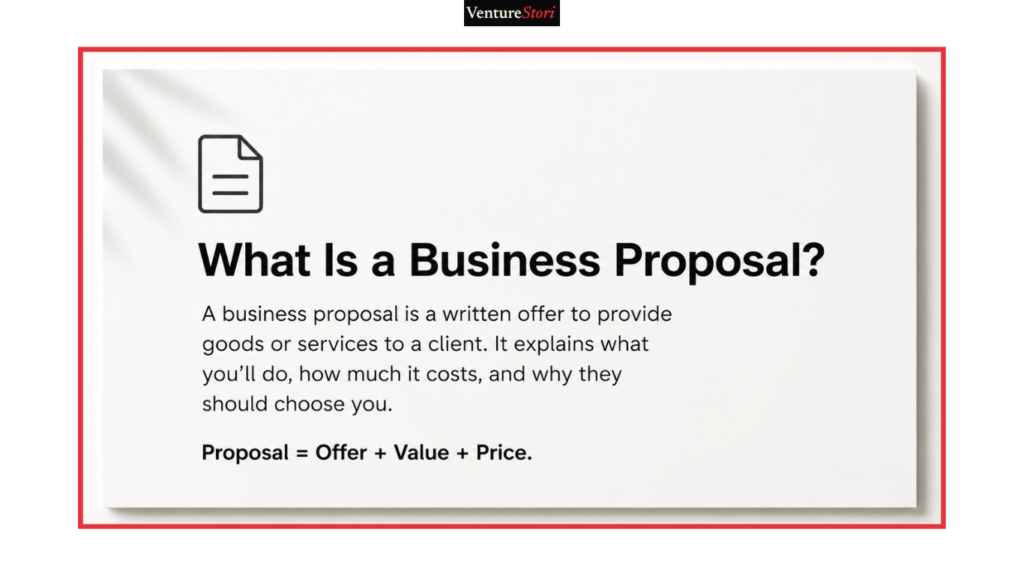
How to Write a Business Proposal in Nigeria: The Three Main Use-Cases For Nigeria’s Idea
The type and style of your proposal will vary with your audience. Proposals usually come in three categories in Nigeria:
Corporate Pitches (B2B): When pitching to private businesses, it’s best to emphasize return on investment (ROI) and efficiency. You must also have a competitive naira price and a clear service level agreement (SLA).
Government Tenders and Public RFPs: These are formal bidding processes that are conducted by Federal, State and Local Ministries, Departments and Agencies (MDAs). Important here is the overall adherence to the official rules and processes.
Investors and partnership proposal: Pitching local angel investors, VC firms or strategic partners requires an emphasis on market size, revenue sharing plans, scalable operations and capital protection strategies.
Essential Business Proposal Format in Nigeria
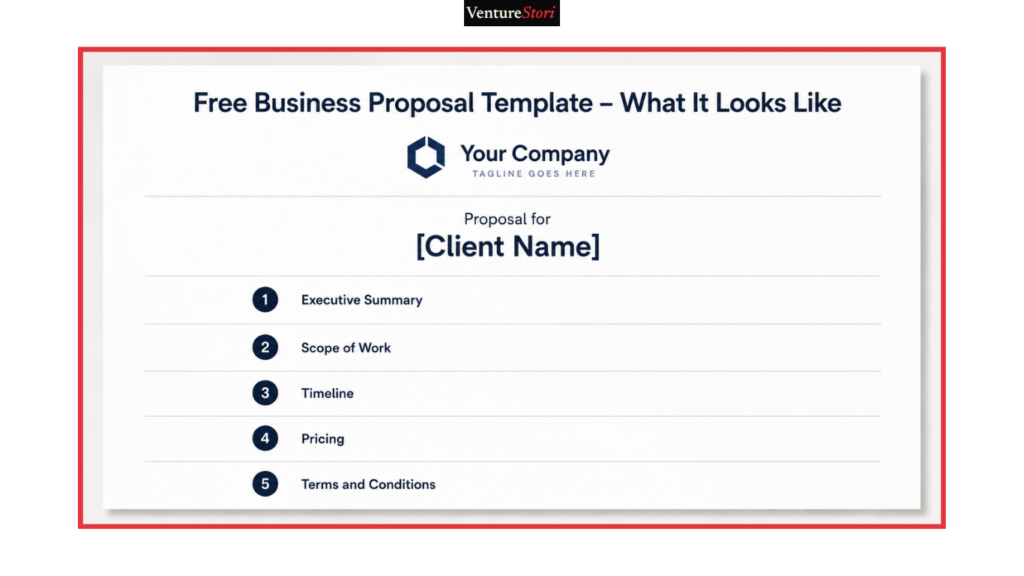
Ensure your business proposal format in Nigeria contains the following eight components:
Cover Page: This should contain the name of the client you are addressing, your registered entity name, the date of submission and reference numbers.
Executive Summary: Your executive summary should live up to its name, a one-page document at the beginning of the proposal summarizing the key offer, value and overall cost. Do not exceed 400 words.
Problem Statement: Your proposal should show that you have a working understanding of the client’s business. Your problem statement shows the operational pain points that your client faces, in which you show detailed understanding.
Proposed Solution: Next, you tailor your solutions to the pain points you have identified. Talk about what services, tools, methodologies and technical specs you have to take care of the issue.
Pricing and Payment Terms: Here’s where you state the currency, cost of items and services, milestone schedule and foreign exchange (FX) adjustment clause.
Company Background and Credentials: For credibility, feature a company or individual profile, relevant Nigerian project experience, logos of clients and key team bios.
Implementation timeline: Your propoak should show scheduled rollout dates, milestones and project governance plans.
Terms, Conditions: Clearly outline the contract period, termination clauses, validity and signature blocks. Advise them on how to accept the proposal and to formally engage.
Localizing prices and payment terms and FX risks
Local economic considerations call for certain provisions to safeguard you and your client.
Mention the currency in which the price is quoted, either Nigerian Naira (NGN) or United States dollars (USD). For NGN contracts of over 60-90 days, incorporate an FX benchmark or inflation-adjustment clause to protect against currency fluctuations. If you must price in USD for local payments, you must be clear that the conversion rate (Central Bank of Nigeria official window or agreed bank rate) must be indicated on the invoice date.
You should not reserve the full payment until the end of the project. Standard practice is to attach payment deposits to milestones. It could look like a 40%–50% upfront commitment fee, 35% on key milestone delivery and 15% on final sign-off. Or a commitment fee of 60%-70% is required with the procurement and supply job, the balance to be paid on inspection of delivery.
Global credentials come second to local execution ability. Highlight local knowledge, local authorities and previous experience working with local brands or local public institutions.
How to Write a Business Proposal in Nigeria: Navigating Government Tenders and Public RFPs
Technical know-how is as important as administrative compliance, equally vital in writing an effective proposal. Here’s where many tenders fail based on incomplete documents and this process is repeated regularly by government evaluation committees, without regard to the quality of the technical proposal.
Critical Government Tender Compliance Checklist:
- The Corporate Affairs Commission (CAC) gives the license to incorporate.
- Tax Clearance Certificate (TCC): For the previous 3 years.
- Compliance Certificate from Industrial Training Fund (ITF)
- Compliance Certificate from the National Pension Commission (PenCom).
- Compliance Certificate for Nigeria Social Insurance Trust Fund (NSITF).
- Federal Contractors Database Registration (FCDR): Bureau of Public Procurement (BPP).
Make sure that all administrative instructions are followed. Stick to the layout and sequence of the tender document. Also close attention to the physical or digital delivery instructions or deadlines (such as separate sealed, inner envelopes for “Technical” and “Financial” bids with the exact tender reference codes and before the specified closing time).
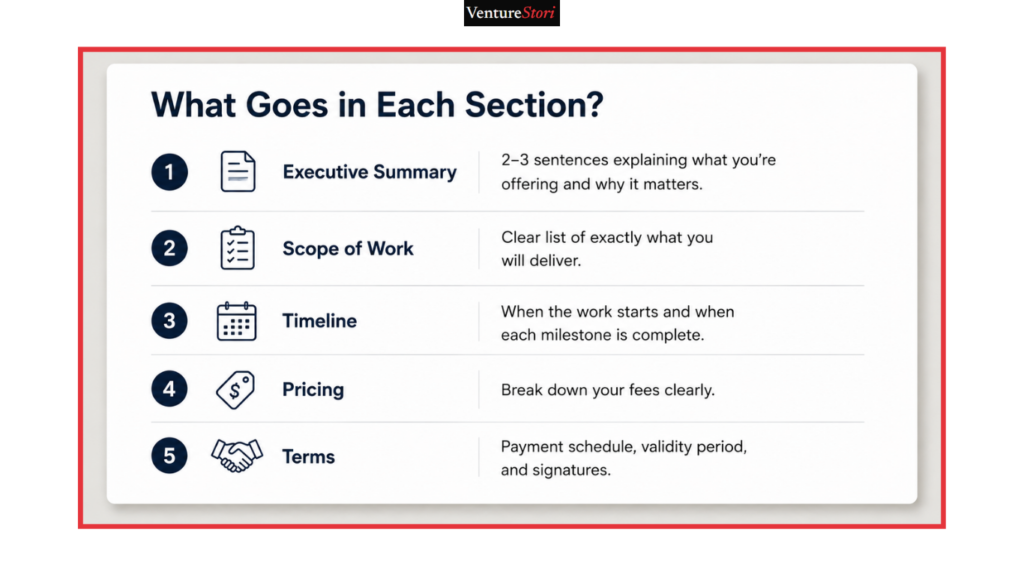
Organize your proposal into these five core sections to keep your presentation clear and easy for decision-makers to review.
Complete Business Proposal Nigeria Template
Use this Nigeria business proposal template to prepare a business proposal that’s ready to use for your next client pitch or tender response.
[YOUR COMPANY NAME]
PROPOSAL FOR: [Project/Service Title] Client Organization Name
DATE: [DD/MM/YYYY]
YOUR NAME: [Surname First name]
1. EXECUTIVE SUMMARY
Currently, [Client Name] is looking at [main client objective, e.g., improving operations / growing digital presence / acquiring physical products]. Your Company Name offers services in [your core competence] that will be carried out to this end efficiently.
When working together, [Client Name] will gain [Key Benefit 1], [Key Benefit 2] and [Key Benefit 3]. Our team has [Number] years of firsthand experience in achieving success with similar engagements in Nigeria.
New Investment: ₦[Amount]
Estimated Project Time: [Number] Weeks / Months
Maximum Proposal Validity: 30 days from submission date.
2. PROBLEM STATEMENT
From our preliminary assessments and discussions, we feel that the current operational bottlenecks for [Client Name] are:
Challenge 1: [Identify specific problem, e.g. delays in manual supply chain].
Challenge 2: [Explain specific problem e.g., failure to keep up to date with industry regulatory changes].
Challenge 3: [Explain how these problems caused a loss of money or resources].
If these challenges are not addressed, up-to-date [Client Name] could suffer from [impact of doing nothing, e.g., increased operating costs / lost revenue / lost market share].
3. PROPOSED SOLUTION
To overcome these challenges, [Your Company Name] will be leveraging a tailored [Name of Service/Product Solution]. The work includes:
Phase 1: Discovery and Planning (State here the specific tasks, initial audit and requirement gathering).
Phase 2: Delivery and Implementation: [Core delivery, system integration, asset deployment]
The testing and quality assurance stage of the software development lifecycle is known as Phase 3. Phase 3 of the software development lifecycle is the testing and quality assurance phase or the user acceptance test phase and the performance verification phase.
Phase 4: Training and Post launch Support: [Handover, Staff Training, Maintenance SLA]
4. PRICING AND PAYMENT TERMS
Itemized Cost Breakdown:
Phase 1: Setup and Discovery (Deliverable A): ₦0,000,000
Phase 2: Execution (Deliverable B): ₦0,000,000
Phase 3: Implementation (Deliverable C): ₦0,000,000
Subtotal: ₦0,000,000
VAT (7.5%): ₦0,000,000
Total Project Cost: ₦0,000,000
Payment Schedule and Terms
Final Deposit: 60% after the contract date and invoice the quote.
Milestone 1 Completion: 40% at delivery of phase 2 deliverables.
Final Acceptance: 20% at the end of sign-off and handover.
Note on Taxes and Currency: All prices include/exclude 7.5% Value Added Tax (VAT). Official credit notes are required for applicable withholding tax (WHT) deductions. Quotes in NGN are valid for 30 days from the date of issuance of the quote.
5. COMPANY BACKGROUND.
[Your Company Name] is a fully registered Nigerian Company (CAC Registration No: [RC Number]) operating in the [Industry/Sector] industry. Founded in [Year] we have worked for leading companies in Nigeria on a variety of projects.
Clients Served:
Client A (Corporate): Provided [Service/Project] to client, saving the client [X]% on operational costs.
Client B (MDA/Public Sector): [Tender Title] “Well done to you for completing successfully within the time and budget.”
Core Technical Team:
Name 1, Title: [brief background (2 lines) and relevant certifications] to the project.
6. IMPLEMENTATION TIMELINE
Phase 1: Onboarding (Targeting Week 1 to Week 2) Duration of 2 Weeks.
Phase 2: Core Execution: 4 weeks (Targeting Week 3 to Week 6).
Phase 3: Testing and Training: 2 Weeks (from Week 7 – Week 8).
7. TERMS AND CONDITIONS
This offer and the pricing are valid until [Expiry Date].
The content is confidential and shall not be shared, disclosed or otherwise used by others.
To accept thisf service, please sign and return a copy of this proposal and the initial commitment fee.
Signatures:
For [Your Company Name]:
Signature: ______________________
Name: [Your Name]
Title: [Your Title]
Date: [DD/MM/YYYY]
For [Client Organization Name]:
Signature: ______________________
Name: [Client Name]
Title: [Client Title]
Date: [DD/MM/YYYY]
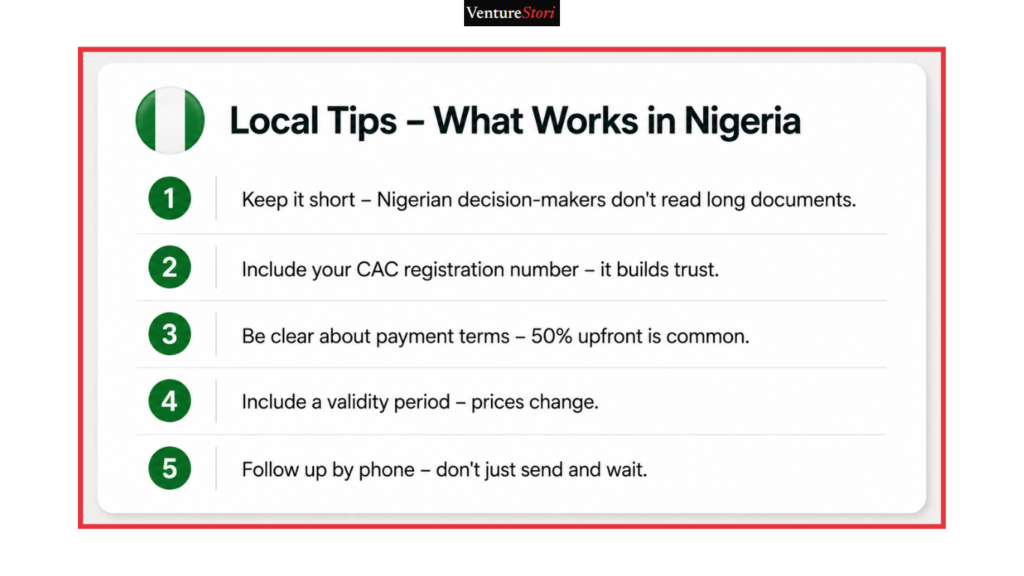
4 Common Proposal Mistakes to Avoid
A poorly presented proposal can beat an otherwise good technical offer. So here are some common mistakes to avoid when pitching local clients:
Too long, Too focused executive summary
If your executive summary is too long with lots of background information, your busy executives have to look for the basic facts. Be sure that your executive summary doesn’t go past one page and that you make your direct value proposition as soon as possible.
Lump sums that lack items:
Pricing structures that specify “Costs to be discussed later” or give an un-itemized lump sum create trust issues right away. Communicate deliverables and tax responsibilities in a clear and concise manner.
Failure to present professionally
The use of inconsistent fonts and bad formatting, failing to include page numbers and misaligned text all detract from your credibility. Present your proposal in a professional-looking PDF.
Generic Pitching
When you take the same proposal to many different clients and don’t customize the problem, context and deliverables you are pitching, it demonstrates neglect of the client’s business objectives.
An effective business proposal in Nigeria must have a clear and precise offer, a pricing structure, terms that are clearly understood and professionally formatted. Customize the template to fit your client’s exact requirements, review all compliance papers prior to submission and offer terms in full financial clarity.
RECOMMENDED READING:
FTSE 100 July 2026: What the UK Stock Market’s Resilience Teaches African Investors