Imagine standing on the edge of the Mambilla Plateau, where crisp air, misty clouds, and lush tea plantations reveal a region filled with immense commercial potential. For local entrepreneurs, investors, and consumers seeking verified commercial contacts across Jalingo and surrounding local government areas, accessing an up-to-date Taraba State business directory is the most effective way to navigate this expanding market.
Beyond its agricultural prowess in coffee and tea cultivation, Taraba features untapped mineral wealth, thriving local markets, and a diverse workforce. Whether you are scaling an enterprise, sourcing local vendors, or exploring regional trade, utilizing a structured Taraba State business directory connects you directly with registered companies, trade hubs, and essential commercial services across the state.
Taraba as a Business State
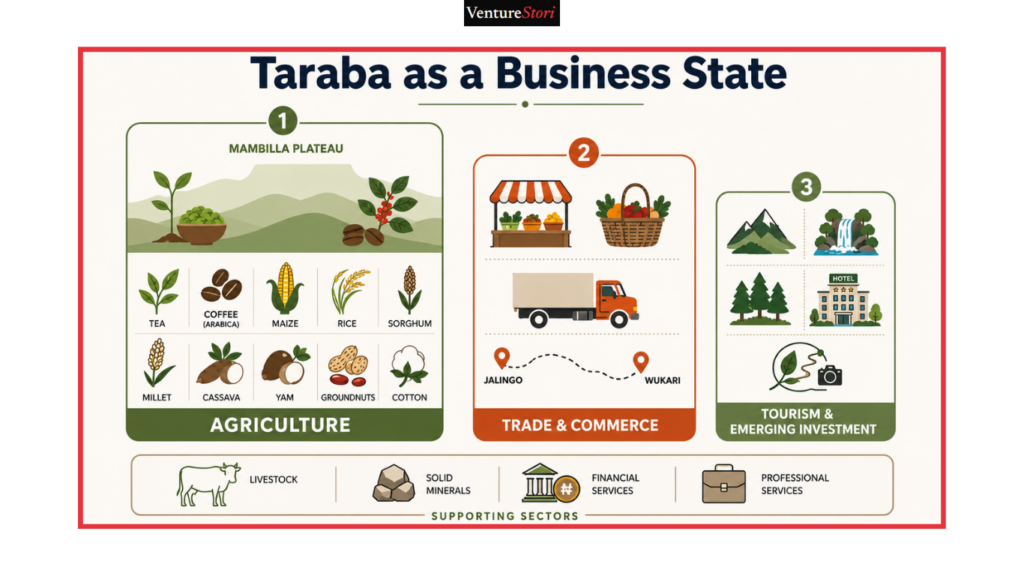
Taraba State is located in the northeastern part of Nigeria, created from the former Gongola State by General Ibrahim Babangida on the 27th of August, 1991. The state has a rich historical geography with roots in the old Wukari, Mambilla, and Muri divisions—a history that helps explain the distinct cultures in the state.
Jalingo serves as the state’s capital and its administrative headquarters as well. To the south lies Wukari, a major agricultural and commercial hub in the state and the seat of the traditional ruler of the Wukari Federation, the Aku Uka. To the east is the Mambilla Plateau, located in the Sardauna Local Government Area, home to the state’s most distinctive geographic and agricultural asset. It sits about 1,600–1,800 meters above sea level, and its cool highland climate helps with the production of commercial tea and Arabica coffee—both of which are rare crops, especially with Nigeria’s primarily lowland agricultural landscape.
Taraba State shares its borders with Nasarawa and Benue (West), Plateau (Northwest), Bauchi and Gombe (North), Adamawa (Northeast), and the Northwest Region in Cameroon (South). It is one of the most ethnically diverse states in Nigeria, with over 77 ethnic groups.
The major ethnic groups in the state are the Mumuye, Wurkun, Fulani, Jukun, Chamba, Tiv, Kuteb, Ichen, and Mambilla. These ethnic groups are also scattered across the state. The Mumuye and Wurkun ethnic groups have prominent ties in the North; the Jukun, Chamba, Tiv, Kuteb, and Ichen ethnic groups are commonly found in the South, while the Fulani, Mambilla, and other related groups are spread across the central highlands.
This diversity is key to grasping the social and commercial geography in the state. For instance, Wukari is not just an agricultural and commercial hub or just the seat of the Aku Uka. It holds a deeper, historical significance as the spiritual and political center of the Jukun people.
There has also been a documented history of tension and conflict in the state over the past decades. Certain parts of the Southern and Central areas in Taraba have seen several land disputes and farmer-herder violence, as well as ethnic and communal conflicts.
Between January 2024 and August 2025, ACLED recorded about 135 security incidents in Taraba, and the number of fatalities rose to 219. These incidents were listed as 54 battles, 10 riots, 71 civilian violence cases, amongst others.
Karim Lamido LGA, with 26 recorded cases, Wukari LGA, with 24 cases, and Takum LGA, with 23 cases, have experienced the most incidents. On the 23rd of May 2025, gunmen killed at least 40 people in Munga Lelau village in Karim Lamido LGA, displacing hundreds of people. Munga Lelau, Magami, and Bandawa villages in Karim Lamido LGA have also seen several houses set on fire during herder attacks. Communal violence has also been recorded in Wukari and Bali LGAs.
The state government, under the leadership of Governor Dr. Agbu Kefas, established the Taraba State Bureau for Peace and Conflict Management in 2025 to foster peaceful coexistence and settle conflicts between farmers and herders. In August 2026, the Executive Summary of the Taraba State Zonal Security Summit Report was presented to the governor as part of the ongoing efforts to improve security, promote peace, and maintain development in the state.
As mentioned earlier, these violence reports are concentrated in certain parts where farming and grazing are prevalent, not in the state’s major commercial core. Readers conducting business research on the state should be familiar with the difference between the state’s commercial areas and the rural areas where these violence reports have happened.
The Active Sectors
- Agriculture
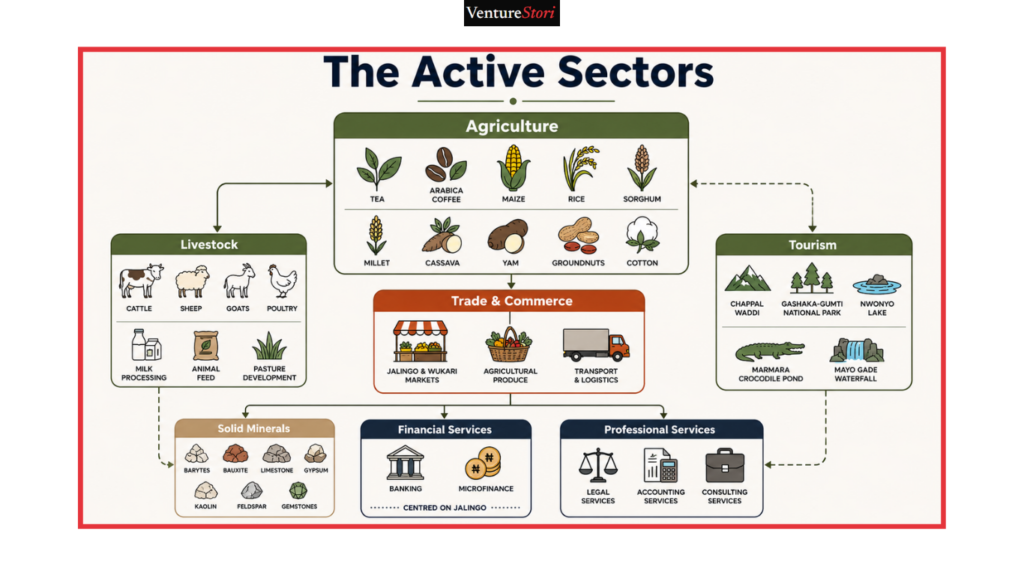
Agriculture is the foundation of Taraba’s economy. One of its most unique products is tea and Arabica coffee on the Mambilla Plateau. Mambilla is the leading area in commercial highland tea production, as its highlands are the most suitable ecology for tea production in Nigeria. Its research station in Mambilla specializes in Arabica coffee and tea research.
Mambilla Beverages Limited is the state’s tea processing company and producer of the Highland and Green Tea brands. The company is located on the Mambilla Plateau in Kakara Village, Sardauna LGA of Taraba State.
In January 2026, during a roundtable discussion held at the ASUU secretariat in Jalingo, organized by the National Coffee and Tea Association of Nigeria (NACOFTAN), Taraba State University (TSU), and the Raw Materials Research and Development Council (RMRDC), the Federal Government of Nigeria mentioned plans to revitalize its coffee and tea sector. The Taraba State government identified Sardauna, Gashaka, Kurmi, and parts of Bali LGAs as fertile grounds for the coffee and tea expansion.
Taraba’s agricultural products also include maize, rice, sorghum, millet, cassava, yam, groundnuts and cotton.
- Livestock
The highland pastures in the Mambilla Plateau have been a rearing ground for cattle, sheep and goats for a long time. Poultry, rabbit, and pig rearing are also done in other areas of the state. In 2024, the World Bank included 5,200 female livestock farmers as part of its plan to support 40,000 people in the livestock value chain across the state through its Livestock Productivity and Resilience Support (L-PRES) program. For the six-year support program, the state chose four classes of livestock: cattle, sheep, goats, and poultry, including production, milk processing, feed, equipment, and pasture development as areas where the beneficiaries will be supported.
- Tourism
Tourism is one of the most underrated sectors in Taraba State. The state is home to the highest mountain in Nigeria and West Africa, Chappal Waddi, standing at roughly 2,419 meters. The Gashaka-Gumti National Park is one of the most significant wildlife and forest tourism destinations in the country as well.
The Nwonyo International Fishing and Cultural Festival held at Nwonyo Lake in Ibi, the Marmara Crocodile Pond in Wukari, and Mayo Gade Waterfall in Gembu are other tourist attractions in the state.
The state government has taken steps to embark on a multibillion-naira agro-ecotourism project in 2026, and it has entered into a partnership with La Campagne Tropicana Resort Group. For the project, the government has approved 2,500 hectares scattered across 12 locations in the state as part of its plans to turn Taraba into a choice destination for tourists.
- Trade and Commerce
Jalingo is the administrative headquarters of Taraba and the main business hub. While Wukari is a major agricultural and commercial hub in the state and beyond its borders.
- Solid Minerals
Taraba is blessed with a diverse range of mineral resources, including barytes, bauxite, limestone, gypsum, kaolin, feldspar, mica, and other metallic ores, industrial minerals, and gemstones. The Nigerian Investment Promotion Commission and Taraba’s own Bureau for Solid Minerals both see mining as a massive investment opportunity for the state. But the sector is a lot less developed compared to agriculture. The state government partnered with Finland in 2024 to develop its solid minerals sector and attract mining investments.
- Financial Services
Jalingo is home to several commercial banks, and they’re mostly located along and around the Hamma Ruwa Way—Access Bank, Ecobank, FCMB, and Fidelity Bank.
- Professional Services
Legal, accounting, and consulting firms are also located in Jalingo, along with the state’s government house, institutions, courts, and major business communities.
The Business Districts and Key Areas
- Jalingo — City Centre and Central Market
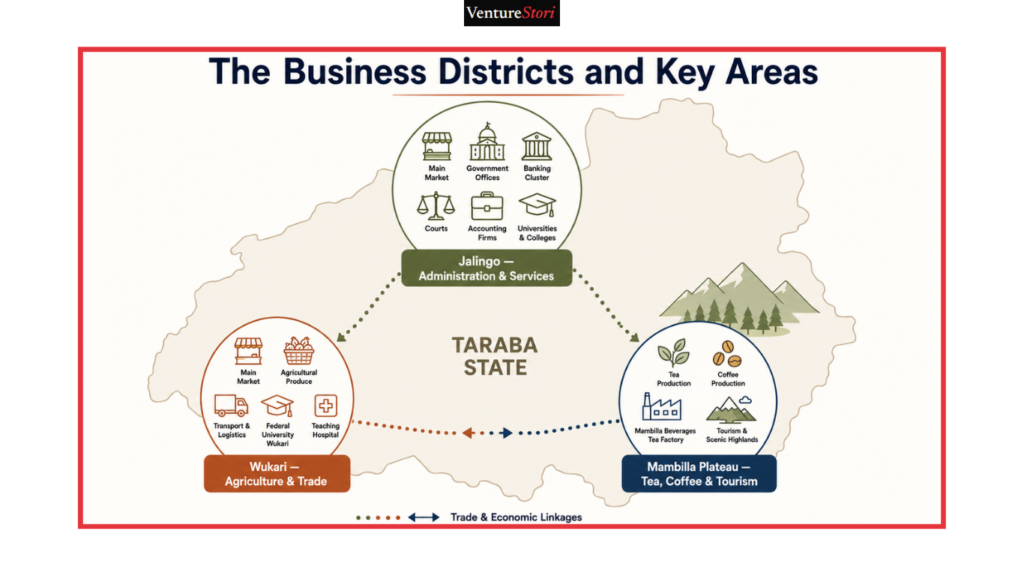
Jalingo serves as a major market hub linking the state to Yola, Numan, Wukari, and Bali. A lot of its commercial operations happen in Jalingo Main Market, while Hamma Ruwa Way has a significant number of banks; there are also government houses, institutions, legal and accounting firms scattered across the city as well. Education-wise, Taraba State University and the College of Agriculture, Science, and Technology, Jalingo also call the city home.
- Wukari — The Southern Trading Centre
Wukari is one of Taraba’s most important agricultural and commerce hubs. It also has a rich history attached to it as the seat of the Aku Uka and the Wukari Federation. Federal University Wukari and the Federal University Teaching Hospital have given the city an educational and healthcare outlook alongside its commercial activities.
- Mambilla Plateau — Tourism and the Tea Company
Mambilla Beverages Nigeria Limited, located in Sardauna LGA owns a tea estate and factory that is contributing heavily to Taraba’s agricultural economy.
Tourism is also a sector that is now being exploited, with the recent partnership between the state government and La Campagne Tropicana on a multibillion-dollar agro-ecotourism project.
Investment and Development Activity
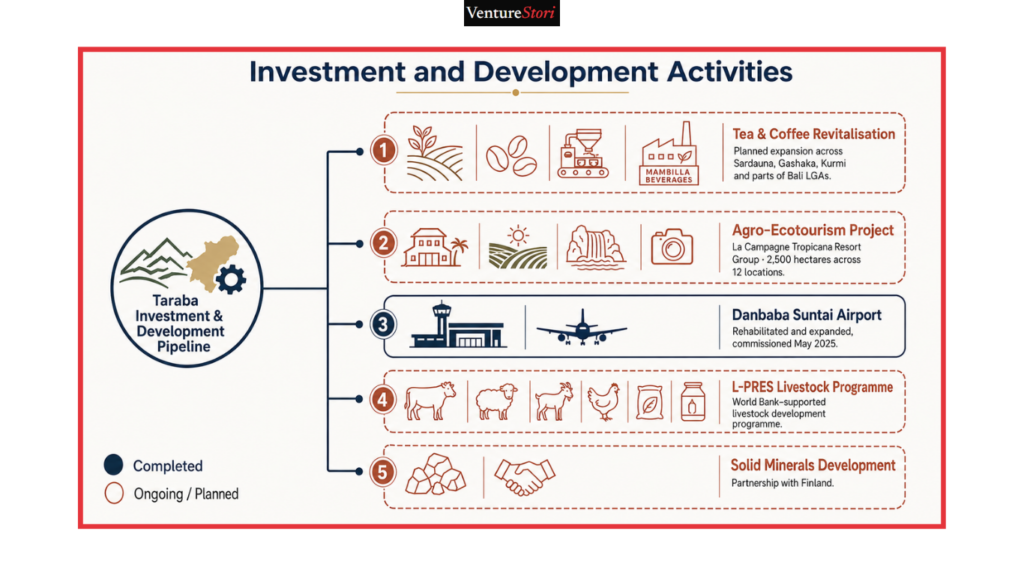
So far in 2026, the Taraba State government has focused its efforts on agricultural revitalization and tourism infrastructure.
The round table discussions in January were about Mambilla Plateau tea and coffee production expansion and attracting potential investors into Mambilla Beverages’ Kakara operation. For tourism, as already mentioned, the state has partnered with La Campagne Tropicana on a multibillion naira agro-ecotourism project.
The state government had already completed the rehabilitation and expansion of Danbaba Suntai Airport in Jalingo, commissioned on the 21st of May 2025, as part of its commitment towards opening the state to investors and the world at large.
Development activities in the state include the six-year World Bank’s Livestock Productivity and Resilience Support (L-PRES) program for people in the livestock industry.
Venture-backed companies in the state remain limited to date.
Who Is Building Here
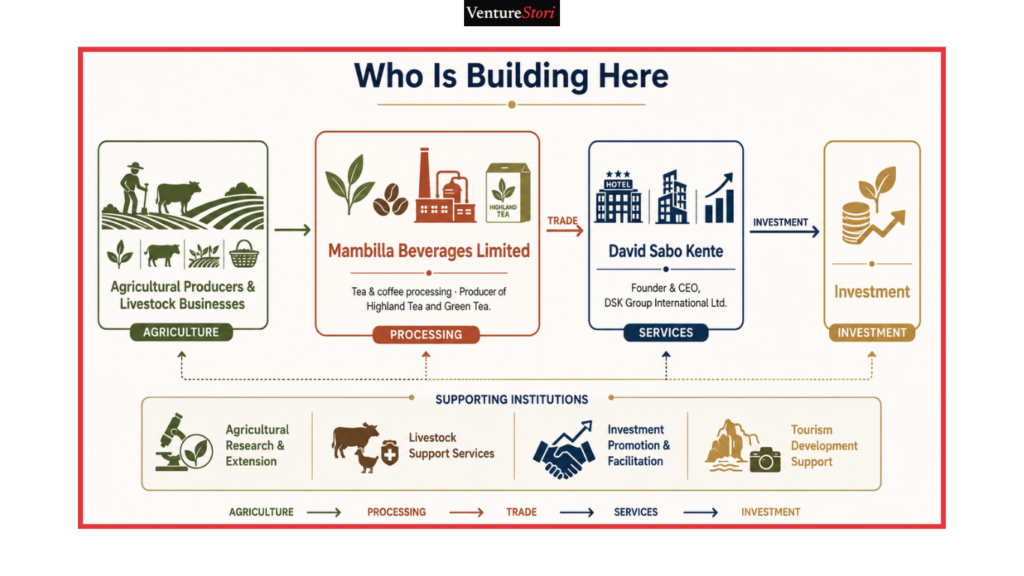
- Mambilla Beverages Limited: The state-owned tea and coffee processing company and maker of Highland Tea and Green Tea. The company seeks to revolutionize tea and coffee production beyond Taraba and over Nigeria, like how palm oil processing is being revolutionized in Nigeria.
- David Sabo Kente: David Kente hails from Kente in Wukari LGA and is the founder and CEO of DSK Group International Ltd. Kente has ties to hospitality and real estate businesses. His entrepreneurship story is similar to what Aruwa Capital is hoping to recreate with female African entrepreneurs.
Agriculture remains the anchor of Taraba’s economy: Mambilla Plateau’s tea and coffee production, livestock rearing and farming, and trade and commerce around Jalingo and Wukari. The state’s agricultural potential is massive.
Although certain parts of the state still face security and internal conflict, it isn’t spread across the state.
Taraba State Company Listings
Note: The following listings are paid placements from businesses operating in Taraba. Venture Stori editorial content above is independent of this directory and is not influenced by, or contingent on, directory placement.
Listing template:
- Business name:
- Category:
- One-line description:
- Contact details:
- Website:
- Location within Taraba:
Word count: 1,973