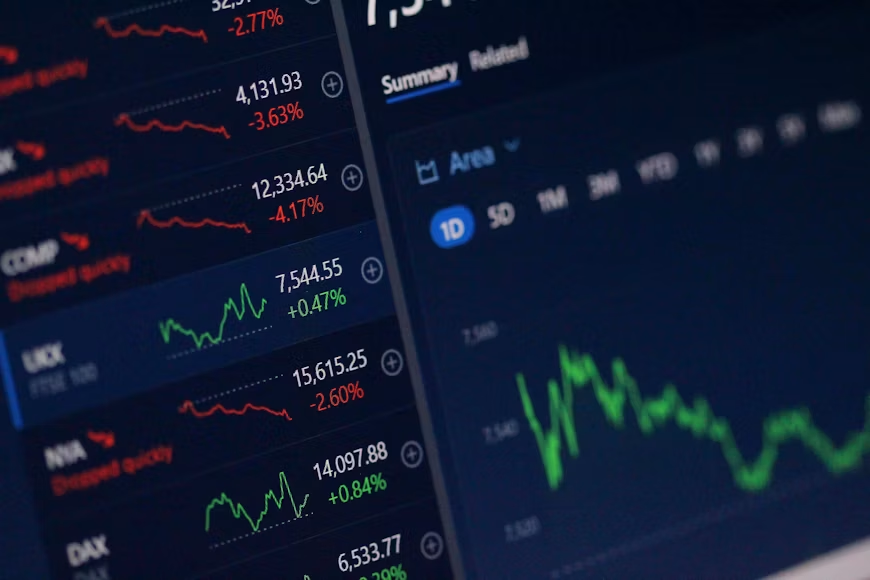
While US and Asian technology and semiconductor stocks fell in June and July, the FTSE 100 index remained relatively stable. The FTSE 100, which had been trading between 10,400 and 10,600 for several weeks, reached 10,600.37 on July 17. It’s a significant difference from the index’s performance in 2023 and early 2024 when it mostly traded below 8,000.
The FTSE 100 opened beneath its average on July 17 as the global tech and semiconductor market crashed on the back of tensions in the Middle East. However, the market recovered quickly and gained 0.27%, closing out at 10,600.37. It was helped by the energy and utilities sector, which gained from higher oil prices, and by the steady resilience of FTSE 100 defensive stocks.
Why the FTSE 100 Holds Up When Tech Crashes
The FTSE 100 mostly comprises big energy companies, global banks, pharmaceutical giants, mining companies, and consumer goods businesses. These corporations already have established profits and steady dividends, unlike emerging tech stocks that are mostly valued based on speculation and future projections. This fundamental structure is one of the major reasons why the FTSE 100 reacts well during global technology sell-offs.
When technology and semiconductor markets crashed, the FTSE 100 was supported by non-tech companies that profited regardless. Non-tech companies don’t depend on volatile semiconductor stocks, providing a steady structural floor for the index.
This is not to say that the FTSE 100 will always outperform tech stocks or that UK stocks are inherently the single best buy for every portfolio. In fact, the FTSE 100 has a long history of delivering lower total investment returns over extended periods compared with tech-heavy indices like the S&P 500. What is crucial to note is that when global markets experience a tech sell-off, the specific mix of companies within an index determines how much that market is affected.
RECOMMENDED READING: Cathie Wood SpaceX Buying: What the $51 Million Space Bet Means for African Investors
Why Sector Diversification Is Your Secret Weapon
Many new investors are naturally drawn to high-growth opportunities in US tech stocks. While the growth potential of tech stocks is enormous, concentrating a significant portion of your portfolio in one industry leaves you exposed to severe downside risk when market sentiment shifts. Smart sector diversification acts as a buffer to soften the blow of sudden sector crashes, offering a timely lesson for FTSE 100 2026 African investors.
A global fund versus a developed markets fund can differ sharply in risk profile. If tech stocks drop sharply, a fund heavily weighted in tech companies will behave very differently than a FTSE 100 index fund comprised of healthcare, finance, and energy holdings. Every sector faces unique headwinds and reacts differently to shifting interest rates and macroeconomic conditions—a reality that FTSE 100 2026 African investors must account for in their asset allocation.
True sector diversification is about more than geographical location—it requires holding assets across distinct, non-correlated business models to build volatility resilience for FTSE 100 2026 African investors.
How African Investors Can Access the FTSE 100 & UK Markets
For African investors looking to build a resilient, diversified portfolio, gaining exposure to the FTSE 100 is straightforward through UK-listed index funds or international exchange-traded funds (ETFs) offered by major regional investment platforms.
Before deploying capital, African investors should evaluate three key practical factors:
- Currency Risk: Investing internationally introduces currency fluctuations alongside equity risk. Fluctuations between local currencies, the British Pound (GBP), and the US Dollar (USD) can impact your net returns.
- Underlying Sector Weightings: A fund labeled “UK Exposure” is not identical to a pure FTSE 100 tracking fund. Look closely at the exact breakdown of companies inside the fund rather than relying solely on country labels.
- Fund Asset Breakdown: Most ETF providers publish real-time breakdowns of their largest holdings. Checking these holdings shows you exactly how the fund will perform during a tech market downturn.
Use this approach as part of a broader strategy rather than an all-or-nothing pivot. Investors do not need to dump their growth-focused tech stocks to benefit from defensive assets. Instead, combining tech stocks with defensive indices like the FTSE 100 builds a balanced portfolio designed to weather market shifts smoothly.
Disclaimer: This piece is strictly for informational purposes and does not constitute financial or investment advice. Readers and potential investors should conduct independent research or consult a certified financial advisor before making investment decisions.
Up Next: Continue Reading on Venture Stori
Sony RX10 V 2026: The Camera African Content Creators Have Been Waiting For
An inside look at how Sony’s latest all-in-one superzoom camera is revolutionizing production workflows and gear budgets for independent creators across Africa.