In a study of brand presence across West Africa, Chi Limited, a Nigerian beverage brand with approximately 27,700 social followers, achieved an average post engagement rate of 9.23% through effective social media marketing. Over the same period, Coca-Cola Nigeria, backed by a massive follower base of over 759,000, mustered an engagement rate of just 1.62%. Chi Limited outperformed the global beverage giant by a factor of 5.7x, relying not on ad spend or celebrity endorsements, but on localized hyper-relevance.
This single metric highlights a critical reality in modern African commerce: vanity metrics are failing Nigerian businesses. While 86% of internet-enabled Nigerian consumers use digital platforms to discover and purchase products, an estimated 75% of Nigerian small and medium-sized enterprises (SMEs) still lack a structured framework for social media marketing. Mastering this discipline through localized campaigns is no longer optional for brands aiming to succeed in Nigeria’s competitive digital landscape.
The Nigerian Social Media Landscape in 2026
Social media advertising spend in Nigeria reached $130 million in 2024 and is on track to hit $217 million by 2029 (PwC). Digital channels are projected to command 84% of all advertising expenditure in the country. This growth is driven by a young population where a mobile-first population is navigating an evolving economic landscape. Understanding where this audience spends its attention and is essential for effective resource allocation. Let’s look at how the popular social media platforms compare.
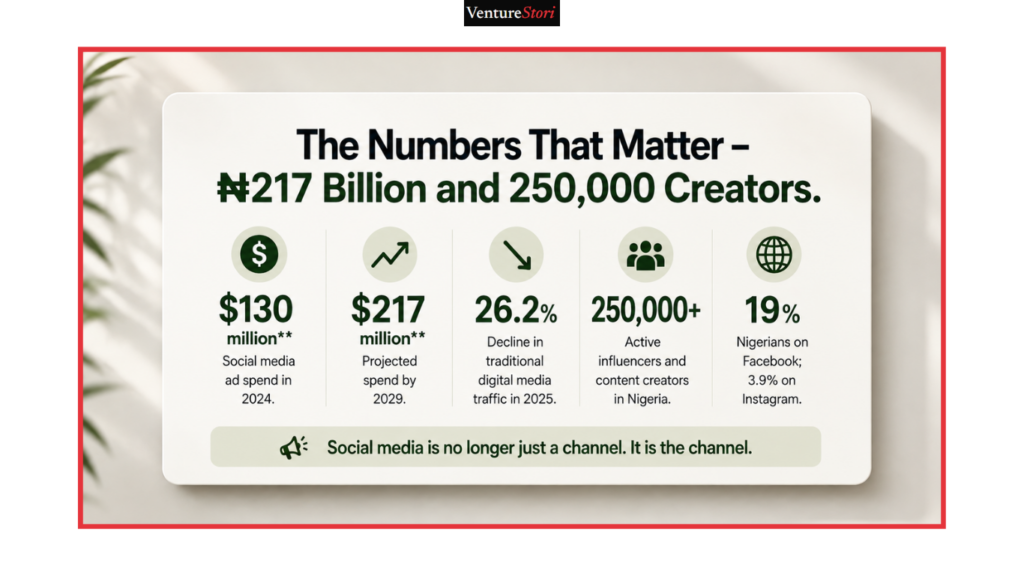
The Numbers That Matter – ₦217 Billion and 250,000 Creators.
Why Facebook Remains Nigeria’s Primary Commerce Engine
While Western tech commentators frequently declare Facebook an “aging platform,” in Nigeria it remains the undisputed social media marketing powerhouse for commercial transactions. Data shows that 86% of Nigerian online shoppers use Facebook to research, evaluate, or directly buy products. It functions as both a discovery engine and a trust verifier for everyday consumers across tier-1 cities like Lagos and Abuja, as well as emerging commercial hubs like Aba, Kano, and Port Harcourt.
Nigeria has about 19% of its population on Facebook; that is about 46 million users. With Facebook Marketplace, people sell and purchase both new and mostly second-hand products from within their neighborhood.
Navigating TikTok’s High-Attention, High-Data Environment
TikTok commands 51% of the short-form video market share in Nigeria and accounts for roughly 28% of all social media marketing data traffic nationwide. Because its algorithm prioritizes content virality over follower counts, TikTok serves as a powerhouse channel for rapid brand awareness within any modern social media marketing campaign. However, because video streaming consumes significant data, brands must capture audience attention within the first few seconds before users scroll past.
Leveraging Instagram for Visual Discovery and Intent
Instagram accounts for 64% of social commerce discovery in Nigeria, catering primarily to middle-to-upper-income urban demographics as a core channel for visual social media marketing. It serves as a digital storefront for lifestyle, fashion, beauty, electronics, and professional services. However, rising CPMs mean that static feed posts within any social media marketing campaign must be paired with structured conversion paths.
Using WhatsApp to Convert Inquiries into Sales
With over 51 million users in Nigeria, WhatsApp serves as an undisputed operating system for Nigerian business communication and a critical closing tool for social media marketing. It allows product inquiries and price negotiations, and even payment receipts are sent through WhatsApp alongside post-purchase customer support. Brands that fail to route inbound social media marketing traffic directly into a structured messaging funnel lose a significant percentage of potential sales.
With the emergence of WhatsApp Business, brands can now create an official account and shorten the sales funnel by showcasing product catalogs and running targeted messaging ads.
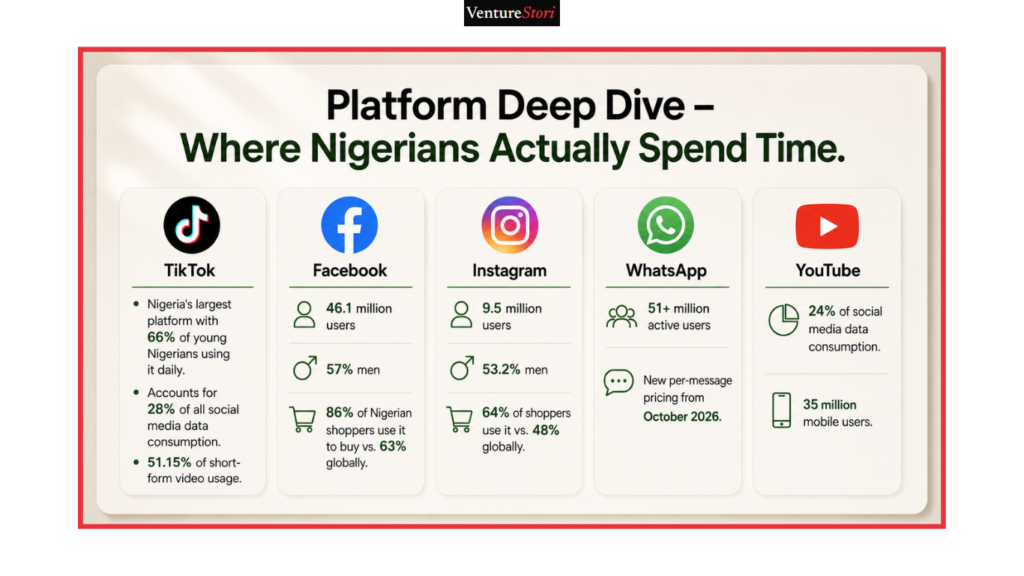
Platform Deep Dive – Where Nigerians Actually Spend Time.
Decoding the Data: Insights from the Nigerian Benchmark Study
The inaugural Nigerian Social Media Benchmark Study revealed data that challenges standard digital marketing advice. Businesses that blindly apply international best practices often end up spending more while seeing lower returns.
Rethinking Posting Frequency for Better Reach
Conventional international advice for social media marketing often recommends publishing one to three times daily to maximize algorithmic reach. However, this high-frequency approach does not necessarily produce the same results for Nigerian brands. A verified Nigerian benchmark shows that posting three to four times per week can generate an engagement rate of around 1.64%, compared with approximately 0.66% for brands posting daily within their social media marketing schedules.
This suggests that posting more frequently is not automatically better. Nigerian audiences may experience content fatigue when brands publish too often, while data-conscious users may be less willing to engage with a constant stream of content. For businesses targeting Nigerian consumers through social media marketing, the emphasis should therefore be on producing useful and relevant content rather than simply increasing the number of posts. Quality, timing, and audience relevance can be far more valuable than maintaining a high posting volume.
Shifting Primary KPIs from Followers to Engagement
Many international social media marketing strategies place emphasis on growing raw follower numbers, often treating a large audience as an indicator of brand authority. However, follower count alone may provide a misleading picture of overall social media marketing performance.
A private study shows that micro-audiences can generate 5.7 times higher engagement since most followers are not generic. This means a smaller community of people who genuinely care about a brand can be more valuable than a much larger audience that rarely interacts with its content.
Brands should therefore look beyond follower growth and pay greater attention to meaningful social media marketing indicators such as engagement, leads, inquiries, and conversions. A business with 5,000 highly engaged followers may have a stronger commercial position than one with 100,000 followers who rarely interact with its content. The objective should not simply be to attract more people but to attract the right people and give them a reason to respond.
Choosing the Right Content Medium for Trust
International social media advice often encourages brands to focus on polished, professionally curated images. While high-quality visuals remain useful for establishing a consistent brand identity, Nigerian consumers respond strongly to content that feels authentic and grounded in real experiences.
Raw, user-generated video can outperform highly polished graphics because it gives potential customers visible evidence of how a product or service works. A customer demonstrating a product, sharing an experience, or recording a genuine testimonial can sometimes create more trust than a professionally produced advertisement.
This does not mean abandoning professional content altogether. Instead, polished brand assets should be balanced with real customer experiences, behind-the-scenes footage, and user-generated videos. The strongest content strategy may be one that looks credible without becoming so polished that it feels disconnected from the people the brand is trying to reach.
This data shows that social media users display high fatigue toward repetitive brand posting. Because data costs represent a tangible household expense, users reserve their limited bandwidth for content that provides immediate practical value, entertainment, or clear financial incentives.
The ARCON Compliance Challenge: Legal Realities for Businesses
A major operational hurdle for businesses utilizing social media marketing in Nigeria is the regulatory mandate established by the Advertising Regulatory Council of Nigeria (ARCON) under Act No. 23 of 2022.
ARCON requires that all advertising targeted at the Nigerian market, including sponsored social media posts, influencer promotions, digital banners, and algorithmic ad campaigns, receive formal pre-exposure vetting before going live.
According to Techpoint Africa the cost of standard review is between N7,500 and N20,000 depending on the category classification of an ad, and it is a 7-day vetting. However, accelerated options scale up to N100,000 for 16-hour processing and N150,000 for 8-hour processing. But registered micro-enterprises (backed by NASME or SMEDAN certification) can access concessions on pricing, provided the documentation is submitted correctly.
Despite ARCON’s low ranking on the Presidential Enabling Business Environment Council (PEBEC) efficiency index (3%), enforcement against digital non-compliance has expanded. ARCON actively monitors digital platforms and issues cease-and-desist notices, platform blocks, and fines exceeding N500,000 per unvetted ad campaign.
A Compliant Workflow for SMEs
SMEs trying to comply with the ARCON procedure can use the following workflows:
- Batch Vetting: Instead of submitting individual assets, group quarterly campaign creatives (video scripts, carousel designs, ad copy variants) into a single master file to minimize vetting fees.
- SMEDAN Registration: Register your business with SMEDAN to qualify for SME regulatory discounts.
- Agency Intermediaries: Partnering with accredited digital agencies that maintain dedicated ARCON vetting desks can help to fast-track approval.
The Creator Economy: Why Micro-Influencers Deliver Better ROI
Nigeria’s creator economy includes over 250,000 active content creators. However, the era of paying millions of Naira to mega-celebrities for a single static Instagram grid post is coming to an end. Brands are shifting budgets toward performance-driven partnerships with micro-influencers (10,000 to 50,000 followers) who maintain engaged and niche communities.
In sectors like fashion, local culinary arts, B2B services, consumer tech, and so on, micro-influencers deliver engagement rates between 4% and 6%, compared to under 1.5% for macro-celebrities.
Businesses looking to settle this can use the following strategy to achieve better ROI:
- Structure contracts around sales conversions or qualified lead metrics rather than raw impressions.
- Provide creators with creative flexibility so the promotion feels authentic to their audience.
- Ensure all creator partnerships comply with disclosure rules and ARCON guidelines.
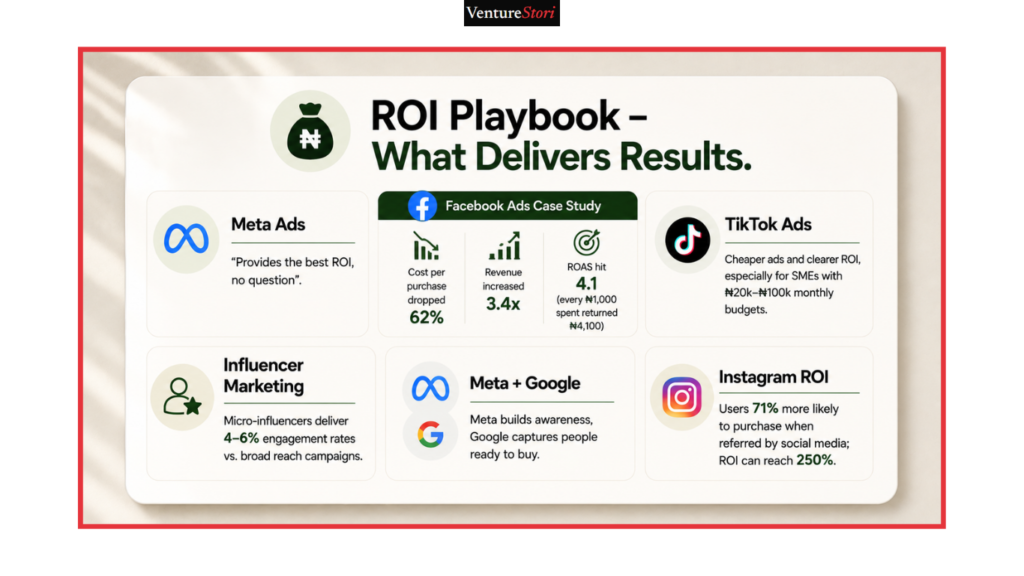
ROI Playbook – What Delivers Results.
Executing Social Media Marketing in Nigeria
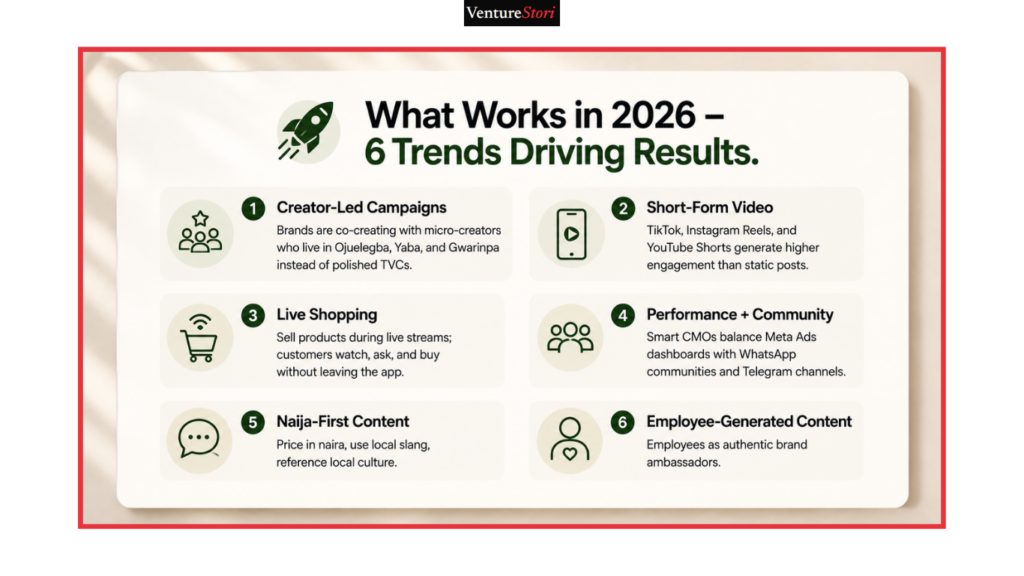
A common reason social media campaigns underperform in Nigeria is the reliance on generic, globally template-driven content. Local context consistently outperforms generic copy
Core strategy elements
- Transparent Naira Pricing: Due to currency fluctuations, ambiguous pricing such as the “DM for price” raises a red flag for Nigerian consumers. Displaying the clear cost of a product or service upfront can help to build trust and filter out uncalculated leads.
- Addressing Local Challenges directly: Acknowledge operational realities such as delivery windows, power outages, or payment processing stability within your messaging. Demonstrating how your product solves these daily pain points builds immediate credibility.
- Conversational Language: Incorporating local expressions and Pidgin English makes brand messaging feel accessible and authentic rather than distant or corporate.
- Leveraging Real-World Proof: User-generated unboxing videos, customer video testimonials, and live payment confirmations help address consumer skepticism around online shopping fraud.
These strategies can help an organization to achieve more qualified leads and direct sales while building trust.
Strategic Action Plan for 2026 Social Media Marketing Campaign
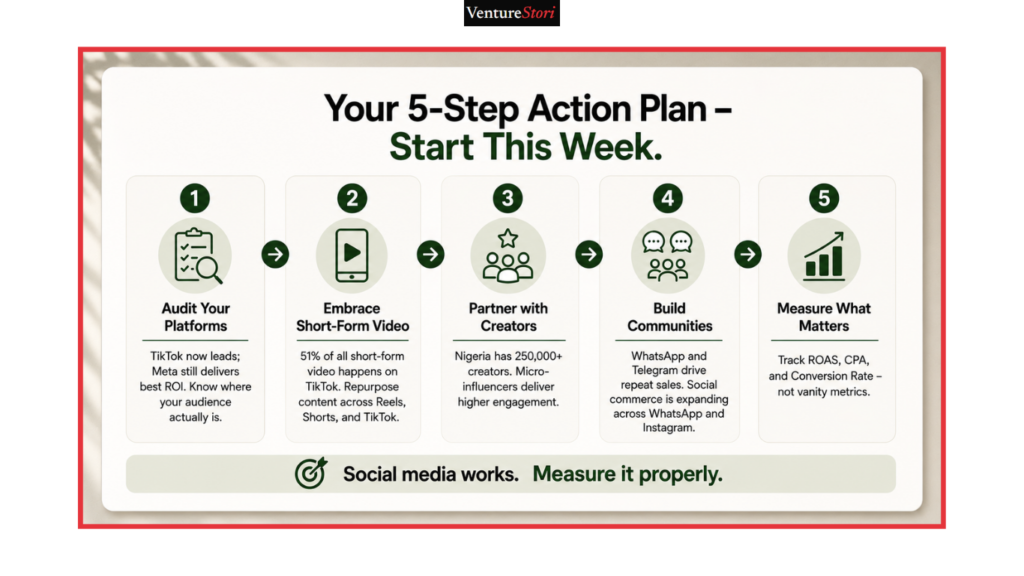
Your 5-Step Action Plan – Start This Week.
To build an efficient, compliant, and high-converting social media marketing strategy in Nigeria, follow this prioritized roadmap
- Phase 1: Compliance & Infrastructure Audit: Secure SMEDAN registration and establish a batch ARCON vetting workflow.
- Phase 2: Funnel Optimization: Set up WhatsApp Business API with automated FAQs and local payment integrations.
- Phase 3: Content & Publishing Strategy: Shift to a 3-post-per-week schedule focused on hyper-local, video-first content.
- Phase 4: Creator & Performance Scale: Reallocate budget from macro-influencers to performance-linked micro-creator deals.
Digital media traffic habits are shifting as AI-powered search engines provide direct answers, reducing outbound click-through rates by up to 26.2% globally. In response, Nigerian social commerce is moving away from external websites toward direct, conversational channels.
Recent commerce studies reveal that 46% of internet-enabled Nigerian shoppers use AI-powered chat tools for product discovery, and 88% of local e-commerce businesses use AI automation for lead qualification and customer service.