Iyinoluwa Aboyeji has built two successful technology companies in Africa. He has now moved to funding new businesses and founders. His journey reflects that of an entrepreneur who has substantial achievements without relying on unverified claims about his personal wealth.
Aboyeji is a partner and co-founder of Future Africa. This is an investment platform that backs early-stage companies in Africa. The portfolio of Future Africa consists of about 106 companies, and it has deployed more than $10 million and is raising more than $1 billion in follow-on funding.
The Background and Early Life of Iyinoluwa Aboyeji
Iyinoluwa “E” Aboyeji was born on March 28, 1991, in Lagos, Nigeria, and grew up across Lagos, Warri, and Abuja. He attended Loyola Jesuit College before relocating to Canada for university. There, Iyinoluwa Aboyeji read Legal Studies at the University of Waterloo and also studied international development at St. Jerome’s University.
Iyinoluwa Aboyeji displayed a passion for entrepreneurship from a tender age. During his university days, he became deeply involved in student publishing, eventually serving as president of the board for one of Canada’s largest student-owned publishing houses.
Working on this board provided Iyinoluwa Aboyeji with foundational experience in leadership, organization, and institution-building. These early management lessons later became indispensable tools for Iyinoluwa Aboyeji as he shaped groundbreaking ventures across Africa’s technology sector.

Founding Andela and Shaping African Tech Talent
In 2014, Iyinoluwa Aboyeji co-founded Andela alongside Jeremy Johnson, Nadayar Enegesi, and other founding team members. Iyinoluwa Aboyeji and his co-founders discovered that Africa possessed immense software development talent, while technology companies around the world faced a persistent shortage of skilled engineers. This insight led Iyinoluwa Aboyeji to help establish Andela as a vital bridge connecting those two realities.
What the company does is train and connect African software engineers with international technology companies. Starting small with a tight-knit team in Yaba, Lagos, the venture scaled rapidly under the vision of Iyinoluwa Aboyeji to become a global technology talent organization.
Andela is celebrated as one of Africa’s multi-billion-dollar enterprises, as described by Future Africa. Historical records show that the company has built a community of more than 100,000 technologists across 110 countries and six continents, attracting heavy-hitting international investors. Backers such as the Chan Zuckerberg Initiative, Google Ventures, and SoftBank helped establish Andela as a major player in the global tech market, cementing a massive milestone for Iyinoluwa Aboyeji and his early co-founders.
For Iyinoluwa Aboyeji, however, Andela was never just another startup. The company represented a crucial step toward proving that African talent should be empowered locally rather than exclusively exported from the continent. After spending formative years scaling Andela, Iyinoluwa Aboyeji turned his attention toward solving another massive friction point across the continent, which was the complex reality of digital payments.
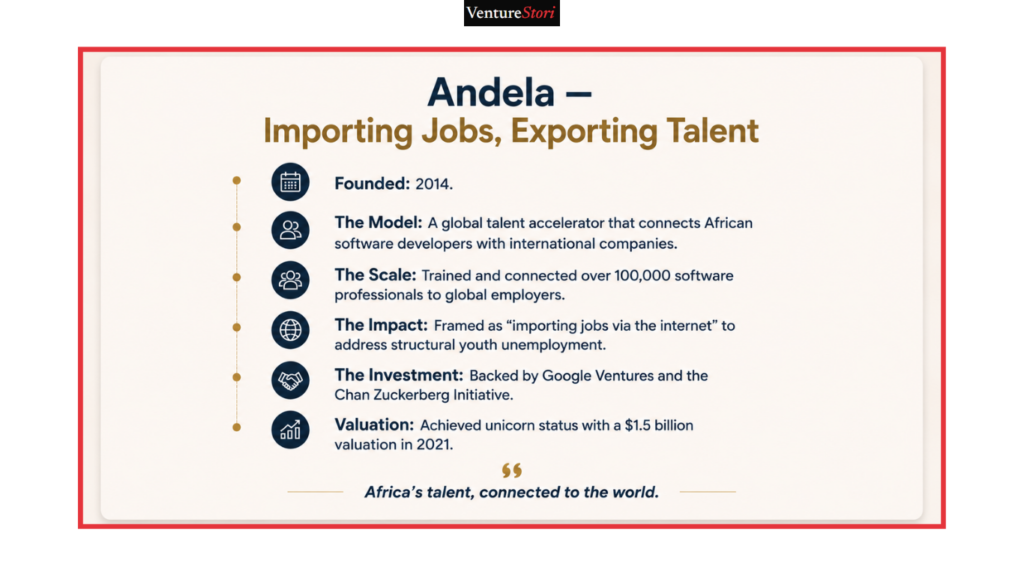
Andela — Importing Jobs, Exporting Talent.
Transitioning to Flutterwave: Solving African Payment Challenges
Aboyeji proceeded to solve the problem in 2016 by co-founding Flutterwave with other technology and financial services professionals. The problem of moving money anywhere in the African market was familiar to anyone building a business in Africa.
Businesses have had to deal with different payment systems, currencies, and financial institutions. Flutterwave was created to simplify that process through technology. It now made it easy for businesses to accept and make payments through multiple payment methods and across different African markets.
This made the idea quickly gain international attention. He later stepped down in 2018 after serving as Flutterwave’s CEO during its early period for his co-founder, Olugbenga Agboola. In 2021, Flutterwave became a unicorn, reaching a valuation above $1 billion after raising $170 million. That achievement launched it to become one of the African technology companies to reach unicorn status.
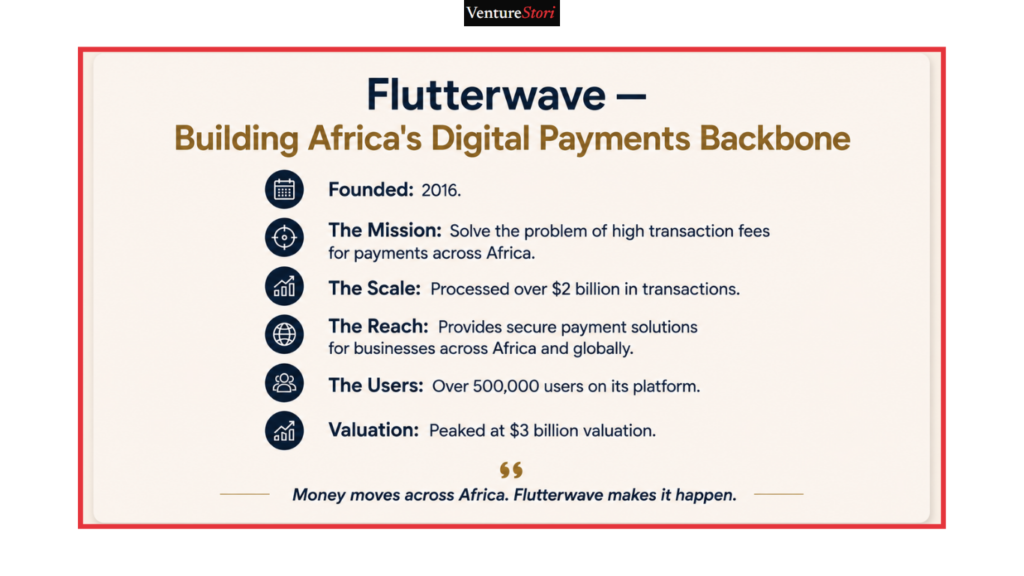
Flutterwave — Building Africa’s Digital Payments Backbone.
Advocacy and the Transition to Future Africa
Aboyeji took a break from entrepreneurship after leaving Flutterwave to commit himself to advising startups and supporting entrepreneurs.
He also got involved in Nigeria’s politics, where he served as Deputy Director-General of Oby Ezekwesili’s 2019 presidential campaign. Working in this space opened him up to problems outside the technology ecosystem and the need for Africa to attract entrepreneurs and investors.
Moving forward, Aboyeji, together with Olabinjo Adeniran and Adenike Sheriff, started working together to create Future Africa. It started as a community focused on conversations about Africa’s future. They later discovered that conversations alone were not sufficient.
They evolved into Future Africa, which focuses on raising capital, coaching and building a community for African founders. This innovation launched Aboyeji to the next chapter.

The 2x Unicorn Philosophy — What He Learned Building Billion-Dollar Companies.
The Vision and Investment Portfolio of Future Africa
Future Africa was created to support problem-solving entrepreneurs by identifying and supporting African startups at an early stage. Future Africa has become a backer to businesses across many sectors such as financial technology, mobility, agriculture, construction technology and digital infrastructure.
Its portfolio includes companies such as Flutterwave, Andela, Moove, Releaf, and Itana. This company has invested in 106 portfolio companies and deployed more than $10 million across its first funds.
However, there is no credible public evidence establishing a confirmed personal net worth figure for Aboyeji. Future Africa’s worth cannot be automatically termed as Aboyeji’s personal worth.
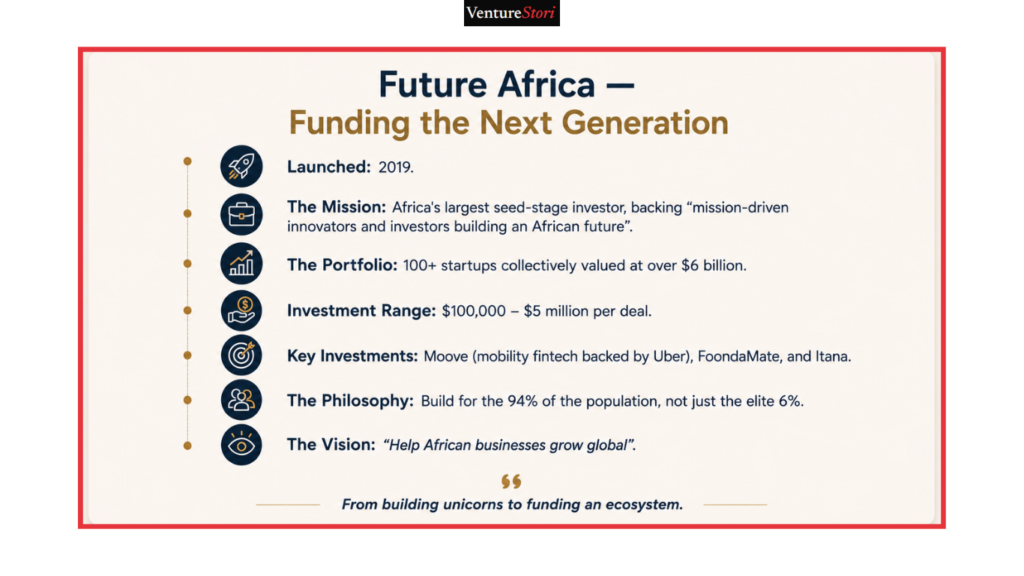
Future Africa — Funding the Next Generation.
Public Service and Global Recognitions
Aboyeji has served as a member of Nigeria’s Presidential Council on Industrial Policy and Competitiveness. The council was established to bring government and private-sector expertise into Nigeria’s industrialization efforts.
He was given a national honor, the Officer of the Order of the Niger, or OON. Other recognition includes the Forbes 30 Under 30 honor and the World Economic Forum Young Global Leader designation.
He has ventured into technology, investment, public policy and entrepreneurship all while remaining focused on African economic development.
Lessons for Aspiring African Entrepreneurs
Aboyeji’s career offers several practical lessons for young African entrepreneurs.
Solve a real problem
Andela bridged the gap between African technological professionals and global demand. Flutterwave solved the difficulty of moving money across African markets.
Future Africa addresses another problem: the truth that early-stage entrepreneurs need more than capital. All of these ventures are solution-centered, not just technology companies.
Build for scale
The companies Aboyeji built were created to thrive beyond the immediate location or environment. Just as Flutterwave built payment infrastructure across markets. Founders need to have the mindset of scaling the business from the beginning.
Know when to move
Aboyeji left Andela to concentrate on Flutterwave. He later resigned as the CEO of Flutterwave. He then got into the realm of investments via Future Africa. The transitions illustrate that it is not always necessary to work in one sector for a lifetime as an entrepreneur.
Capital is only one part of the equation
The way Future Africa was built reveals that founders need to have networks, guidance, and experienced people around them. With money, the company can hire, build products, and enter new markets.
Defining Success Beyond Net Worth
Aboyeji’s story is one that exemplifies the power of recognizing structural issues and creating companies to address them, which is a true picture of an evolving entrepreneurial spirit.
A founder can be a company builder, investor, or government adviser and then help other founders create companies. That might be the most important part of the story to young Nigerians and Africans.