The All-Share Index returned a healthy 51.2% in 2025 and started 2026 at a record-breaking 165,000+ and a market cap of over ₦100 trillion. With the increased interest in stocks, it is natural that changes in the Nigerian regulatory environment, specifically the Investment and Securities Act (ISA), will have both direct and indirect effects on all trading platforms.
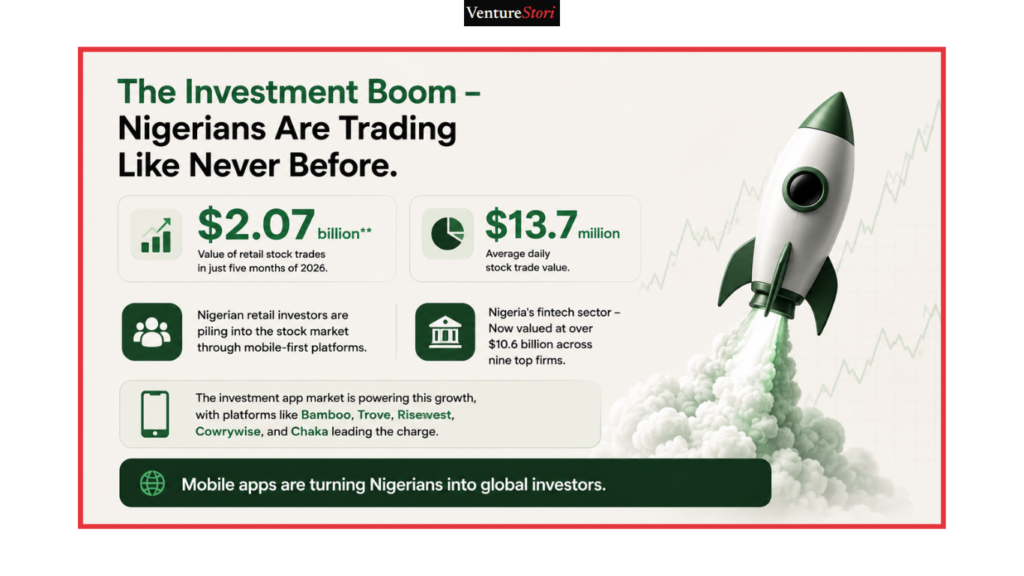
The Investment Boom – Nigerians Are Trading Like Never Before.
Regulatory Background: What Changed With the ISA 2025?
In March 2025, President Tinubu signed the Investment and Securities Act (ISA) 2025 into law, replacing the 2007 ISA with a framework better suited for the evolving crypto and digital assets space.
For the first time, the ISA explicitly includes digital assets and cryptocurrencies as securities, placing Virtual Asset Service Providers, Digital Asset Operators, and Digital Asset Exchanges under the SEC’s regulatory supervision. Consequently, any digital asset trading platform operating in Nigeria must now navigate these stricter guidelines.
Under this updated legislation, choosing the right trading platform requires verifying that the provider meets strict compliance standards and SEC registration requirements.
In practice, this means the SEC has the authority to require capital from digital asset exchanges and custodians, with reports indicating the SEC has already moved to impose a ₦2 billion minimum capital requirement on digital asset firms, including exchanges and custodians, with a compliance runway granted to meet it. Any crypto platform operating in Nigeria is expected to formally register with the SEC and demonstrate that it meets fit-and-proper criteria, as well as minimum capital requirements, in order to operate legally.
In practice, this means that a potential investor’s primary concern when choosing a trading platform should be its registration with the SEC. It is no longer business as usual, and the SEC maintains a public list of licensed trading platforms in Nigeria that can be used to confirm any given platform’s status.
Best Trading Platform Nigeria Options Compared
Trove currently offers the most comprehensive service, allowing Nigerian investors to trade over 10,000 stocks and ETFs on Nigerian, US, European, and Chinese exchanges through a single account, with brokerage services provided by its subsidiary Innova Securities Limited. It has a ₦1,000/$10 minimum deposit and encourages self-directed trading, with recurring options and educational resources provided in-app.
Bamboo, on the other hand, offers a more focused service of allowing users to manually select and trade from a list of 3,000+ US stocks and ETFs, as well as Nigerian stocks. Minimums are lower and start at $2, and the platform is aimed more at those who want to build a portfolio manually rather than rely on automated investing. Both platforms have been reported to have over 500,000 registered users as of early-mid 2026, so this shared figure doesn’t meaningfully distinguish between the two in terms of scale; either is a viable choice on that basis alone.
Risevest is different in that it does not offer access to Nigerian stock exchanges, focusing instead on dollar-denominated assets with professionally managed portfolios. If you’re looking for a fully automated, diversified dollar-based investment with managed risk and no individual stock picking involved, Risevest is a natural choice. However, it cannot be used to directly access NGX-listed securities.
Chaka rebranded as Hisa in June 2026, a subsidiary of Risevest, which acquired Chaka in 2023, and allows users to trade on the NGX, Nairobi Securities Exchange, and select US stocks for a flat 1% commission. Some describe Hisa as a new and rising platform, while more recent comparison articles suggest that Chaka suffered from a lack of engagement following the rebrand and that Risevest is the preferred choice for a new account in 2026.
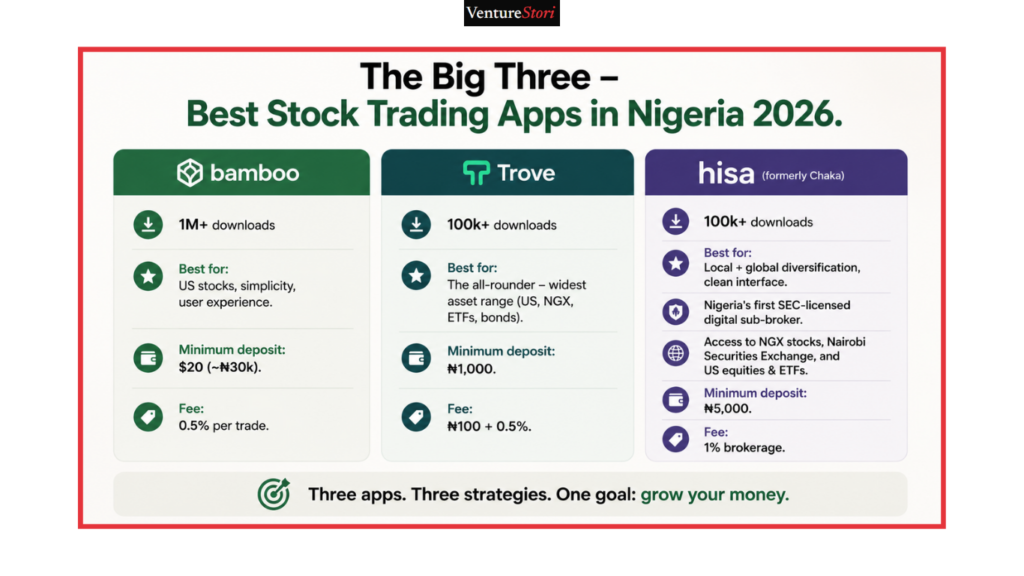
The Big Three – Best Stock Trading Apps in Nigeria 2026.
The Traditional Brokerage Counter-Question
Nigeria’s traditional brokerages are now adapting to the rising convenience of mobile investing. First Securities Brokers, a subsidiary of FirstHoldCo Plc, launched its FirstInvest app in July 2026, allowing users to open accounts, track their portfolios, and trade NGX-listed securities from their mobile devices. It promises to “remove the traditional barriers associated with investing.”
Similarly, Coronation Securities was named Nigeria’s fastest-growing online trading platform for 2025, having reworked its retail-friendly approach to better fit the expectations set by native apps. Coronation’s merchant banking arm has undergone a similar digital-first shift under its current leadership. This means more options for the Nigerian investor.
A traditional brokerage’s mobile app and a fintech-native app may have similar appearances and promise similar benefits but have fundamental differences in execution, fees, and support.
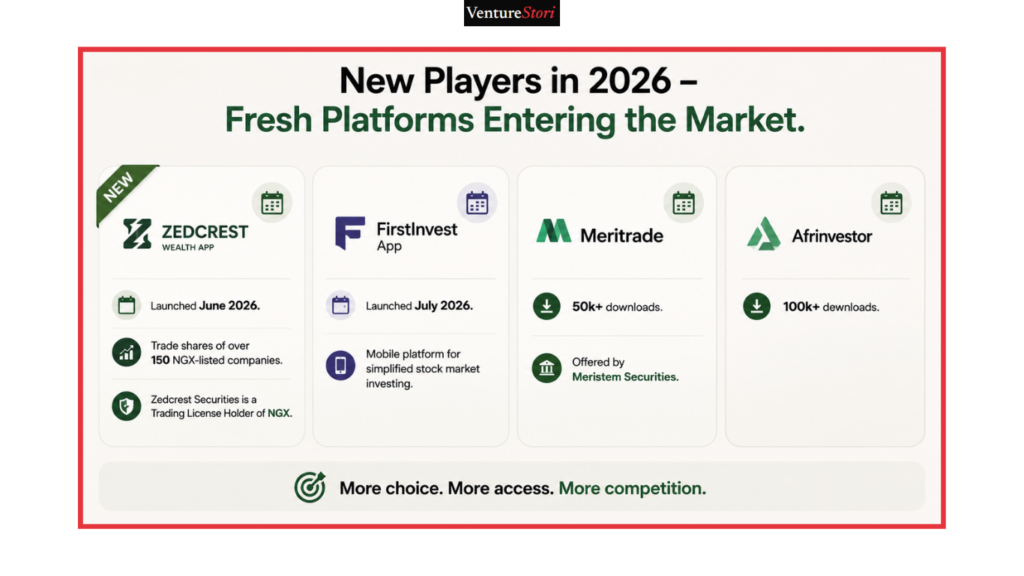
New Players in 2026 – Fresh Platforms Entering the Market.
Crypto Exchanges: Tread Carefully
Cryptocurrencies are now officially considered securities in Nigeria, and this means that crypto exchanges must register with the SEC and that banks are now allowed to do business with crypto exchanges, having previously been prohibited by the CBN in 2021. The CBN and SEC have worked together since December 2023 to ensure that banks only work with officially sanctioned virtual asset service providers and that both agencies cooperate with the EFCC to freeze illicit crypto wallets.
Peer-to-peer trading is common in Nigeria and will likely continue , but such transactions fall outside the protections offered by the combined CBN-SEC framework. What this means for the average Nigerian investor is that they should be wary of any crypto exchange that cannot demonstrate its SEC registration or participation in the aforementioned regulatory sandbox. Do not put your money on an exchange that only claims to be legal, or that operates exclusively through peer-to-peer trading.
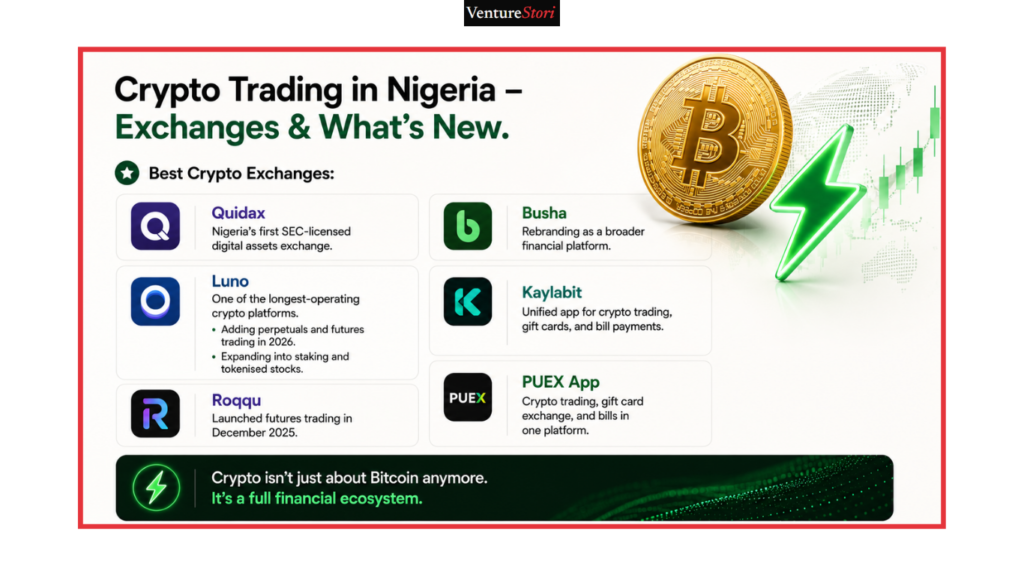
Crypto Trading in Nigeria – Exchanges & What’s New.
The Real Issues Beginners Run Into
Instead of focusing on that unverified UX failure rate figure, let’s look at the issues that are actually common for beginners to report about these apps. These are issues with KYC and identity verification that feel needlessly complicated, menus and options that make assumptions about the user’s knowledge of investing, and in-app guidance that explains how to make a trade, but not why one would want to make it. When looking at an investment platform as a beginner, look for guidance that does not try to overwhelm you, transparent disclosure of fees before making a deposit, and evidence that the customer support is actually reachable and helpful, rather than a generic email address.
What To Actually Check Before Depositing
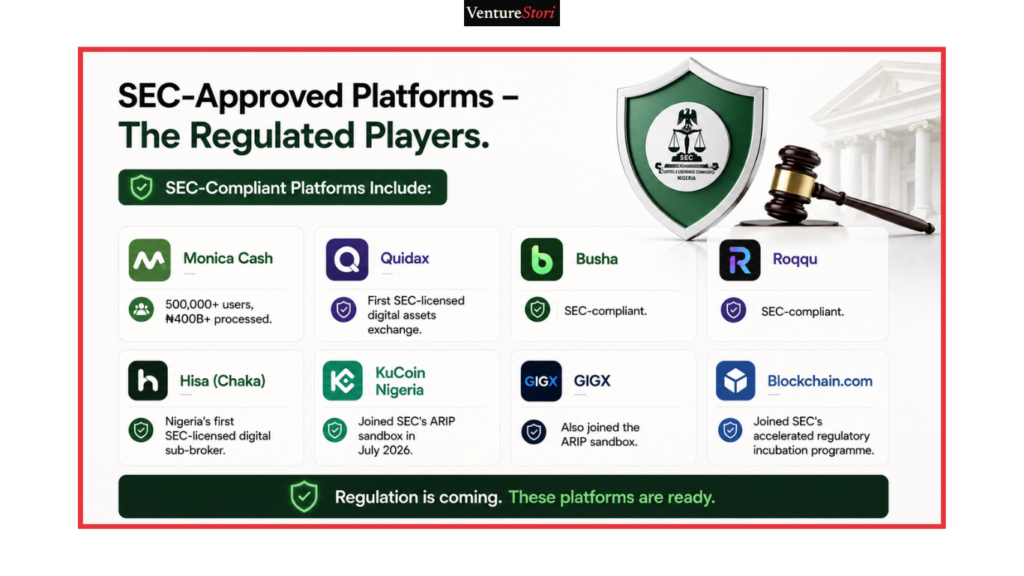
SEC-Approved Platforms – The Regulated Players.
Check the trading platform’s licensing against the CBN or SEC’s public database, rather than relying on anecdotal evidence or social media posts. Look for platforms that offer BVN-based identity verification, and the protections, if any, the platform offers for deposited funds.
Most importantly, understand the fee disclosure and any terms and conditions before depositing money with any platform. Our FTSE 100 guide for African investors contains information on portfolio diversification and sector concentration risk.
Verify a trading platform’s SEC or CBN registration status before depositing any funds. Start small to test real usability before committing meaningful capital.
Always match your trading platform choice to your actual financial goals rather than choosing based on whichever app has the most aggressive marketing.
Hands-off dollar diversification points toward Risevest; active self-directed picking across Nigerian and US markets points toward Trove or Bamboo. Ultimately, selecting the right trading platform comes down to balancing your risk appetite, asset preferences, and regulatory peace of mind.