The Delta Business Directory covers one of Nigeria’s most important oil-producing states, a region largely driven by two major cities. Warri built its reputation through the oil and gas industry. For nearly 50 years, it has hosted international oil companies, industrial operations, and a seaport, with port activity dating back to the colonial era.
Asaba, on the other hand, has experienced rapid economic growth in recent years, largely due to a real estate boom that accelerated after the opening of the Second Niger Bridge in 2023. With a population of approximately 5.6 million people, Delta State continues to play a central role in Nigeria’s economy.
Delta As a Business State
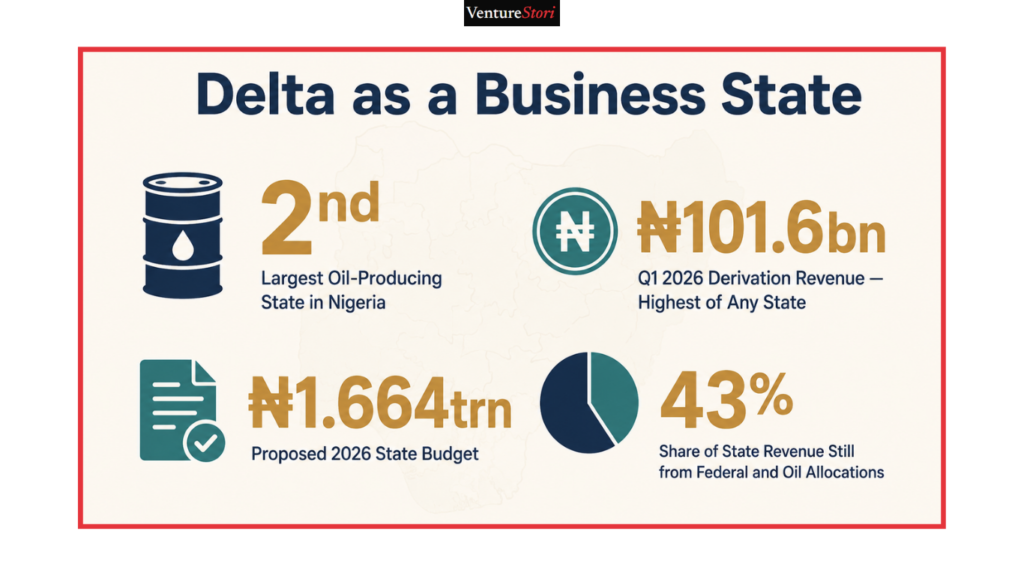
A Delta Business Directory provides a crucial starting point for evaluating commercial opportunities across one of Nigeria’s top energy and industrial hubs. As one of the largest oil-producing regions in the country, Delta State receives a 13% derivation fund under Nigeria’s revenue-sharing framework for resource-rich states. In the first quarter of 2026, Delta received ₦101.6 billion—the highest derivation payout among all oil-producing states during that period.
However, these fiscal allocation figures reflect natural resource revenues rather than overall enterprise performance, meaning high state receipts do not automatically translate to thriving local business operations.
When exploring enterprise listings on a Delta Business Directory, it becomes clear that the state functions through two distinct commercial anchors. Warri serves as the industrial and energy engine, housing oilfield services, maritime infrastructure, and heavy industrial facilities with roots extending to the colonial era.
Conversely, Asaba operates as the administrative and real estate hub, home to state ministries, the House of Assembly, and a property market that has accelerated significantly since the commissioning of the Second Niger Bridge. Viewing Asaba strictly as an administrative capital overlooks its growing role as a commercial gateway to eastern trade corridors.
To support long-term growth across the Delta Business Directory, Governor Sheriff Oborevwori proposed a ₦1.664 trillion budget for 2026, allocating 70% toward capital projects including road networks, healthcare infrastructure, and public works. Speaking at the Economic and Investment Summit in Asaba, Secretary to the State Government Kingsley Emu emphasized the rising importance of non-oil sectors like agriculture and corporate services.
Specifically, the administration highlighted state-backed support for cassava value-chain expansion and commercial aquaculture—a strategy aimed at broadening the state’s economic base, though its long-term impact on local enterprise development remains to be fully measured. Despite these diversification efforts, public finances remain tightly tied to crude production, with federal allocations and oil derivation funds still accounting for approximately 43% of total state revenue.
The Active Sectors
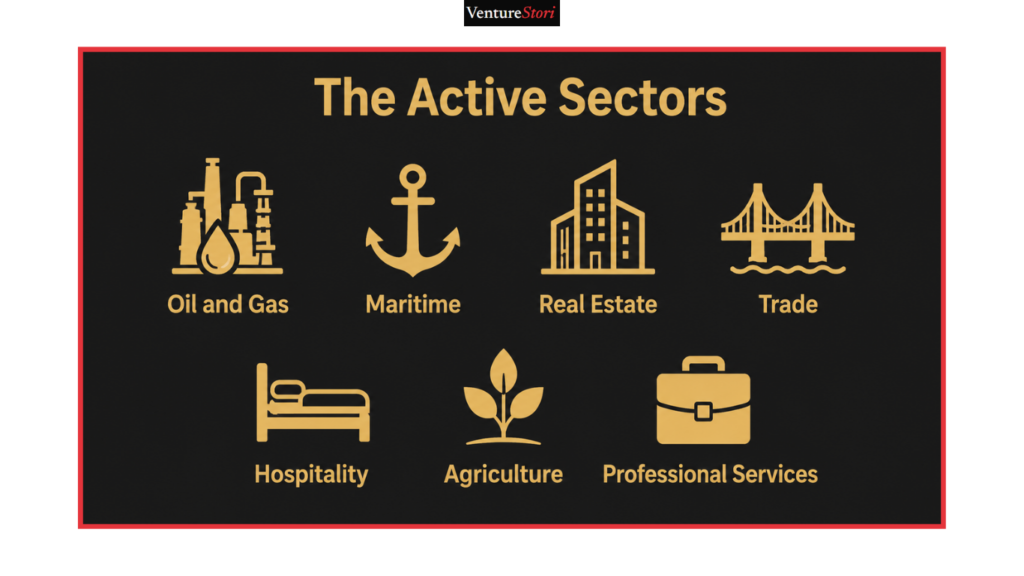
Oil and Gas
The Warri refining and petrochemical company (WRPC) can refine up to 125,000 barrels of crude oil per day at full capacity. The refinery struggled for years and produced almost nothing until it was reopened in December 2024 by NNPC. Not long after, it shut down again due to a safety problem in the crude distillation unit’s main heater. Almost $900 million has already been spent on it to get it to a proper working condition.
Two Chinese companies, Sanjiang Chemicals and New Future Group, were brought in by NNPC in June 2026 to run a technical assessment on what it would take to restore full operations. This process could take another two years.
In 2026, Nigeria continued to produce between 1.5 and 1.8 million barrels a day, below what the federal government expects to be produced. Globally, the demand for oil is getting slower than it was before due to the rising increase in renewable energy. For this reason, Delta can’t rely on just extracting and selling oil. The state’s success relies on both the production of crude oil and the refining of the oil into higher products like petrol.
Maritime and Port Activity
Warri has a seaport with the potential to reduce congestion at the Lagos ports. It is geographically positioned between Lagos and Onne. It holds a Free Zone status. The opportunity is real, but there are infrastructural problems that prevent it from being maximally used. For ships to use the ports, the water has to be deep, but the channel has become shallower without regular dredging. It has been reduced from 7 meters to 3 meters, making it difficult for large ships to pass through.
The Nigerian Ports Authority (NPA) had added the Warri Port as part of its plan for 2026 to reduce the traffic at Lagos Port. The idea is to spread cargoes across various ports in the country instead of them being concentrated at the Lagos port. The government has announced this including dredging the channel. For now these are just promises. The Wari port can’t carry out the role it’s meant for until the dredging is done.
Real Estate and Construction
After the second Niger bridge was reopened in 2023, transportation between Onitsha and Asaba became faster and easier. For those working in Onitsha and living in Asaba, it became easier to commute to work.
Because of the reopening of the bridge, the property market has expanded. Most people who work in Onitsha rent in Asaba because it is less expensive and quieter. Property developers have concentrated on Ibusa, Okpanam, and the areas near the second bridge. Projects like Ebeonadj Luxury City and Oxford Heights Estate are examples of estates promoted in these areas. Most of the sales here are for just lands instead of completed buildings, which matters when assessing how far the boom has built out
Trade and Cross-River Commerce
Asaba has a lot of businesses, but it still depends on Onitsha. Many of the traders who trade in Onitsha live in Asaba because it’s quiet and more secure. They pass through the Niger Bridge to get to their point of sale. This makes Asaba a residential and logistics beneficiary of the Onitsha economy rather than an independent trading center in its own right.
Hospitality and Tourism
Hotels in Warri rely on the oil and gas industry for customers, and the majority of the guests are oil contractors and international oil company staff who come to Warri temporarily for work. If the oil company in Warri reduces its activities, fewer workers will come to Warri, reducing the occupancy of the hotel. Hotels in Asaba, on the other hand, rely on government meetings, weddings, and social events to attract customers. One city’s hospitality sector rises and falls with the prices of crude oil, while the other follows the state’s schedule.
Agriculture and Agribusiness
Delta has a strong agricultural sector with a lot of active fish farmers. It produces large amounts of cassava and palm products. However, Delta still lacks enough cold storage, feed production, and processing facilities that would allow these farmers to store, preserve, and sell their produce on a larger scale. This aspect limits the farmers. Since there is no means of preservation, products spoil quickly and can’t be processed into higher-value products. Delta’s agricultural industry is expanding, but the infrastructure needed to sustain this expansion is lacking.
Professional Services
The professional services sector in Delta State includes businesses like law firms, consulting companies, and accounting firms. Like many other industries, these businesses in the state are divided between Warri and Asaba based on the client they serve. This shows the broader structure of the Delta’s economy, where Warri is driven by oil and Asaba is driven by government activities and property development
The Business Districts and Key Areas
Warri and Effurun
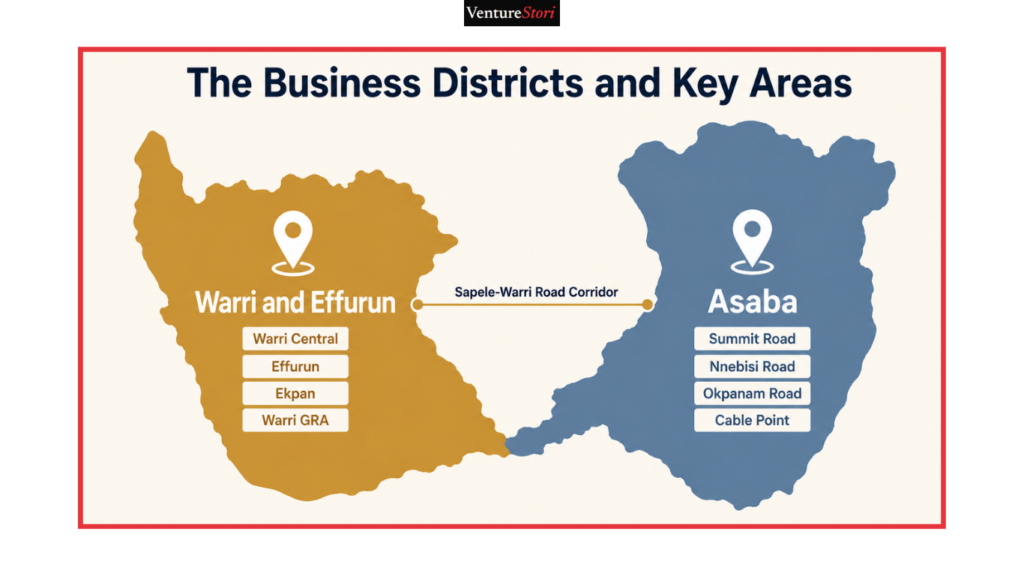
Warri Central is a historical commercial center in Warri. Long before oil discovery, the Itsekiri, Ijaw and Urhobo merchants used this as their trading center. Today, it is the address of choice for companies that want a strong Warri identity without operating from
Effurun, the headquarters of Uvwie LGA, functions as the state’s actual industrial floor, where most industrial activities take place. It hosts the Warri Refining and Petrochemical company. It is also the closest town to the Delta steel complex at Ovwian Aladja.
Ekpan, located along Refinery Road, has become the default location for oil services offices, contractor yards and the hotels that serve the rotating IOC staff.
Warri GRA is mainly a residential and professional services enclave. Postal data shows that most of the residents here are oil and gas professionals.
Asaba
The summit road is the administrative enclave. It houses the house of assembly. Most businesses that reside in this area are businesses that work closely with the government. The Nnebisi road carries the commercial weight. It is home to the largest market in Delta State, the Ogbe-Ogonogo market.Traders from Onitsha market also visit this market especially on market days. Okpanam Road has become the land banking corridor.
The plots near the airports have reportedly appreciated by as much as 60% annually. This increase reflects a speculative land value not built commercial stock. The waterfront around Cable Point and the Niger Bridge Head has shifted from a transport route into a leisure hub. Instead of relying on passing traffic, restaurants and lounges now attract customers with their scenic river views.
Delta State has two economic centers. Warri and Effurun is built around oil production, refining, heavy industry and oil services while Asaba is built around government proximity and cross-river arbitrage.
Delta State’s Investment and Development Activity
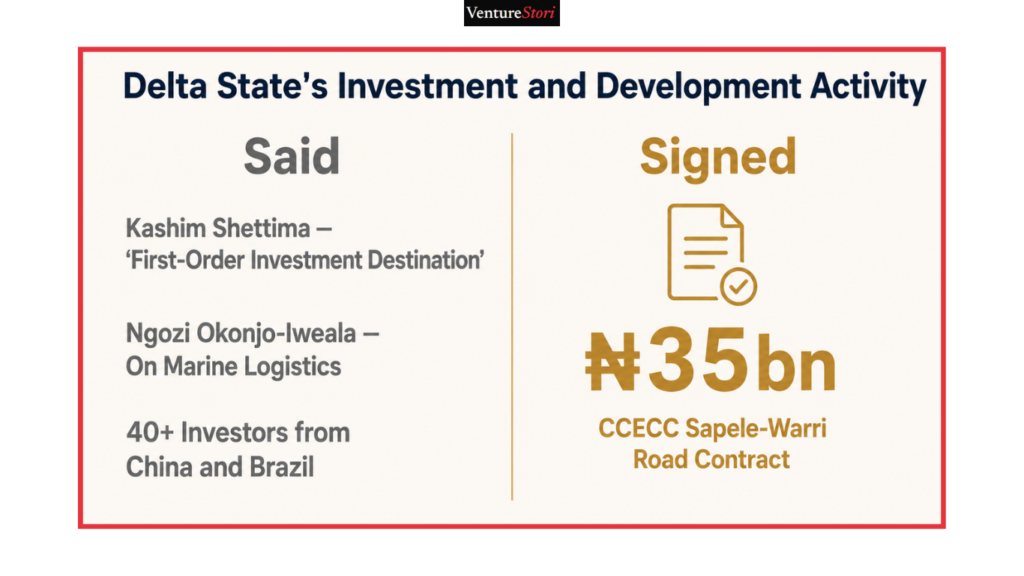
The August 2026 Economic and Investment Summit, a three-day summit in Asaba, attracted several high profile guests like Vice President Kashim Shettima who described Delta as a “first-order investment destination“; WTO Director-General Ngozi Okonjo-Iweala who encouraged the state to invest more in marine logistics and ship repair capacity.
More than 40 prospective investors, including delegates from China and Brazil, as well as development finance institutions, were in attendance. During this event, Delta State presented several investment opportunities for agriculture, mining, and other economic marine activities like shipping, fishing, and ports.
Most investment summits generate exciting announcements, but the actual investments usually come later. One of these was the award of a 35 billion naira contract to CCECC to construct the Sapele-Warri road. Even though this project is not directly connected to Asaba, it improves transport between the hinterland and Warri port.
On the federal side, the Nigerian Upstream Petroleum Regulatory Commission projects that Nigeria could attract $30-50 billion in offshore gas and oil investment. Many residents in Delta see this as a state-specific opportunity, though the state’s actual share isn’t yet defined.
Delta State’s startup ecosystem is an important indicator of its diversification. In 2025, startups in Delta raised only $34,964 in funding. Early investors like Ocean Ridge Limited and Delta Startups Limited provided funding, but most investments were around $30,000, which shows the startup ecosystem is still at a very early stage.
The government is investing 1.664 trillion naira, with 70% allocated to capital projects, against a startup ecosystem that attracted a private investment of $34,964 in 2025. This is the gap between government ambition and private capital formation.
Delta diversification is funded on paper and not yet by the market. Until larger private investments follow, diversification will remain more of a government initiative than a market-driven transformation
Who is Building Here?
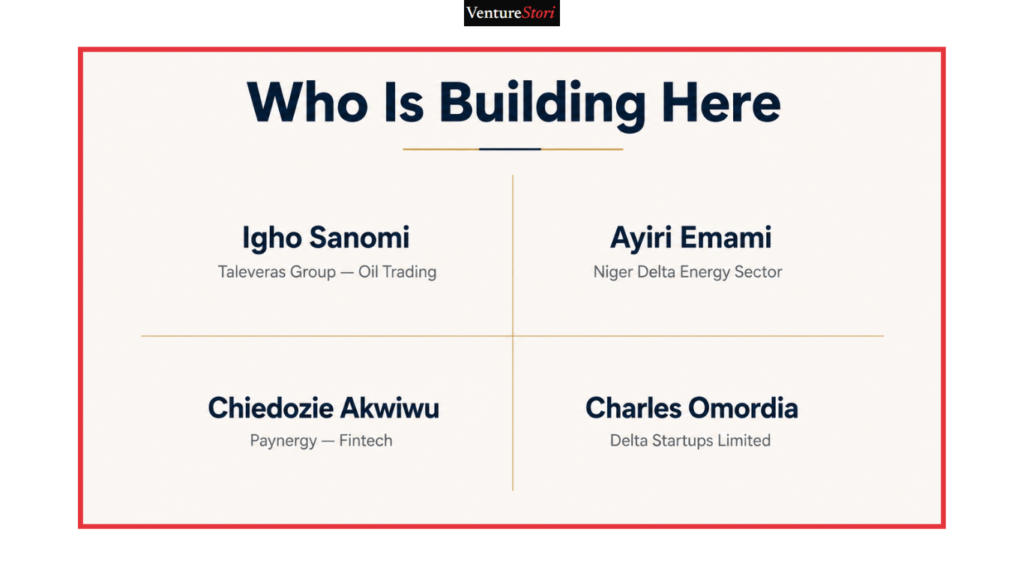
Igho Sanomi, born in Agbor, Delta State, didn’t originally plan to work in oil trading but eventually built Taleveras Group into one of Nigeria’s well-known crude oil and petroleum product trading company. He ventured into a business that required the understanding of Lagos boardrooms and the reality involved in moving fuel through Delta. Igho Sanomi’s story reflects a common pattern among the wealthy elite entrepreneurs: a lot of their wealth stems from upstream and midstream parts of the oil industry rather than operating downstream in Delta states.
Ayiri Emami’s story runs closer to the ground. He’s from Ugorodo, in Warri South-West, an oil-producing country in the most literal sense. He spent his career inside the Niger Delta energy sector rather than commenting on it from outside. That distinction matters in a region where plenty of executives claim Delta roots without ever operating there.
Then there’s Chiedozie Akwiwu, who grew up in Warri. He is the co-founder of Payenergy, an online energy bill payment platform. He co-founded this company after building an early career in agribusiness and construction. Instead of the oil route, he took a different route—fintech. His path is the exception the sector needs more of.
Delta Startups Limited is an organization based in Asaba and run by CEO Charles Omordia. The organization is designed to help other businesses grow. It invests approximately $30,000 in early-stage founders. The objective is to establish Delta as “Africa’s next innovation and investment frontier” upon its launch in 2025.
Delta’s Listing Directory
The following listings are paid placements from businesses operating in Delta State. Venture Stori’s editorial content above is independent of this directory.
Listing format
Business name
Category
One-line description
Contact details
Website, location within Delta (specify Warri, Asaba, Effurun, or other).
Coastal Infrastructure & Energy Hub
Explore Infrastructure & Enterprise in Akwa Ibom
From Ibom Air’s regional aviation expansion to multi-billion dollar free trade zones and agricultural investments, discover verified company listings and active business sectors across Uyo and Akwa Ibom State. Access the Akwa Ibom Business Directory →