The Katsina State Business Directory serves as the vital entry point into one of Nigeria’s agricultural powerhouses, defined by vast arable land, historical cotton and groundnut production, and historic trade routes extending north into Niger Republic. While the historic textile mills and state-sponsored groundnut processing centers of earlier decades have largely phased out, primary agricultural production remains a massive economic driver with vast untapped potential for industrialization.
Whether you are consulting the Katsina State Business Directory to locate active commercial enterprises or evaluating verified company listings for supply chain partnerships and regional expansion, understanding Katsina’s evolving market dynamics is essential for strategic investment.
Katsina as a Business State
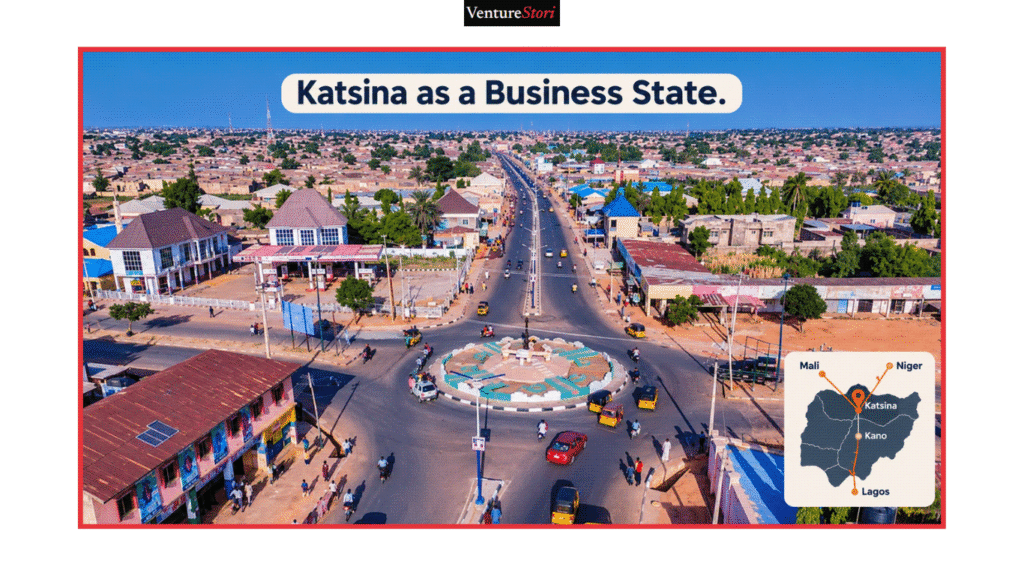
Katsina State, with an estimated population of over nine million people, continues to be a major commercial center in northern Nigeria and Sub-Saharan Africa. Geographically, the state is located on the coast, with old and modern transportation routes connecting West African ports and cities in Nigeria’s middle belt, as well as landlocked markets in the Sahel to the north.
Katsina was once the agricultural “crown jewel” of Nigeria’s export economy in the mid-twentieth century. The renowned groundnut pyramids were an integral part of the commerce in northern Nigeria, mainly from the fertile plains of Katsina, Funtua, and other districts. The cotton sector also provided raw material for the textile industry in the major centers in Kaduna and Kano and even in Katsina itself.
These massive processing centers have decayed over the last 40 years due to shifting world trade policies, the decline of domestic industry, lack of infrastructure, and changes in national revenues flowing from the petroleum industry. The large groundnut pyramids ceased to exist. and ginneries reduced their activities or even shut down completely. The agricultural base eventually split up into a large network of smallholder farmers and informal trading systems. The critical challenge today is to transition from a raw-material-based economy to a modernized one that adds value and is an agro-industry powerhouse.
Security Context and Rural Commercial Impact
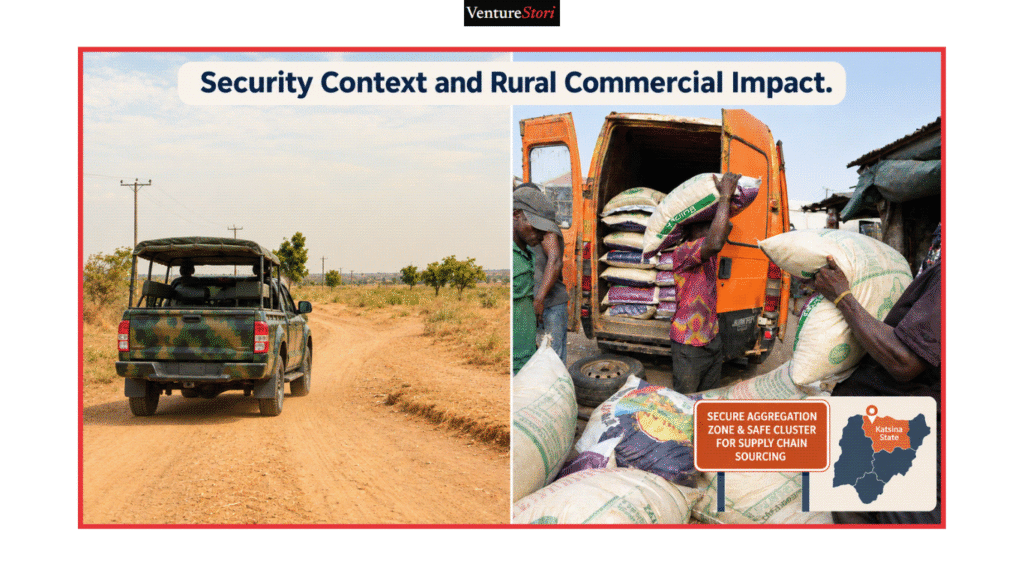
No honest, intelligent assessment of Katsina’s commercial environment can be made without a frank and open examination of security issues that have impacted some parts of the state in recent years. The operational challenges are a reality of rural bandits, cattle rustling, and occasional security breaches in rural agrarian communities and in some border districts bordering the Rugu forest expanse and neighboring states.
Occasionally, smallholder farmers in affected local government areas have been denied access to farmland in remote areas, displaced and disrupted by challenges to their market day in the rural areas. This has affected the potential yield of crops in localized areas and supply chain managers’ decisions for sourcing, which may be increasingly centralized on aggregation centers or safe clusters of farms.
On the other hand, one must not forget that these risks are not to be generalized. Katsina City, Funtua, and Daura are still active, resilient, and secure commercial centers. Such trade continues to be active each day in these cities.
The Active Sectors
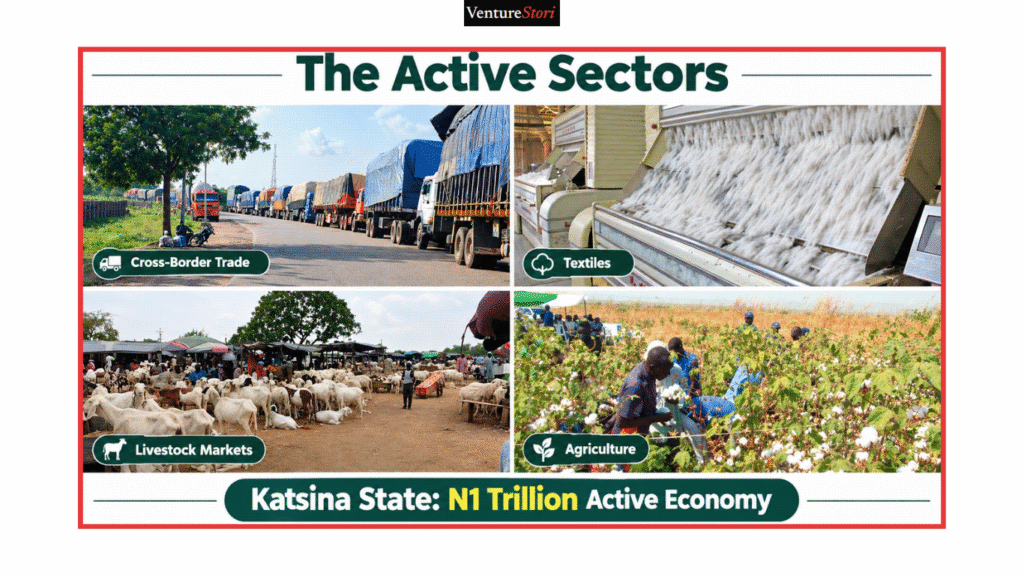
Agriculture and Agro-Processing
Agriculture continues to hold sway and is the mainstay of the Katsina State economy. it provides jobs for more than seventy percent of the working population. The state of Katsina is one of the leading producing states of Nigeria for millet, sorghum, cowpeas, maize, groundnuts, sesame seeds, and cotton. In the wet season, huge tracts of land in the state are used for rain-fed grain and legume crops. dry season farming is actively carried out along the river basins and irrigation schemes (e.g., the Zobe and Sabke dam areas) of the state, with high yields of tomatoes, onions, peppers, and wheat.
Cross-Border Trade
The strategic position of Katsina City, near the Niger Republic, puts it in a position of advantage in economic activities across the Economic Community of West African States (ECOWAS) region. Jibia, Mai’Adua and Kongolam are border posts that are significant gateways for millions of dollars worth of formal and informal trade annually.
There are various mechanisms of this cross-border trade. To the north, commercial centers in Katsina in Nigeria receive manufactured consumer goods, processed foodstuffs, building materials, agricultural inputs and refined petroleum products from Nigeria and then continue north through Niger to other Sahelian markets.
Textiles Manufacturing
Despite its diminished capacity, Katsina’s historical textile milling industry continues. In the old times, cotton ginning and textile manufacturing were the hallmark of towns such as Funtua where raw cotton was sourced from farmers and manufactured for the industries.
In modern times, large-scale integrated manufacturing of textiles has decreased while light manufacturing is still being carried out in niche segments. Cotton ginning enterprises are still in operation, providing raw lint to the domestic market and to export markets.
Leather, Hides and Skins
Katsina is a key player in the hide and skins industry. The state has a large livestock herd, with influx of cattle, goats, and sheep from neighboring territories.
Apart from commercial hide aggregators who purchase raw hides from the abattoir and rural markets, the other tanneries and artisanal leather craftspeople are based locally. They are either processed locally or graded at big tanning centers in Kano and Sokoto and sent to international luxury leather supply chains in Europe and Asia.
Livestock Trading and Pastoral Commerce
Livestock trading is one of the important livelihood activities in the rural and peri-urban areas of Katsina. Specific days are set aside for specific people to attend dedicated livestock markets on a weekly basis in areas throughout the state, with people coming from all over West Africa to sell and buy livestock products. Thousands of cattle, sheep and goats are sold every week to meet the demand for meat in the big towns in the South of Nigeria, such as Lagos, Ibadan, and Port Harcourt.
Financial Services
Katsina has a well-developed financial services sector with its focus in Katsina City and Funtua, which caters to the agricultural and trading economy, whose total market value is in excess of N1 trillion. The major commercial banks have established branches in the state capital to provide corporate banking, trade finance, treasury management, retail banking, and banking services to the public sector entities and the large traders of commodity and corporate sectors.
Apart from the traditional commercial banks, microfinance institutions, agricultural development funds and mobile money networks are becoming more and more important to access rural farmers and small traders.
Professional Services
The public sector and commercial and cross-border trading organizations are the major clientele of a growing professional services sector, largely located in Katsina City. Law firms, auditing firms, tax consultancies, and civil engineering advisory services encircle the state administrative core.
The state has a dual legal system: statute and Islamic law (Sharia), which often regulates domestic real estate transactions, inheritance matters, and commercial contracts between the traditional merchant families.
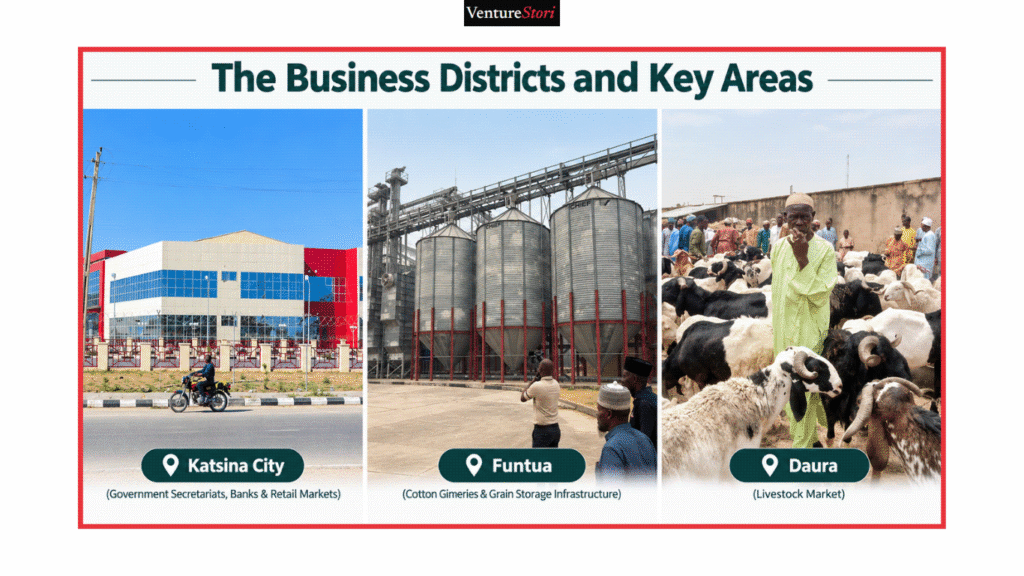
The Business Districts and Key Areas
Katsina City
Katsina City is the “home of formal businesses, corporate offices, institutional headquarters, and administrative, market, and political functions” and therefore harbors the highest density of these businesses, offices, and institutions in the state. It has a clearly differentiated functional geography in terms of its commercial zones:
City Centre and Administrative Core: This is the area where the state government secretariat, the federal ministries, and the regional headquarters of the important commercial banks are located, as well as the most prestigious professional service companies. Business and government decision-making and institutional formal trade are concentrated here.
Centennial City: The oldest and central part of the retail and light wholesale trade. This is a very dense commercial area with thousands of stores selling textiles, electronics, fast-moving consumer goods (FMCG), pharmaceuticals and housewares.
Kofar Sauri & Kofar Kaura Districts: They are existing commercial districts, which are located at the main arterial entry points to the city, to facilitate heavy trading and logistics. Kofar Sauri is famous for its grain aggregation, building materials distribution, and agricultural input supply for the whole country.
Funtua
Funtua is located in the southern part of the state, which is the agricultural belt of the state, and is also known and recognized historically and commercially as the main industrial and agricultural processing center of the state, Katsina. It is naturally situated at the intersection of roads that connect to Kaduna, Kano, and Zamfara, making it a regional trade gateway.
Daura
Daura has a unique commercial identity due to its historic cultural background and its proximity to the border of the Niger Republic in the far north of the state. It acts as a principal economic engine of the northernmost local government areas.
Cross-border trade logistics, livestock trade, and border transportation are the key elements of Daura’s trade business.
Investment and Development Activity
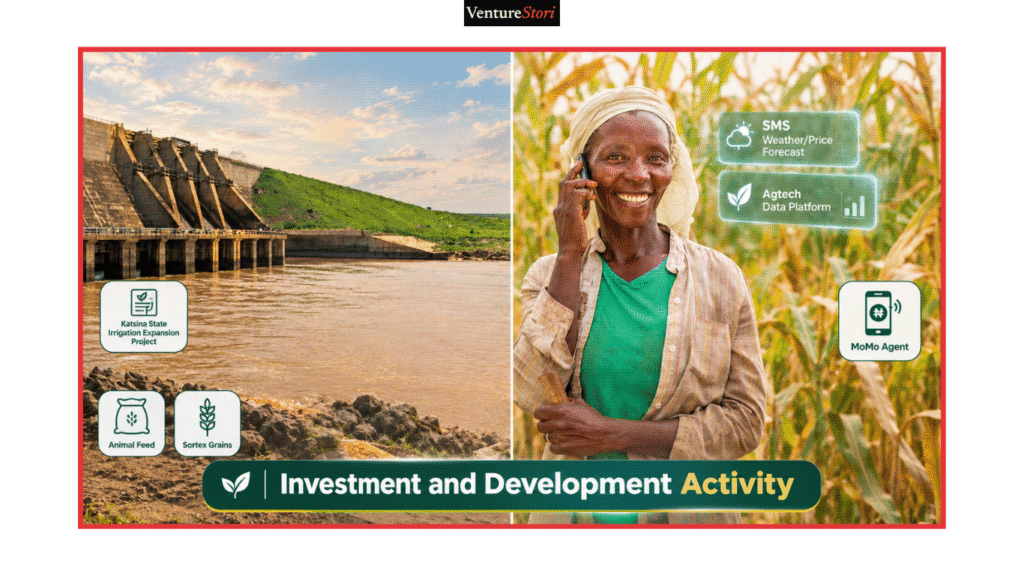
In 2026, targeted public sector policy initiatives, private sector agro-industrial initiatives, and international development finance programs for unlocking the enormous rural economy of the State drive investment and economic development activity in Katsina State.
State Government Investment Promotion: The Katsina State Government has established investment promotion policies to bring foreign capital into the identified key sectors. One of the key priorities is the rehabilitation and extension of the government-owned irrigation infrastructure in general, with priority given to the Zobe dam basin and the Sabke and Ajiwa dam basins.
Private Sector Agro-Industrial Investment: In 2026, medium-scale agro-processing and the integration of renewable energy will be the primary areas of private capital flow. In southern and central Katsina, the country has seen an increase in commercial animal feed mills, modern grain cleaning and color sorting facilities, and comparatively large investments in vegetable oil pressing machines.
Development Finance and Multilateral Programs: International development finance institutions and non-governmental organizations continue to be active in Katsina, focusing their investments on financial inclusion for smallholder farmers and strengthening financial value chains and smallholder livelihoods
Startup and Tech Ecosystem Activity: Technology start-ups with venture capital funding are relatively sparse in Katsina City, but there’s a newfound cluster of technology-driven businesses. These are early-stage companies mostly engaged in agtech solutions like SMS-based weather and price forecasting platforms for farmers in rural areas, digital grain aggregation platforms, and agency-banking distribution networks to deliver basic financial services to unbanked farmers in rural areas.
Who Is Building Here?
Funtua Bottling & Processing Enterprise: The Funtua Bottling & Processing Enterprise is an established industrial anchor in the southern part of Katsina State, which is involved in large-scale agricultural commodity aggregation, grain processing, and distribution at the regional level, thus playing a pivotal role in linking smallholder farmers and large-scale food manufacturers in the region of Katsina State, Nigeria.
Dahiru Mangal Group: It is one of the most significant industrial conglomerates of the North of Nigeria from Katsina. The group continues to have significant commercial interests in aviation, cement manufacturing, bulk petroleum distribution and logistics, and is a significant driver of investment in infrastructure and jobs in the state.
Katsina Green Produce Cooperative Union: A progressive group of local farmers and agricultural entrepreneurs experimenting with new methods of drip irrigation during the dry season, seed multiplication projects and set up off-take agreements as a way to provide food markets in large cities in Nigeria. To evaluate surrounding commercial markets and trade hubs across North-Central Nigeria, access the complete Kwara State Business Directory.
Katsina Business Directory
The following listings are paid placements from businesses operating in Katsina State. Venture Stori editorial content above is independent of this directory.
(Directory entries are added via verified commercial placements. Contact the Venture Stori directory desk to register your enterprise.)