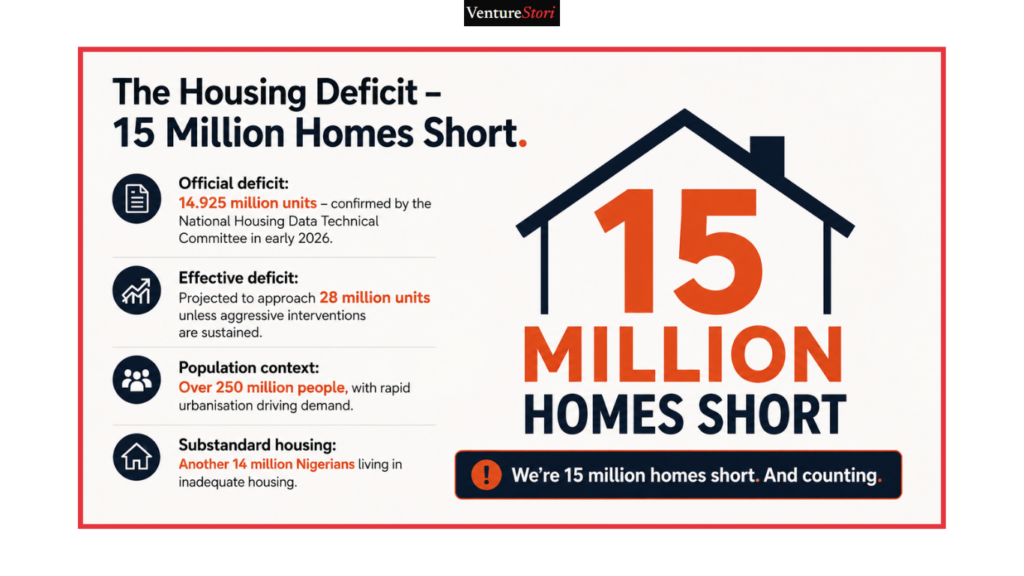
Investing in real estate in Nigeria is expected to add $2.42 trillion to the national economy and become the third-largest contributor to GDP within the next few years. However, these figures conceal a severe crisis in affordable housing: a shortage of nearly 28 million units and rental inflation that has tripled housing costs in less than four years.
Successfully navigating real estate in Nigeria in 2026 requires ambition and savvy market knowledge for developers, venture builders, and institutional investors. Let us unpack the human side of the shortfall, macroeconomic returns, the ballooning cost of development, and how technology and regulatory change are reshaping the asset class.
The Human Toll of Nigeria’s Housing Shortage
Currently, examining the current state of real estate in Nigeria, Nigeria has a housing unit shortage of more than 28 million. The country needs at least 550,000 new housing units per year, according to urban planners, to remedy this deficit. But in both the public and the private sector, fewer than 100,000 units are delivered per year, so the deficit continues to rise.
The Price of a Home – 751% Land Surge & ₦1.1B Mansions.
The Burden Of Rising Urban Rents
In prominent business districts like Lagos, middle-income families usually spend 60% to 70% of their after-tax income on rent. While a typical two-bedroom apartment in mid-market mainland locations such as Yaba or Surulere now costs ₦1,400,000 per annum, a similar property on the Island can comfortably fetch ₦10,000,000 annually, far outpacing any local wage increments. Consequently, it remains nearly impossible for the average wage earner participating in real estate in Nigeria to build up the necessary equity to purchase a home.
Financial Hurdles for Returning Nigerians
Dollar or pound savers returning home frequently discover that traditional commercial banks offer no viable mortgage products for diaspora buyers, or that the available options are prohibitively expensive with interest rates ranging from 28% to 32%. Because traditional financing is out of reach, buyers active in real estate in Nigeria are typically forced into rigid multi-year developer payment plans or compelled to purchase land outright in fast-growing fringe locations.
Barriers to Housing Development
Discrepancies in land tenure under the Land Use Act, prohibitive construction finance rates, spiraling material input costs, and lower-margin projects make it financially difficult for formal real estate developers to build middle-income or “affordable” housing. Learn more about How to Get Business Funding in Nigeria.
Real Estate in Nigeria: 2026 Market Intelligence and Investment Yields
Despite ongoing macroeconomic headwinds, real estate in Nigeria continues to serve as one of the primary vehicles for hedging against inflation and currency volatility in West Africa. The property sector accounts for about 13.4% of the country’s Gross Domestic Product (GDP), while the total value of the residential real estate in Nigeria market exceeds ₦58.16 trillion, according to data from the National Bureau of Statistics (NBS) and sector intelligence companies. This soaring demand curve is heavily driven by massive rural-urban migration.
Estimates for Lagos alone show 475,000 new residents arriving per year, with the city population constantly expanding across all housing sectors.
Rental yields in prime locations clearly illustrate where capital is working efficiently within real estate in Nigeria. For example, luxury three-bedroom apartments in Ikoyi are expected to generate rent between ₦15 million and ₦45 million, averaging ₦35 million in 2026 compared to ₦15 million in 2022. Victoria Island commercial and residential spaces maintain a yield range of 7% to 8.5%, with rents climbing to ₦28 million. Average rents for Lekki Phase 1 studio and one-bedroom units increased from ₦2.5 million in 2022 to ₦7.5 million in 2026, delivering some of the highest returns between 9.0% and 11.5%.
For executive duplexes, the yield ranges from 5.5% to 7.2%, with rents spanning ₦18 million to ₦38 million in Abuja’s Maitama and Asokoro neighborhoods, respectively. In Jabi and Utako, two-bedroom units offer a yield of 7.5% to 9.0%, with rents averaging ₦8.5 million.
This structural shift in rental prices highlights how high interest rates and steep construction costs are pushing retail buyers of real estate in Nigeria to redirect their demand straight into the high-yield tenant market.
The increasing costs of building materials and infrastructure development are the major impediment to supply responding to demand. In a world of historically low developer margins, inflationary pressures, foreign exchange fluctuations affecting imported finishes, and energy costs are all to blame. For more investment insights, see Trading Platforms in Nigeria 2026.
The price of cement (50kg) has risen from ₦6,000 to between ₦12,500 and ₦15,000, a change of more than 110% in 2 years. The price of steel rods has increased by more than 210% from the major steel supply nodes during the same period. The budget for the overall building project has increased by 50% – 100% in all prime developments.
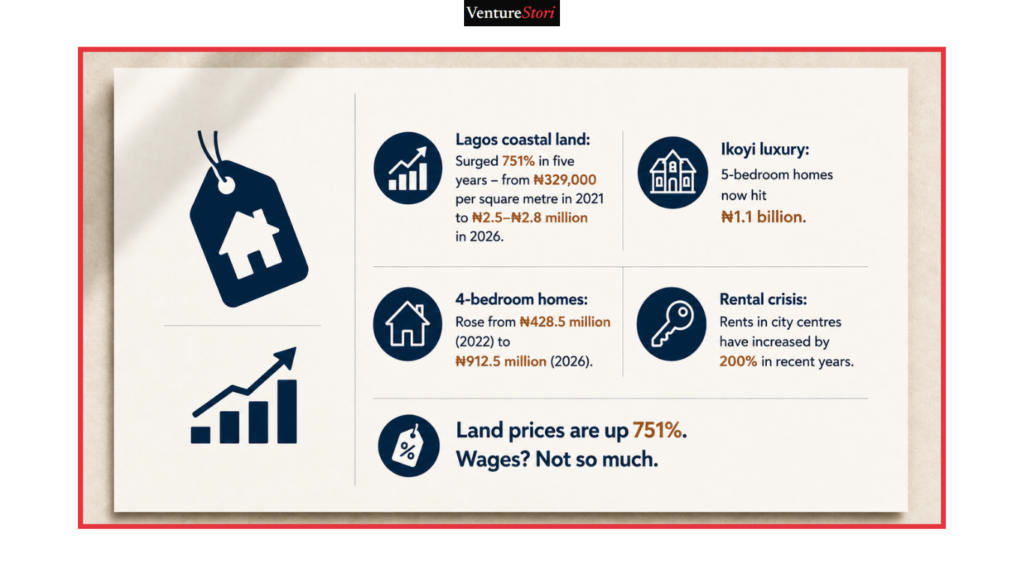
The Price of a Home – 751% Land Surge & ₦1.1B Mansions.
Regional Growth Hubs: Tracking Capital Flows
Investment rationale for real estate in Nigeria varies significantly based on the distinct economic drivers of individual regions and municipal governance:
Lagos Mainland: A Growing Frontier
While the majority of short-let yields and ultra-luxury developments remain concentrated on the islands of Lekki, Ikoyi, and Victoria Island, the mainland (including Ikeja, Yaba, Gbagada, and Maryland) has emerged as the premier growth market for long-term income assets within real estate in Nigeria. The high value of urban regeneration projects, expanding commercial hubs, and close proximity to infrastructure like the Blue and Red Rail lines combine to make mainland multi-family developments exceptionally profitable for savvy investors.
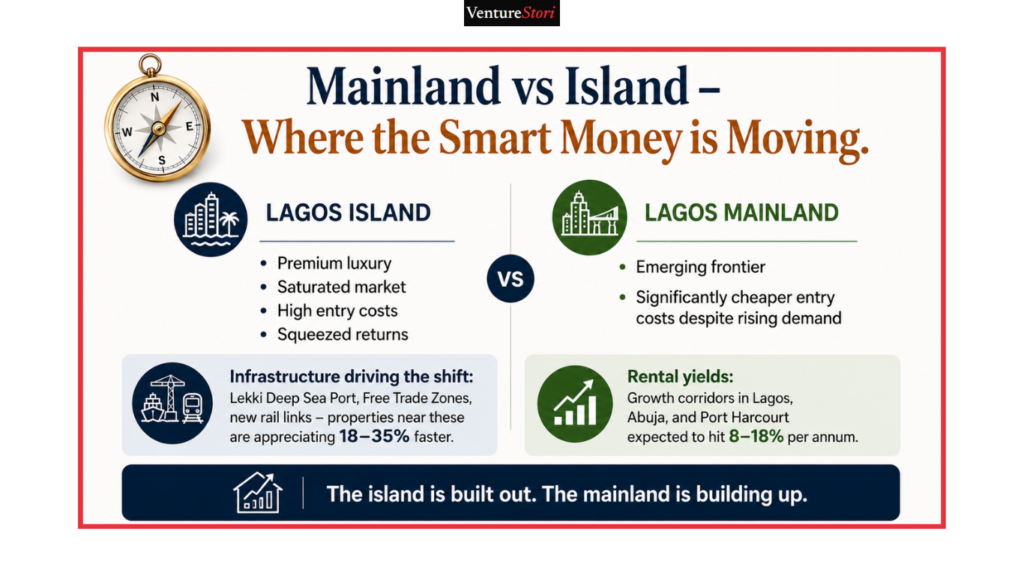
Mainland vs Island – Where the Smart Money Is Moving.
Abuja: Stability in the capital
The fundamentals in the property market are different in Abuja than in Lagos. Demand is concentrated, stable, and less susceptible to speculative peaks in prime districts in the Federal Capital Territory (FCT) such as Maitama, Asokoro, Guzape, and Wuse II, which are anchored by the headquarters of the civil service, diplomatic missions, and corporate regional offices. Cities relying on private developers’ money, such as emerging suburban districts such as Jahi, Katampe Extension, and Lugbe, are flourishing with private investment.
Regional Hubs: Growth Beyond the Metros
Examining regional property markets across real estate in Nigeria, the Port Harcourt market in the South-South continues to be closely linked to energy sector activities and industrial logistics.
While commercial infrastructure developments along Trans-Amadi and GRA Phase 2/3 have temporarily paused certain yield expectations, secondary cities like Ibadan, Abeokuta, and Enugu are experiencing a major surge in secondary urbanization. This regional expansion within real estate in Nigeria is largely driven by improved rail connectivity, urban modernization, and much lower market entry costs for investors seeking long-term value.
The Impact of Diaspora Investment
The diaspora community continues to serve as the largest capital pipeline for private residential purchases within real estate in Nigeria. Nonresident Nigerians heavily prefer tangible land investments, short-term leases held in managed properties across major cities, or off-plan developer setups. For these international investors, deploying capital into real estate in Nigeria remains a primary, trusted strategy to preserve and protect their wealth against currency depreciation.
Bridging the Mortgage Gap
Nigeria’s mortgage-to-GDP ratio is lower than 1%, whereas South Africa has a 31% and the United States more than a 77% mortgage-to-GDP ratio (Business Day).
Conventional mortgage financing is practically unavailable to more than 95% of the working population due to high interest rates offered by commercial banks and also high collateral requirements they impose. As a result, other methods of financing are used in the transaction layer:
Direct Equity & Cash Sinking Funds: Outright savings over a number of years, known as Direct Equity & Cash Sinking Funds.
Developer Payment Plans: Short-to-medium-term (12-36 months) structured payment plans with the developer off-balance sheet.
Informal & Cooperative Lending: Cooperative society’s loans, family pools, and micro-mortgage schemes.
Diaspora Remittance Inflows: Money transfer from abroad via trusted legal persons or close relatives.
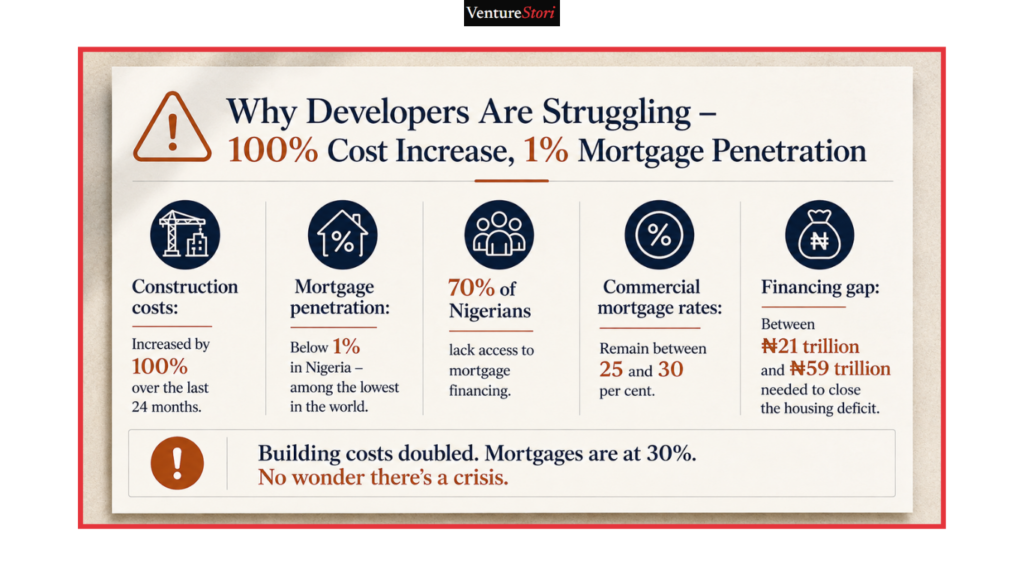
Why Developers Are Struggling – 100% Cost Increase, 1% Mortgage Penetration.
Proptech Innovation and Market Disruption
A new type of PropTech start-up is bringing the transaction ecosystem up-to-date due to the inherent conflicts of paper-based title searches, agency markups, and unverified broker networks (see Fintech in Nigeria 2026):
Crest App: A direct property marketplace, Crest removes the middleman, stopping predatory caution charges. It enables verified landlords and tenants to interact immediately, using organized, monitored escrow and listing processes.
Housevisory: A technology that uses algorithmic efficiency to power the property search, powered by an intelligent comparison engine, interactive map filtering and automated agent verification to enhance the residential search experience in Lagos and Abuja.
OgaRent: Emphasizes the linkage between tenants and landlords, providing flexible rent payment cycles and clear, direct communication channels between the two.
MyAgent: An added layer of trust verification to combat fraudulent fee collection and land scams by credentialing property managers and agents.
Regulatory Reform: Promises vs. Execution
The Ministry of Housing and Urban Development has proposed a series of radical changes to its policy and legal structure to clean up the chaotic property market and make real estate in Nigeria far more accountable to buyer capital:
- Mandatory Buyer Escrow Accounts: A proposed initiative that would mandate developers to deposit client funds into regulated escrow accounts, releasing money only upon achieving concrete construction milestones to prevent fund diversion between development stages.
- National Housing Regulatory Commission (NHRC): A centralized regulatory body designed to oversee developer adherence to the national building code and officially register professional practitioners across the entire landscape of real estate in Nigeria.
Compulsory Accreditation for Agents & Developers: State and federal laws requiring all estate managers, realtors and commercial building professionals to be accredited. Check out How to Start a Real Estate Agency in Nigeria.
National Housing Data Observatory: A central database that aims to establish a common system for land registration, price indexes and housing supply data for all 36 states.
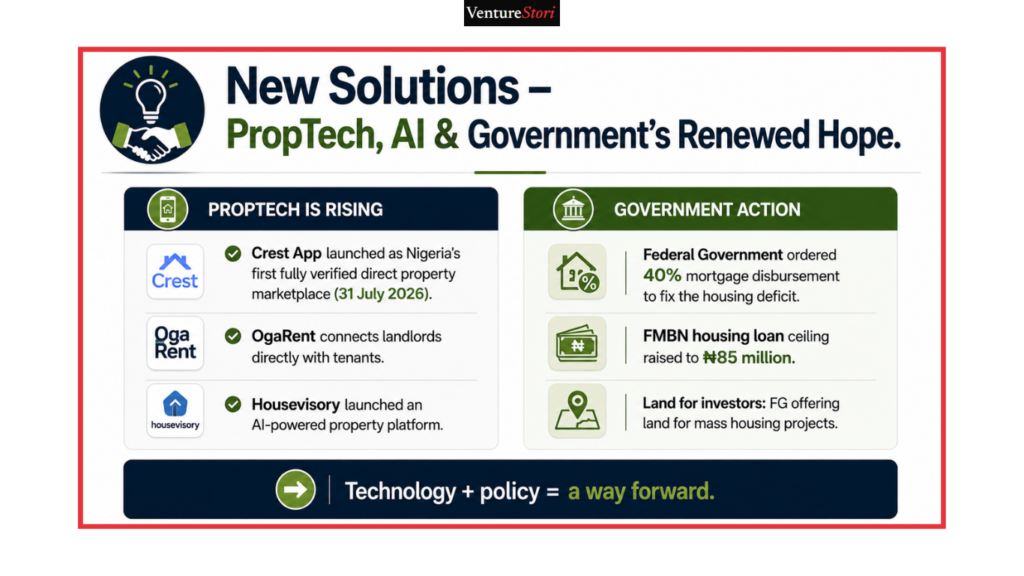
New Solutions – PropTech, AI & Government’s Renewed Hope.
These proposed changes are good steps towards maturity in the regulatory framework, but there is still a long way to go. The Land Use Act of 1978 still confers exclusive land ownership rights to the landowners, who are the state governors, while state-level land registries are yet to be fully digitized.
Investors and developers still need to do extensive legal due diligence prior to investing.
Investor Synthesis: Balancing Risk and Opportunity
To succeed in real estate in Nigeria, investors and developers must master the delicate balance between project-level execution risks and broader systemic challenges.
On the risk side, operators face rampant material inflation that can quickly erode project budgets, lingering land title discrepancies, and secondary market illiquidity that frequently pushes exit timelines out to 12 or 18 months for non-prime assets.
However, exceptional prospects remain available for developments featuring high occupancy rates along major transport corridors and technology-driven property management tailored to the growing demands of retail and trade sectors.
Ultimately, participating in real estate in Nigeria is no longer just about physical bricks and mortar. It is a sophisticated, evolving asset class that demands advanced investment strategies, operational capital efficiency, and proven technological integration to achieve sustainable long-term success.