Most guides on how to register a business in Nigeria entrepreneurs encounter present this information in a vague manner that hides crucial specifics telling you to “go to the CAC portal, fill forms, pay fees,” without giving exact figures for how much each step costs, how long processing takes, or the most common mistakes that cost first-timers thousands of naira and weeks of delays on their business registration.
This guide reflects actual costs based on the 2026 CAC fee schedule, an honest assessment of the time it would take to complete each step, and the most common mistakes made by first-time registrants.
Finding the Right Structure for Your Business
Before jumping into the actual step-by-step process of business registration, there is one critical thing to decide- which of the 3 structures you can register under is the best fit for your business model at this particular point in time.
Business Name registration is the cheapest and fastest option, which makes it perfect for startups and solo ventures. It has no separate legal complexity and is only suitable for proprietorships and partnerships—businesses that do not have a legal personality separate from their owners.
With it, the business is not able to own any property under its own name, make contracts in its own name, or have shareholders. A business name can be perfect for certain niche markets, such as small-scale trading activities, individual professional services (graphic design, massage therapy, consulting, etc.), and other similar businesses.
Private Limited Company registration, on the other hand, creates a separate legal entity for your business that is capable of owning property in its own name, making contracts and other obligations, and holding debts separately from its owners. This is required for all businesses looking to raise investment from external shareholders, have any business partners, and deal with larger-scale projects and government contracts.
Such a business structure, however, requires at least 1 director and 1 shareholder (can be the same person) to register.
Incorporated Trustees registration is the preferred structure for registering NGOs, churches, foundations, and other organizations, which fall under a completely different jurisdiction (Part F of the Companies and Allied Matters Act 2020).
It is significantly more expensive to register than the other two, which we will discuss in detail below.
A common beginner mistake here is to register a proprietorship because of its cheapness and simplicity, when in a year the founder realizes they need to raise investments or invite a business partner that would have to become a shareholder. In such cases, registering a Private Limited Company would be significantly cheaper and faster than re-registering the business with CAC later.
An example is a freelance graphic designer that starts their own business as a contractor with no employees or investments. Registering a proprietorship makes excellent sense due to its cheapness, ease of paperwork, and liability risks.
But for a tech startup of 3 people that plan to raise a pre-seed round in 12 months, registering a Private Limited Company makes much more sense. A proprietorship would have no shares to be distributed to an investor, no separate legal entity to sign contracts with said investor, and the founders would be held personally liable for the debts of the company.
A less common structure worth noting is a Public Limited Company, intended for organizations that plan to trade shares publicly or simply require such a status from the beginning. Almost no first-time registrant would ever have to use this, and it is better suited for subsequent re-registration, but it exists and is worth knowing about.
Understanding Registration Costs and Timelines
For all but the most exceptional cases, business registration takes place exclusively on the online portal (pre.cac.gov.ng). The CAC registration steps can be broken down as follows:
- Searching for a name availability. Do a preliminary search on the CAC portal to ensure that your desired name is available.
- Name reservation. It is then necessary to reserve your name with the appropriate cost, which is about ₦1,000 – ₦1,200 for an ordinary name and up to ₦5,000 if you want to use a restricted name or a name with a company suffix, indicating the status of a Limited Company.
- Completing the online registration form. Fill in the registration form on the website, indicating the personal data of the owner or owners of the enterprise. For a proprietorship, this includes personal information and the nature of the business. For a Private Limited Company, this includes the information of its director(s), shareholder(s), and the amount of authorized capital.
- Submitting scanned copies of the documents. With a proprietorship, you will need to provide documents that confirm your identity and a scan of your passport photo. With a Private Limited Company, in addition to the above, you will also have to submit the Memorandum and Articles of Association (the document that describes the objectives and internal policies of the company), and identification documents of the director(s) and shareholder(s).
- Paying the registration fee through the intercession of the online payment system. You will need to pay the actual registration fee for your chosen structure, which runs ₦20,000 for a Business Name or ₦30,000-40,000 for a Private Limited Company as detailed below, plus a smaller portal/transaction fee of about ₦161-₦322 on top.
- Downloading a digital copy of your certificate. Having completed all the above steps, you need to download the digital copy of the certificate through the same portal (no need to come to the CAC office).
For a proprietorship, it normally takes between 24 and 72 hours, whereas for a Private Limited Company, it takes between 2 and 5 working days. This applies when there are no errors or omissions in the application details. Any mistakes in the submitted application forms will necessitate the resubmission of the request on the CAC portal, which could be on the same day or after several days or weeks.
In most cases, applications in 2026 rarely take longer than the durations discussed above.
When applying for a Private Limited Company, it is worth preparing the Memorandum and Articles of Association in advance. This document must indicate exactly what you want your company to do, which means that it should be thoughtfully prepared so that the CAC does not return the application for revision.
How to Register a Business in Nigeria: Breaking Down the Real Costs
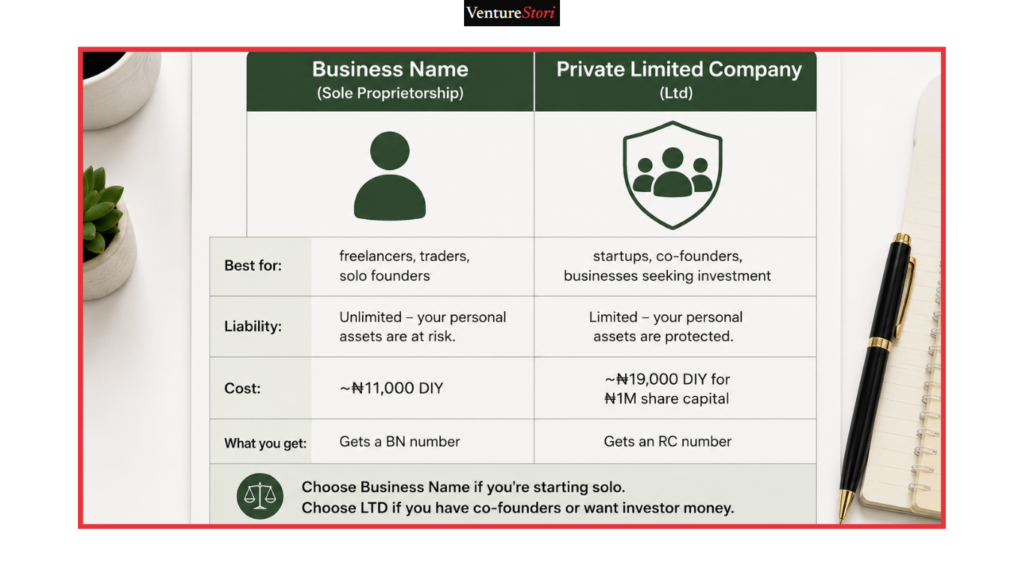
Here is where most other guides fail you with vague information—here is a listing of what the fees are realistically as of current time
Business name registration, total cost: Name reservation: ₦1000 – ₦1200 Registration fee: ₦20,000 (up from ₦10,000 as of 2025 per the 2025 gazette—so most guides that talk about a total of ₦11,000 are already behind the times) Portal/transaction fee: ₦161 – ₦322 Total realistic figure: ₦21,000 – ₦21,500.
Private Limited Company registration, ₦1,000,000 share capital bracket: Name reservation: ₦1,000 – ₦5,000 (higher amount applies to restricted or names with “limited”/”ltd”) CAC incorporation fee: ₦30,000 – ₦40,000 Stamp duty (FIRS): ₦8,500 for the ₦1,000,000 main bracket, 0.75% of every additional ₦1,000,000 Portal/transaction fee: ₦161 – ₦322 Total realistic figure for standard ₦1,000,000 share capital: ₦40,000 – ₦50,000 in direct government fees. Do not forget to budget in any professional assistance if desired.
Incorporated Trustees (NGO) registration: This is the option where people tend to underestimate the fees the most. While the direct CAC filing costs are about ₦50,000 – ₦60,000 (much lower than one may expect), Incorporated Trustees require two additional expenditures that other structures do not.
- advertisement of the notice of formation in at least two national newspapers (cost varies wildly, but the figure is about ₦50,000 – ₦100,000 or higher depending on the papers of choice) and often
- professional assistance with the trust constitution, as it is significantly more detailed and specific than a standard Memorandum and Articles of Association for a company. It should specify the charitable/non-profit purpose to the satisfaction of CAC.
With this in mind, a rough budget for an Incorporated Trustee registration, with professional assistance, would be ₦150,000 – ₦300,000, depending on the complexity of the organization’s setup desired.
Additionally, organizations dealing with donations, grants, or larger sums of money should strongly consider registering with the Special Control Unit against Money Laundering (SCUML), in addition to the standard CAC registration. There are no direct government fees for this particular registration, and it is often forgotten by novice NGO founders until either their bank or a foreign donor requests it; if you are registering an organization dealing with substantial sums of money, consider this registration as an optional extra.
Registering via oneself versus an agent/lawyer: Registering directly with the CAC website oneself only incurs the fees directly listed above. A business name or private limited company registration with an accredited agent/lawyer will typically have an additional ₦15,000 – ₦65,000 fee, depending on who you ask.
Meanwhile, you can register the company yourself via the CAC website,to save that sum of money. Agents and lawyers are worth considering for more complicated incorporations (higher share capitals, multiple stakeholders, etc.) or for Incorporated Trustee registrations.
Mistakes Commonly Made in Registering Businesses
Choosing a Too-Simple Structure Too Early
This is by far the most common error, and it involves the costs of conversion down the line. A founder registers as a business name, considering it cheap and convenient, only to discover half a year later that they need to onboard an investor or a co-owner with a share of profits but have nowhere to do so since a business name has no shares or stakeholders.
Converting from a business name to a private limited company requires going through the private limited company registration process again, on top of whatever was already paid for the business name. If there is any realistic possibility in the next 1-2 years for outside investment or specific contracts that require a shareholder agreement, a private limited company should be registered from the get-go. Similar considerations apply to other more complex organizational structures if needed.
Jumping the Gun on Branding
A common error is to order signboards, letterheads, packaging, and other materials before realizing that the name was not actually reserved and had to be changed. Remember that a name is not reserved until you receive confirmation from CAC that it has been approved, and it may be rejected for being similar to an existing name, containing a restricted word without approval, etc. Always wait for confirmation before spending any money on materials that use the business name.
Using Overpriced and Unaccredited Agents
Due to the government fees for incorporation not being published in an accessible manner, there are many unaccredited agents, often working unofficially, who may demand much higher fees than the ones listed here.
If you decide to use the services of an agent/lawyer, make sure to research and confirm that they are indeed accredited and honest about their costs so that you do not end up paying significantly inflated prices for something you could do yourself via the portal.
Costly Paperwork Omissions and Errors
If a submitted document has an incorrect or slightly misspelled name relative to your ID, if a passport photo does not meet the requirements, or if the Memorandum and Articles of Association are missing a required clause, the submission may be returned with requests for clarification, potentially wasting days or even weeks of effort.
Always double-check that all documents are consistent and complete before submission, rather than relying on the reviewer to point out inconsistencies.
A similar issue involves submitting different details about directors/shareholders across documents. If you are registering a Private Limited Company and have multiple co-founders, make sure to review that all submitted documents contain the same details across all specified shareholders/directors.
It is surprisingly common for one’s address to be different on one document than another because one has moved. The CAC flags such inconsistencies and will request clarification, which would take more time to resolve. All documents across all shareholders/directors must match exactly.
Risks of Similar Business Names
The CAC name search tool will tell you when a name is taken, but it may not always flag potentially similar names that may cause issues in the future. In particular, avoid choosing a name that is similar enough to an existing well-known business that it could be subject to a trademark dispute down the line.
It is wise to do a general web search and check for any potential trademark conflicts alongside the official CAC name search to avoid having to rebrand later on after a trademark infringement lawsuit.
Essential Regulatory Updates for 2026

Your RC Number is your Tax ID
The Nigeria Tax Administration Act, commencing on 1st January 2026, allows registered entities to use their CAC RC number or BN number as their Tax ID. This is a welcome relief, as it negates the need for a business to apply for a Tax Identification Number with the tax authorities after completing their CAC registration.
If you previously registered a company with a separately issued Tax ID before this new regulation, while you will no longer be required to apply for another Tax ID, your old Tax ID is still valid.
Disclosure of Persons with Significant Control Now Mandatory
In 2026, a Private Limited Company now requires a mandatory PSC (Persons with Significant Control) disclosure as part of the company incorporation process. A PSC is any individual or corporate entity that owns or controls 25% of the shares of a company incorporated at the time of registration.
A company that meets the 25% PSC company incorporation disclosure is not completely ‘off the hook. ‘ If any director, shareholder, or nominee continuously owns or controls 5% or more of the issued share capital of a company on an ongoing basis, then such a company must make a separate PSC disclosure to the CAC.
This means that if your company meets the 25% test with any PSC at the point of your company registration, you will be required to complete the PSC notification form with the CAC in respect of al the PSCs that you have identified, providing their details. If your company is relatively straightforward and has only one or two major shareholders (i.e., the founder(s)), this is not a big deal.
However, if there is a more complex shareholding arrangement, like indirectly owning the shares of another company, it is important to understand who qualifies as a PSC, as indirect ownership is taken into account when calculating the 25% threshold.
Taking Action After Your Incorporation
Opening a corporate bank account
With your digital certificate, this should be a formality, as the bank will ask you to produce your CAC certificate, your receipt containing your RC or BN number (your Tax ID). the opening of a corporate bank account, together with the amount initially paid in which is typically between ₦10,000 and ₦20,000.
Maintaining your registration
It is extremely important to note that your company’s registration is not something you pay once and forget. A private limited company currently requires ₦5,000 to be paid to the CAC each year, and failure to do so within the stipulated 18-month window will lead to sanctions from both the CAC and potentially the bank for certain formalities.
Set aside money each year to renew your company registration, similar to how one would set aside money for any other form of annual subscription.
In addition to the annual subscription, it keep track of any changes to your company’s formal documents. While not all changes necessitate update to the CAC, changes in company address, appointment or removal of a director or secretary should be filed with the Commission. The more time passes between the alteration and your updating the CAC, the more difficult and costly it will be.
If you have lost or deleted the electronic file or hard copy of your original certificate along with any supporting documents, you can redownload them from the portal, or ask your agent to.
The common risks of company registration in Nigeria as a first-time registrant include selecting an appropriate entity, unnecessary expenses, inflated agent costs, and maintaining documents. This knowledge should see you breeze through the process of company registration in Nigeria in 2026.