What determines the growth of a business is structure, not size. A ₦10 million business with structures and systems will grow faster than a ₦100 million business that has none.
This is the one of the reasons why the revenue of many Nigerian SMEs is stuck. Many founders spend a most of their time handling daily operations and a little goes to strategies. Because of this, revenue is usually stuck between ₦50 million and ₦100 million because there’s no growth. Business Management in Nigeria depends on a sequence of finance, operations, team, and customer processes.
The Timing Matters
Despite the high costs problems founders are facing, macroeconomics in Nigeria has been growing steadily in key sectors.
The IMF’s July 2026 World Economic Outlook Update predicts Nigeria’s growth forecast at 4.1% for 2026 and 4.3% for 2027. It also, reports improved stability in the macroeconomic environment and favourable terms of trade despite recurring inflation risks.
Headline inflation has also dropped over the past few months, it is down from 15.69% in June to 15.43% in July and 15.39% in August, nearly a seven percent decline from the 23.14% in August 2025.
The Nigerian currency, Naira, has been quite stable for a while. According to the Nigerian Foreign Exchange Market (NFEM), the official rate for September 14th, 2026 was ₦1,326 per dollar. And for September 15th, 2026, the rate was between ₦1,385–₦1,410/$. The rates are subject to change daily and they depend on the market and dealer.
Despite the pressure on Nigerian founders, one of the positives is a different operating environment. Businesses that have better financial management, defined structures, and documented processes will be able to scale better when investments start paying off. This is one of the ways Paul Abigam managed to turn Steering Coronation Merchant Bank into a Nigerian financial powerhouse.
On the side, SMEDAN’s ICSS (Inspire, Create, Start and Scale) has been supportive and has offered business development training.
The Survival-to-Scale Journey
| Stage | Your Framework | Evidence-backed problem |
| Survival — Founder-driven | 0–2 years; ₦5 million – ₦50 million | The founder oversees a large part of the functions; limited systems and specialization can limit growth. |
| Survival — Stuck | 2–5 years; ₦50 million – ₦100 million | Staff may be added without enough delegation, processes or organizational structure. |
| Scale — Systems-driven | 5+ years; ₦100 million — ₦500 million+ | Structured management, delegation, processes and stronger business practices can improve productivity, profitability and growth. |
For a business to move from being stuck in a spot to scaling, it largely depends on the systems the business has put in place to make it happen. Applying the proper SME management systems basically means sequentially incorporating the core systems that will help a business scale.
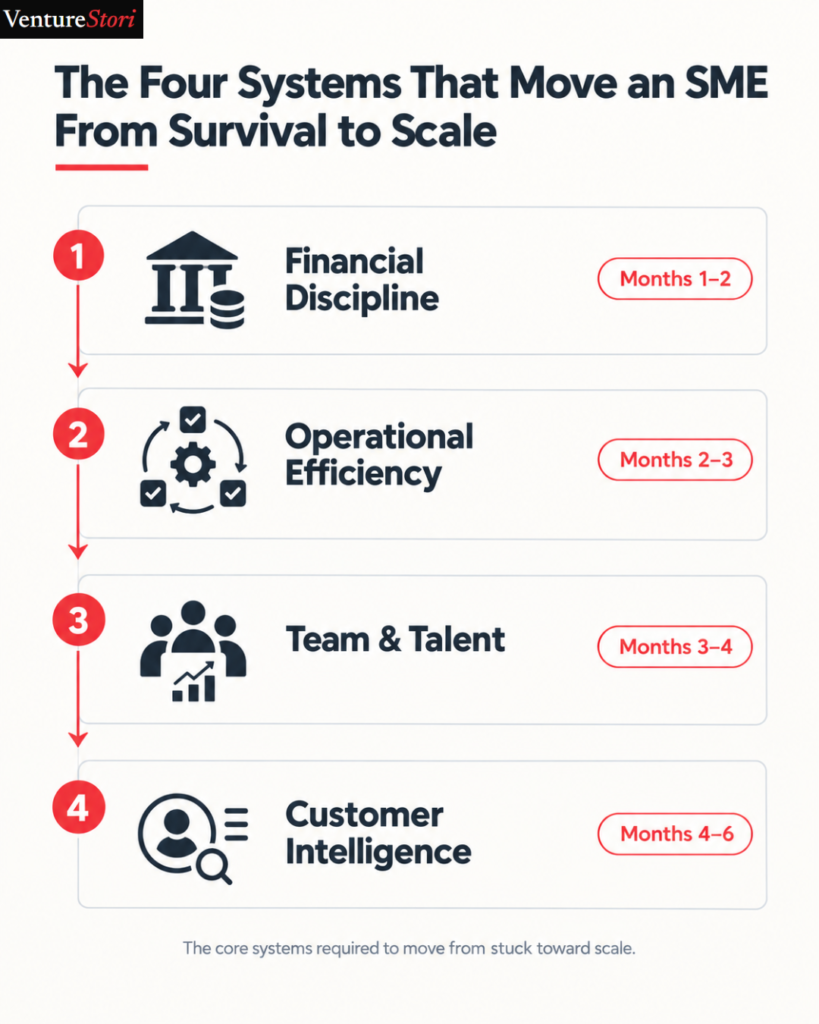
System 1: Financial Discipline (Months 1-2)
A founder’s starting point: A lot of founders use spreadsheets or manual records as their starting point. However, it is difficult to keep the right records of the business’ revenue and expenses.
Target state: Use bank-linked cloud accounting. Nigerian SMEs can use Zoho Books for cloud accounting. It provides bank feeds, transaction categorization, expense management, amongst others.
How to get there: Settle for one accounting system and sort your records. Zoho Books, Profitaa, and Wave are some options to choose from.
Quick win: Unite all of the business bank accounts into one and have a different, personal spending account for yourself. The goal is to know how much the business makes, spends, and what is left afterwards.
System 2: Operational Efficiency (Months 2-3)
The part where many founders get stuck: Most of the important tasks and decisions are done by the founder. When the founder isn’t around, work becomes slower, more difficult, and error prone.
Target state: Key tasks are properly documented, quality checks are clear, and employees know how to handle the tasks assigned to them.
How to get there: Start by documenting between 5-10 regular processes. They can include sales, customer service, purchasing, inventory, and delivery. Keep the standard operating procedures in a shared workspace and assign work to each employee with a task-management tool. For retail and hospitality businesses, Opsuite is capable of bringing together POS, inventory, accounting, CRM, payroll, and other business tools on the same platform.
Example — customer service:
- Keep record of enquiries.
- Respond within four hours.
- If the problem remains unresolved after 24 hours, forward to the founder.
- Record the problems solved with the first response and set a target that works.
System 3: Team & Talent (Months 3–4)
How to get there: Start with job descriptions and KPIs for a couple of key roles. Then HR platforms like SeamlessHR can merge employee records, payroll, and performance management on the same platform.
The management routine is the essential part. Ensure you have clear expectations, regular one-on-ones, performance reviews, and constant conversations about business progress and development.
KPI examples
- Sales team: Revenue/person; close rate; customer satisfaction
- Operations: Order fulfillment time; error rate; inventory accuracy
- Customer service: Response time; resolution rate; satisfaction score
System 4: Customer Intelligence (Months 4–6)
Where most SMEs start: Emails, spreadsheets, notebooks, WhatsApp, Facebook, etc,. are some platforms where you can find customers’ data. And because it is spread across different platforms, it gets difficult to track any repeat purchase or know your business highest spending customer.
Target state: Keep records of customer details and conversations in one Customer Relationship Management (CRM). Keep a record of repeated purchases and use the customer details to figure out pricing, follow-ups, and promotions.
How to get there: HubSpot’s free CRM is one simple option you can start with. It offers contact management, deal pipelines, reporting, and other basic CRM tools for free. Import existing customers, sort them by customer type or value, and have a simple follow-up method like purchase confirmations, repeat-purchase, and abandoned-cart reminders.
Quick win: List your customers based on their spending history. Stay in contact with ones that offer the most value through repeat purchases.Also, track the revenue generated from the campaign instead of entirely assuming a fixed number.
The 2026 Operating Context
For the year 2026, the rallying call is focused on growth and not assumptions of expansion. According to the IMF, Nigeria’s growth is projected to grow by 4.1% in 2026. Reports also say inflation has dropped to 15.39% in August 2026 from 23.14% a year ago. The Naira has also become more stable recently.
What this means for businesses is that keeping up with margins is equally as important as revenue. Be aware of the current prices and supplier costs, keep cash flow airtight, and stay updated with the current market changes.
The global risk threat poses a risk as well. According to the IMF, the ongoing Middle East conflict is reflected in the high energy prices and trade tensions, which are creating problems for the Nigerian economy and many others.
Employees matter too. According to research by CIPD, you can link employee wellbeing with organisational performance.
Management Software Comparison
A workable stack for a ₦50 million — ₦200 million business:
- Softwares like Zoho Books or Profitaa can be used for finance.
- SeamlessHR can be used to collect employee records, employee payrolls, and performance management when it becomes complex.
- Opsuite or Ovaloop for when a business lacks service operations.
- CRMs like Zoho Bigin or HubSpot can be used to keep track of customers.
Prices for each software vary and it depends on the plan, users, and features.
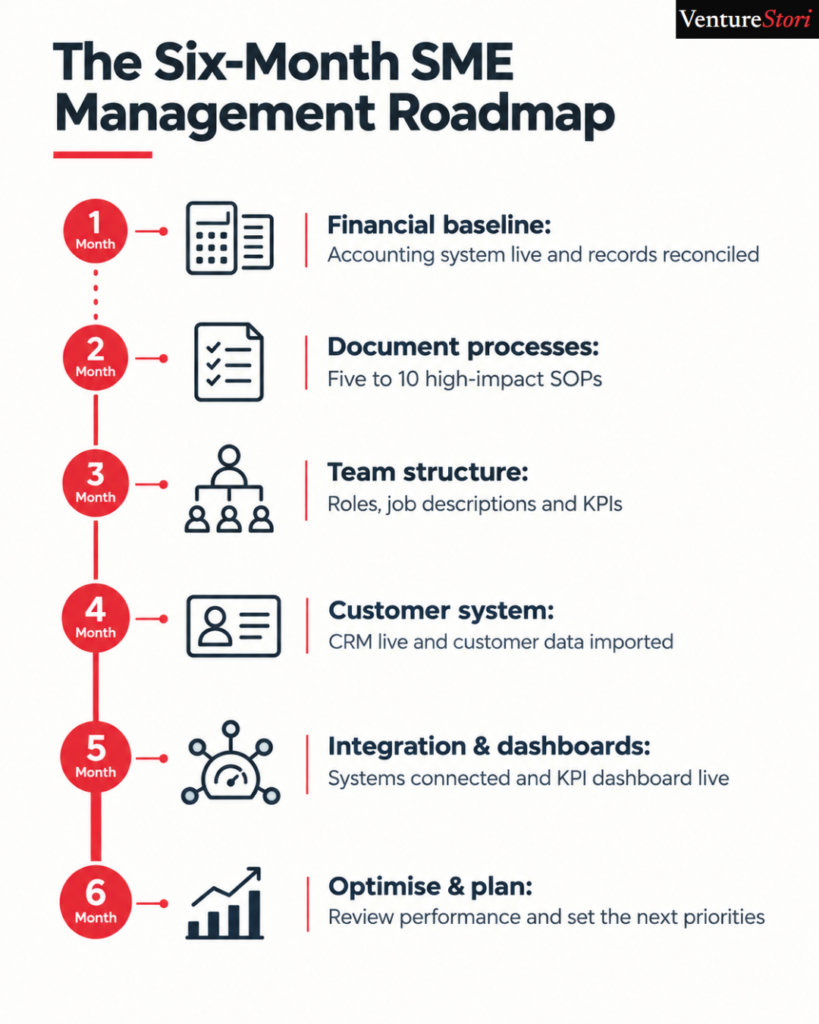
Six-Month Implementation Roadmap
| Month | Focus | Deliverable | Owner |
| 1 | Financial baseline | Accounting system live, bank accounts connected and previous records reconciled | Accountant + founder |
| 2 | Document processes | Five to 10 high-impact SOPs documented and relevant staff trained | Operations lead + founder |
| 3 | Team structure | Roles, job descriptions and KPIs defined; HR system in place; regular one-on-ones started | HR/Operations + founder |
| 4 | Customer system | CRM live; existing customer data imported; useful segments and basic automations set up | Sales lead + founder |
| 5 | Integration & dashboards | Key systems connected where practical; KPI dashboard live | Operations lead + founder |
| 6 | Optimise & plan | Review performance, fix gaps and set priorities for the next phase | Entire team + founder |
Professional Bodies & Frameworks
- Nigerian Institute of Management (NIM):
NIM was founded in 1961 and chartered in 2003. The institute is focused on management and leadership development. It also offers professional development, management, and leadership programs.
- SMEDAN ICSS Framework (Inspire, Create, Start, Scale):
SMEDAN programs cover different aspects of the entrepreneurial journey, from the creation of the idea to growing the business.
- CIPM (Chartered Institute of Personnel Management):
Established in 1968, the CIPM is Nigeria’s professional body for human resource management. It sets the standard for HR practice and offers the relevant training and certification in people management and organisational development.
- FRCN SME Corporate Governance Guidelines 2024:
They offer SMEs the right framework for stronger governance, accountability, transparency, risk management, and business processes.
Illustrative Scenario: Retail Store to Small Chain
Imagine a scenario where a retail business is generating ₦50 million yearly. The founder is directly responsible for most of the daily operations, the financial records are manually recorded, and employees don’t have clearly defined roles. These are some of the details that encompass Nigerian business governance in 2026. And they can learn from founder of UBA, Tony Elumelu who is handing over the reins of the bank to Emmanuel Nnorom.
Over the next six months, the founder will incorporate cloud accounting, documented operating procedures, clearer team responsibilities and KPIs, and a central customer-management system into the business.
These processes won’t increase yearly revenue instantly. But, it will give the business better financial visibility, reduce dependence on the founder, make the employees’ roles more defined, and provide a way to track customers and performance.
If these changes enable the business to have another location, increase sales and profit margins, the financial impact could be substantial. But, this will depend on the business, the market, how the changes are implemented, and the cost of putting them in place.
Common Mistakes
- Starting too many systems at once.
- Picking a software before figuring out the process.
- Skipping employee training.
- The founder is still in charge of every major decision.
- Ignoring the data once the dashboard exists.
- Skipping financial controls.
The Bottom Line
To start, sort out your books first because you need to be sure of what you’re handling. Document your work next so the business can continue in the absence of the founder. Establish the team in a way that the growth of the business doesn’t necessarily link to you working longer hours. Next, pay attention to your customers because it is easier to retain customers than find new ones. This is what Business Management in Nigeria is largely about.
Nigeria’s economy in 2026 is experiencing steadier growth, lower inflation, and a stable currency. It also helps organized businesses grow and businesses that lack proper systems may keep losing part of that growth due to higher costs and weak profit margins.
Master Project Management Tools for Remote & Hybrid Work
Struggling to streamline team workflows, meet client deliverables, and monitor project milestones efficiently? Learn how to evaluate cost-effective software, manage local internet or currency constraints, and boost team collaboration in our hands-on guide on How to Use Project Management Tools in Nigeria.