Understanding the ecosystem of the top luxury fashion brands in Nigeria gives deep insight into how West African heritage, artisanal craftsmanship, and modern tailoring intersect on both local and global stages.
The luxury fashion and accessories market size in Nigeria was approximately $1.4 billion in 2025. According to a recent market forecast, it is estimated to be worth $2.7 billion in 2031. This is an anticipated growth of 11.75% per year.
It has a strong base in wealthy consumers, diaspora spending, weddings, entertainment, and premium events. In 2025, there were approximately 7.2 millionaires, 20 centi-millionaires, and three billionaires in Nigeria.
Meanwhile, Nigerian designers are becoming more popular on the global stage. There are brands like Lisa Folawiyo, Deola Sagoe, Kenneth Ize, Atafo, and Iamisigo that have established Nigerian craft, textiles, and modern design brands.
Nigeria’s Luxury Fashion Market Is Growing
This market is valued at $1.4 billion for luxury fashion and accessories. It covers designer wear, top-quality retail, private ateliers, and other luxury items.
Ken Research estimates that the value of the market will be close to $2.7 billion in 2031. It also estimates some 240 market participants and establishes Lagos as the country’s primary luxury fashion center.
These figures should be considered estimates of the market, not official government figures, however.
The city of Lagos still plays a central role due to its rich consumers, fashion events, designer studios, and luxury retailers. The apparel and appointment destinations of Victoria Island and Ikoyi/Lekki are of special importance.
The market is also getting more international. In 2026, Nigerian designers made their debut in the top fashion marketplaces of Berlin and around the world. Also, Lagos Fashion Week continues to establish links between designers and buyers, retailers, investors, and the international media.
Top Luxury Fashion Brands in Nigeria
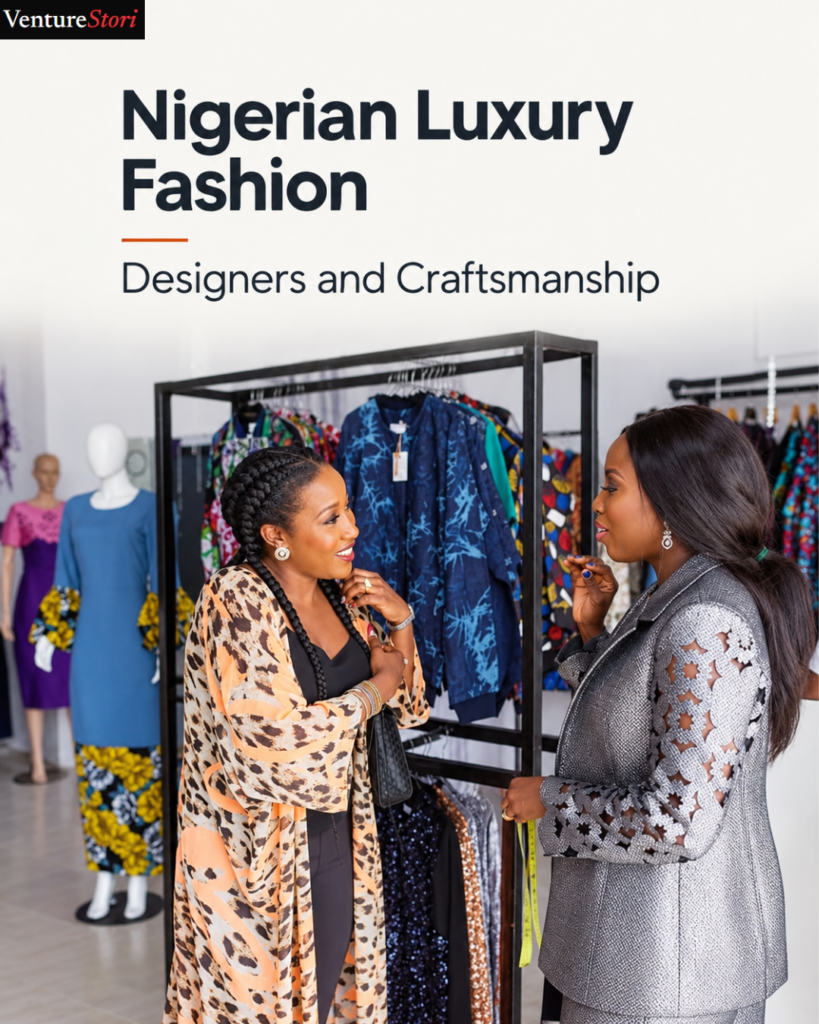
The brands below are not presented as a strict ranking. Instead, they represent established Nigerian labels with strong design identities, international visibility, or significant positions within the country’s luxury fashion ecosystem.
1. Lisa Folawiyo
Lisa Folawiyo is an iconic luxury brand in Nigeria.
It was in 2005 that the label was born, and it garnered a reputation for transforming Ankara and other West African fabrics with tailoring and intricate hand decoration. The brand also collaborates with local textiles in Akwete.
According to Lagos Fashion Week, some of the pieces by Lisa Folawiyo may take up to 240 hours of handwork.
The label has stores in Lagos and New York and is available worldwide. It has had busy clientele like Lupita Nyong’o and Solange Knowles.
One cocktail dress by publicly listed Lisa Folawiyo cost $2,560. Other dresses on Industrie Africa had prices that ranged from $885 to $1440.
The brand’s address is 11 Ribadu Street, off Awolowo Road in Lagos, for shoppers. It also mentions that Temple Muse will be a stockist.
2. Deola Sagoe
The name Deola Sagoe is one of the more enduring legacies in Nigerian luxury fashion.
In 1988, Deola Ade-Ojo started working in her mother’s fashion business, turning it into a modern luxury brand. Her work is characterized by handweaving Nigerian textiles, detailed construction, and couture techniques.
She also has an international record. In 2004, she was the first time a Black woman was invited to present at AltaRoma, and in 2014, she became the first Nigerian designer to stage a solo show at New York Fashion Week.
Here are some examples of international couture pricing at the moment. A selection of Deola Sagoe pieces on sale with World Wide Couture has an average price of approximately €1,599 and more than €8,000.
The above price is the price of a specific made-to-measure piece and is not a standard price list for all Deola Sagoe products.
3. ATAFO
ATAFO is founded around the creative direction of Mai Atafo with menswear, womenswear, and bridal fashion.
The brand calls its creations a mix of Nigerian style, bespoke tailoring, and modern luxury. Especially known for its clean cuts, fit, and detailed construction.
On the current ATAFO website, pieces are available for sale in dollars. For instance, a silk pleated dress and skirt go for $200-400.
Several ATAFO suits are offered on Ananse for approximately $1,110, and those that come with more detail are priced at over $1,400.
The Lagos studio is located on Plot 7, Block 95, Omorinre Johnson Street, Lekki Phase 1.
4. Tiffany Amber
Tiffany Amber is another name in the Nigerian luxury fashion game.
The house opened in 1998, under the name Folake Coker. Lagos Fashion Week says it is Nigeria’s first “ready-to-wear” label. The brand also went on to create diffusion and couture lines.
It is important international work. In 2008, Coker was the first African designer to have made two showings at New York Fashion Week.
The brand has been active in Lagos and Abuja with stores and boutiques, ranking it among the established Nigerian labels for those looking for ready-to-wear luxury.
5. Kenneth Ize
Aso Oke is the focus of Kenneth Ize’s brand and has been.
The label collaborates with local weavers and artisans and uses traditional textiles in contemporary ways of tailoring. It is also stocked by international stores like SSENSE, Browns, and Machine-A.
Ize was a semi-finalist in the 2019 LVMH Prize.
He went back to Berlin Fashion Week in 2026 with a collection centered around dynamic Aso Oke, contemporary tailoring, and deconstructed looks.
Additionally, Berlin Fashion Week has picked Kenneth Ize as part of the AW26 Berlin Contemporary program.
6. Iamisigo
One of the best Nigerian fashion pieces that incorporates craft, history, and present-day design is Iamisigo by the founder, Bubu Ogisi.
The label is not just decorative but is employed through artisanal methods and cultural references.
It gained a worldwide profile again in 2026 when Iamisigo was among the 20 semi-finalists for the LVMH Prize. In that year’s group stage semi-final, it was Nigeria.
The Spring 2026 collection was also shown on the label at Temple Muse in Lagos in the wake of its debut at Copenhagen Fashion Week.
This renders Iamisigo especially significant to those who seek fashion that has cultural and artisanal significance.
7. Orange Culture
Orange Culture was established by Adebayo Oke-Lawal in 2011.
The brand is renowned for bright, modern fashion, and it has been continually expanding its visual vocabulary.
The collections were presented in Berlin by Orange Culture in 2026. Its Spring 2027 line was inspired by Makoko, focusing on layers, sheerness, and color.
The brand also announced its return to Berlin for its AW26 program at Fashion Week.
Orange Culture is more in line with contemporary designer fashion than occasion couture for consumers.
8. Andrea Iyamah
Andrea Iyamah’s specialty is bridal wear, swimwear, womenswear, and resortwear.
Andrea Dumebi Iyamah, a Nigerian designer, created the brand, which is inspired by African cultures, nature, bold color, and modern femininity. It is based in Lagos, Toronto, and NY.
Its website at present provides more transparent pricing details for customers than most couture shops in Nigeria.
Popular models currently available are the Ilora Dress for $390, the Bayo Dress for $320, and the Venti Dress for approximately $400-$495, depending on the version.
This makes Andrea Iyamah one of the most accessible brands for all people who buy online from Nigeria to bring into the world.
9. Lanre Da Silva Ajayi
In 2005, Lanre Da Silva Ajayi established her fashion house in Lagos, Portugal.
Her design language is one of color, texture, metallic fabrics, lace, and references to history. The house makes clothes that are made to order or ready-to-wear.
The brand has also exhibited abroad, such as New York Fashion Week.
The house is also a brand to look out for when it comes to occasion wear that makes a statement and definitely has a Nigerian touch.
The brand’s existing website is now functioning to direct customers to their atelier in Lagos for an appointment.
10. Emmy Kasbit
Emmy Kasbit, a brand by Emmanuel Okoro, blends modern fashion and the history of Nigeria with traditional fabrics.
It is designed to pay tribute to King Jaja of Opobo and feature locally woven, hand-woven Akwete fabrics for its Spring/Summer 2026 collection, “Rebirth.”
The brand provides bespoke services, menswear, and womenswear.
It’s a method that makes it valuable for buyers interested in modern outfits that tell a Nigerian cultural narrative.
What Luxury Fashion Costs in Nigeria
There is no single price list for Nigerian luxury fashion.
Ready-to-wear prices can be publicly listed. Bespoke and couture pieces are usually priced after consultation.
As a practical guide, shoppers can expect the following broad ranges:
| Category | Indicative price |
| Contemporary designer ready-to-wear | ₦200,000–₦600,000+ |
| Premium suits and tailored pieces | ₦500,000–₦1.5 million+ |
| Bespoke luxury outfits | ₦700,000–₦3 million+ |
| Couture gowns | ₦1.5 million–₦6 million+ |
| High-end couture and heavily embellished pieces | ₦5 million–₦10 million+ |
These figures are planning ranges rather than universal designer prices.
For instance, while some current Yomi Casual products are being sold at around N300,000–N385,000, some premium suits and native products from BenFash are being sold under N250,000.
On the other hand, certain Deola Sagoe and Lisa Folawiyo items go for a few thousand dollars when sold internationally.
So, it is best to ask for an up-to-date quote before you start planning a custom order.
Where to Shop for Luxury Fashion in Lagos
Temple Muse
Temple Muse is among Lagos’ established concept stores, which are luxury.
It boasts a mix of modern African designers as well as international and lifestyle items. The store is billed as a “cultivated luxury store” in Lagos.
Historical designers that used to be produced there include IAMISIGO, Lisa Folawiyo, and various Nigerian brands such as Tiffany Amber.
ALÁRA
ALÁRA is another foremost luxury resort.
The concept store is at 12A Akin Olugbade St, Lagos. It fuses together Nigerian and African styles with international luxury, lifestyle, and design.
It also provides personal shopping services for clients who wish for a more guided shopping experience.
Grey Velvet
Grey Velvet has high-end multi-brand shops in Lagos and Abuja.
Currently, it has operations in Centro Lekki Mall, Lagos, and Ikeja City Mall, Lagos, and also Jabi Lake Mall, Abuja.
The retailer also trades online and currently has Nigerian brands like Isi Brown on offer.
Designer Studios
In terms of couture, sometimes it’s more convenient to make contact than head to the mall.
ATAFO has its office in Lekki Phase 1. Deji & Kola has its showrooms in Lekki, with other showrooms in Ikeja, the UK, and Canada.
These appointment-only channels are good for measurements, fittings, and custom orders.
Lagos Is Still the Center of the Luxury Fashion Ecosystem
Luxury fashion is still a big business on Victoria Island, Ikoyi, and Lekki.
But the ecosystem doesn’t stop at retail stores.
Lagos Fashion Week brings together designers and buyers, retailers, investors, media, and policymakers. The platform of the 2026 edition is also focused on handiwork, business possibilities, innovation, and responsible production.
Another level of the industry is provided by FADAN. According to the Fashion Designers Association of Nigeria, it was founded to be a platform for the coming together of designers, promotion of Nigerian culture through fashion, and support of professional development.
The Nigerian Fashion Council is an additional institutional layer. It was opened by the Federal Ministry of Education (MinEd) under the auspices of the National Board for Technical Education (NBTE) in March 2025. It’s responsible for skills, infrastructure, innovation, and protection throughout the fashion value chain.
The organizations are thus proof that luxury fashion is moving from mere individual designers to a whole.
It is growing into a more extensive commercial business that includes artisans, manufacturers, retailers, stylists, photographers, models, buyers, and training institutions.
What to Check Before Buying Designer Fashion
Verification is important when people are paying luxury prices.
First, purchase directly from the designer or from an established retailer, if possible.
Second, ascertain if an item is ready to wear, made to measure, or fully bespoke. The disparity can make a big impact on the price.
Thirdly, inquire what is included in the quoted price. The prices for fabric, embroidery, fittings, alterations, delivery, and rush orders are not included.
Fourth, verify the production schedule. Fancy cuts and handmade clothes take longer to make than off-the-peg.
Last, but not least, watch for designer names on social media sellers. Please make sure to verify on the brand’s official website or trusted social media account before payment.
Bargaining is not always a good thing if it’s low-priced. It may also suggest that further verification is required of the product, the seller, or the origin is needed.
The Business Opportunity Behind Nigerian Luxury Fashion
Entrepreneurs can take advantage of the rise of the luxury fashion industry in Nigeria as well.
Nigerian textiles, craftsmanship, and modern tailoring can be used as a design base.
Retail businessmen can develop multi-brand retail outlets that link both local brands and wealthy consumers and diaspora buyers.
They can create services around wedding dresses, red carpet looks, corporate wardrobes, and personal shopping.
Digital commerce is also a possibility. According to the current market forecast, online retail is set to be a bigger segment of the luxury fashion market in Nigeria by 2031.
However, creativity is not sufficient for aspiring designers.
In addition to product design and development, a sustainable fashion business must also possess solid production, pricing, customer service, inventory management, and brand positioning skills.
Final Word
The luxury fashion segment in Nigeria is gaining visibility, is more organized, and is more international.
Decades of design history are carried by established houses like Deola Sagoe, Tiffany Amber, and Lisa Folawiyo. At the same time, designers like Kenneth Ize, Iamisigo, Orange Culture, Andrea Iyamah, and Emmy Kasbit are reinventing Nigerian fashion in fresh creative territories.
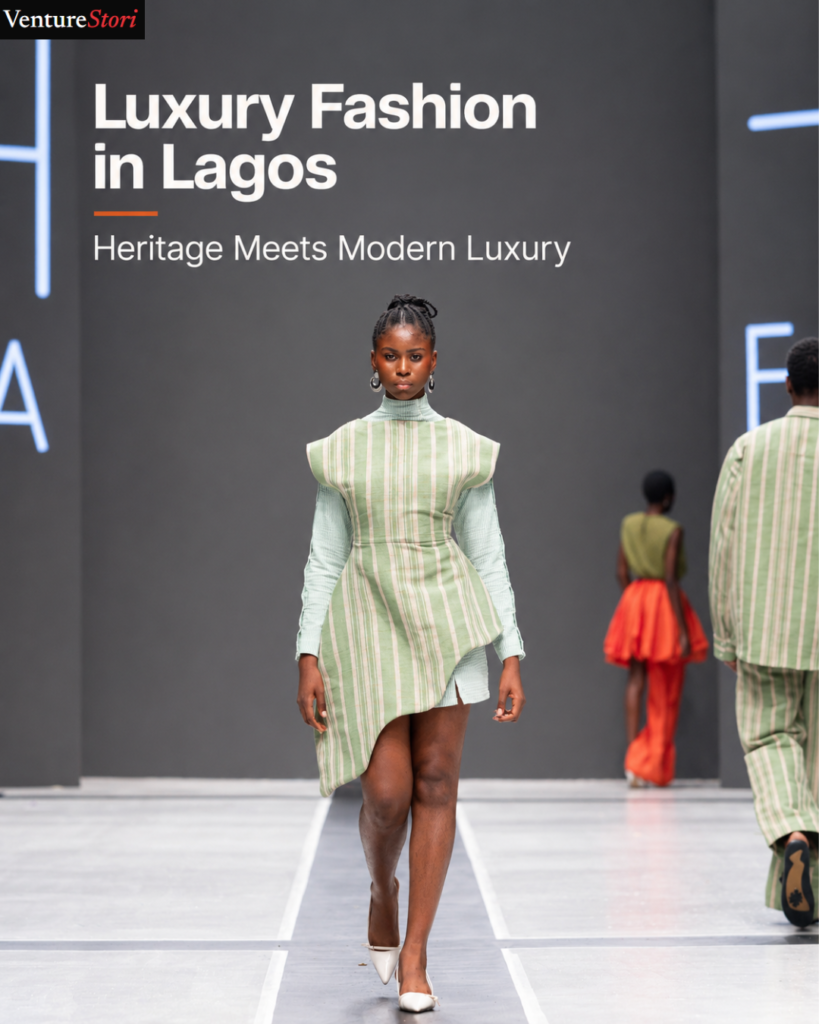
The outcome is a new market where Nigerian heritage meets modern luxury.
The opportunity is larger for shoppers than shopping for a costly outfit. It’s the search for the right designer, the right craftsmanship, the right service, and the right cultural story to go with the event.
The growing ecosystem offers opportunities in design, retail, styling, production, and fashion technology for entrepreneurs.
Whether looking for bespoke bridal outfits, handwoven heritage fabrics, or statement red-carpet pieces, exploring the top luxury fashion brands in Nigeria highlights a market where African heritage seamlessly merges with contemporary luxury.
Explore the Latest Ankara Styles for Women
Looking to elevate your wardrobe with vibrant, high-fashion African prints? From tailored corporate dresses and modern corset cuts to stunning floor-length gowns for weddings and special occasions, discover our curated lookbook of the Latest Ankara Styles for Women to find your next design inspiration.