Niger State is the largest state in Nigeria by land area, a key metric highlighted across every comprehensive Niger State business directory. Beneath this quiet geography sit four major hydroelectric stations: Kainji, Jebba, Shiroro and Zungeru, maintaining a combined installed capacity of 2,638MW. Kainji and Jebba alone have supplied up to 20% of the national grid since 2013, anchoring regional commerce. This verified Niger State business directory covers essential company listings and commercial enterprises operating across Minna, Suleja, and Bida.
Niger State as a Business State
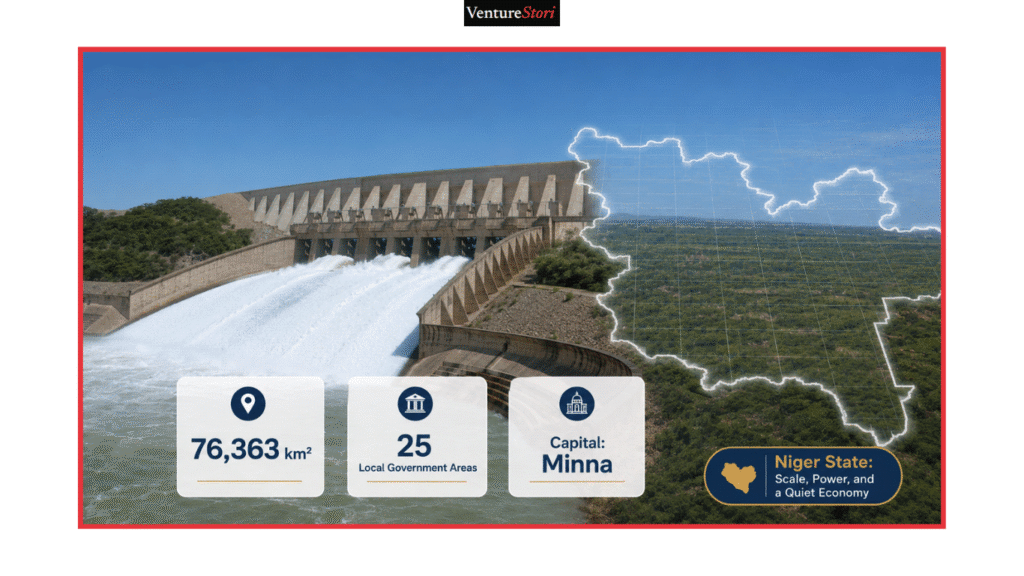
Niger State was created in 1976, with a land area of 76,363 km². This makes up about 8.6% of Nigeria’s entire land area. It has 25 local government areas and a population of 6.78 million (2022 UNFPA/US Census Bureau projection). The state capital, Minna, is where most of the administrative activities take place, alongside a high concentration of commercial enterprises featured in the Niger State business directory.
Nigeria’s most powerful power-generation infrastructure is located there. Some of the areas in Niger State, like Shiroro, Rafi, Mariga, Borgu, Munya, Mashegu, and Kontagora, still face insecurity, specifically banditry affecting farming communities. This is not to say that all areas of Niger State are insecure. Minna and Suleja serve as more stable commercial hubs where registered companies within the Niger State business directory continue to thrive.
The Active Sectors
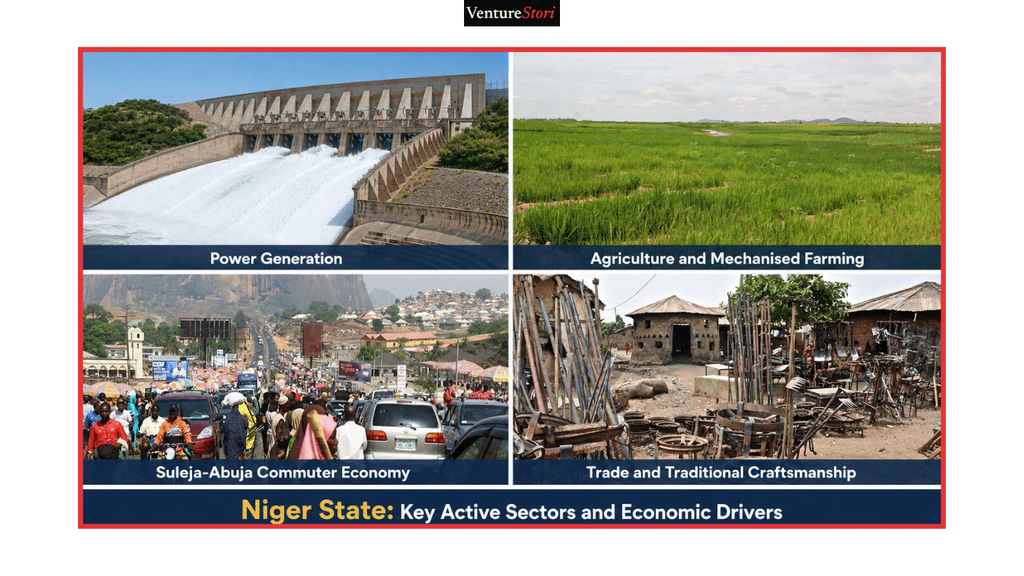
The Active Sectors .
This section explores seven major sectors in Niger State.
Power Generation
Niger State serves as the engine room of hydroelectric power in Nigeria, standing out as a critical industrial sector cataloged within the Niger State business directory. It houses major dams including Kainji, Jebba, Shiroro, and Zungeru, which are all under the concession of Mainstream Energy Solutions Limited.
Mainstream has managed Kainji and Jebba since 2013, focusing heavily on restoring electricity generation capacity that had declined due to decades of underinvestment, a core operational metric highlighted across corporate profiles in the Niger State business directory. In 2024, Zungeru was commissioned as one of Nigeria’s biggest hydroelectric projects since the creation of the Kainji Dam, adding 700MW to hydroelectric generation. Beyond power production, the commercial and infrastructural impact of these sites extends into tourism, such as the Kainji Lake National Park.
Agriculture
Agriculture stands as a primary economic pillar outlined across the Niger State business directory, with farming serving as a dominant occupation for the local population. Governor Mohammed Umaru Bago has heavily driven mechanized farming through 2026, reinforced by state distributions of 250 tractors and 50 combine harvesters across all 25 local government areas to cultivate 120,000 hectares of land.
The 2026 budget allocates 59.2 billion naira specifically to agriculture, cementing the sector’s prominence in commercial databases like the Niger State business directory. Flour Mills of Nigeria has signed a strategic partnership with the state government to integrate operations into the local agricultural value chain, working alongside the Special Agro-Industrial Processing Zone (SAPZ) backed by African Development Bank financing to expand processing and industrial activity. Additionally, the Kainji and Jebba dams provide reliable irrigation channels for surrounding farmlands, reducing rain-dependency during dry seasons to massively scale rice and grain production for enterprises cataloged within the Niger State business directory.
The Suleja-Abuja Economic Benefit
Suleja is located in Niger State but acts as an extension of Abuja. Abuja is the capital of Nigeria, and living there can be expensive, so people find it easier to live in Suleja because of its closeness. Suleja has a population of 369,000 people, and some of this population growth is because of the movement of people from Abuja. This means the Abuja economy indirectly creates business opportunities in Suleja. Because of the closeness of Suleja with Abuja, not all Suleja’s economic growth is traced to Abuja. There is the Suleja Market, an important commercial center that attracts traders from surrounding regions.
Solid Mineral
Niger State has mineral resources, but the government is still preparing and creating policies for mining. Some of the preparation includes the “Executive Bill on Responsible Mining” before the State Assembly and the creation of a dedicated commissioner for the mineral resources portfolio. All this is happening alongside a larger national development in the solid minerals sector. In 2025, the federal government attracted more than $800 million in foreign investment, following licensing reforms. A state-specific investment figure for the mineral sector in Niger State isn’t available, so this remains a policy-stage story.
Tourism
Niger State has a major tourist attraction, but it hasn’t been fully developed. Kainji Lake National Park is Niger State’s clearest example. It has a land area of 5,341 km², situated along the western shore of the reservoir. The park contains wildlife like hippopotamuses, hyenas, baboons and various antelope species. The park also contains two major game reserves, Borgu and Zugurma. The Gurara Falls in the Gurara local government area is also one of the state’s natural attractions. Like Kainji Lake, it is yet to attain its full potential due to lack of infrastructure surrounding this park. Zuma Rock also sits around the area, as well as the scenic Suleja Dam.
Trade and Commerce
When looking at trade in Niger State, there are three important commercial towns:
Minna
This is the capital of Niger State and home to government and administrative activities, with Kure Market serving as its principal grading hub, supporting food, transportation, housing and professional services.
Bida
The commercial activity in this area can be traced to before the creation of Niger State in 1976. The economy and identity in Bida are connected to traditional craftsmanship, particularly brass and glasswork.
Suleja
Apart from the connection of Suleja to Abuja, it is known for its traditional pottery. This includes the work associated with the Ladi Kwali Pottery Centre.
Professional Services
Professional services, including lawyers, consultants, accountants, and other businesses, are mostly concentrated in Minna, where the state government and civil service activities are located.
The Business District and Key Areas
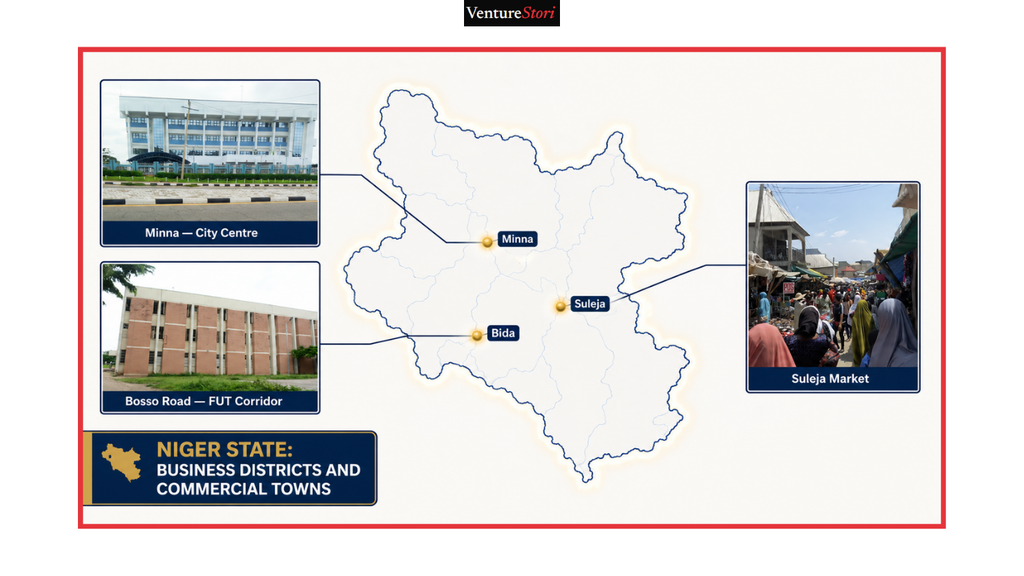
The Business Districts and Key Areas.
Minna
The business activity in Minna is divided into two parts. The first part is the City Centre and Central Market. It is the administrative and major trading centre in Minna, where you would find things like government offices, banks, shops and other businesses that develop around a capital. This area deals with a lot of transactions and businesses that supply goods to government institutions.
The second part is the Bosso Road and Paiko Road. They are different from the central business area. They are commercial roads filled with small businesses like auto parts dealers, building material suppliers, and other everyday businesses. Because of the closeness of Bosso Road to the Federal University of Technology campus, businesses like printing, accommodation, transportation, and food businesses can thrive.
Suleja
Suleja is quite different from Minna because its commercial activity is connected to Abuja.
The Suleja Market is the town’s main commercial anchor. This market attracts traders from northern Niger State and from areas around the Niger-FCT boundary. Suleja is driven more by commuters than by local industry. People live in Suleja because the housing is more affordable and they travel to Abuja to work. This creates a commercial opportunity, and businesses develop to serve these people. Understanding Suleja commercially means understanding it as Abuja’s overflow and not a standalone trading hub with its own independent momentum.
Bida
Bida has the deepest commercial history. Its commercial activity arises through its traditional craftsmanship, particularly in brasswork and glasswork. Today, the traditional craft economy still exists alongside general trading in Bida’s markets.
Investment and Development Activity
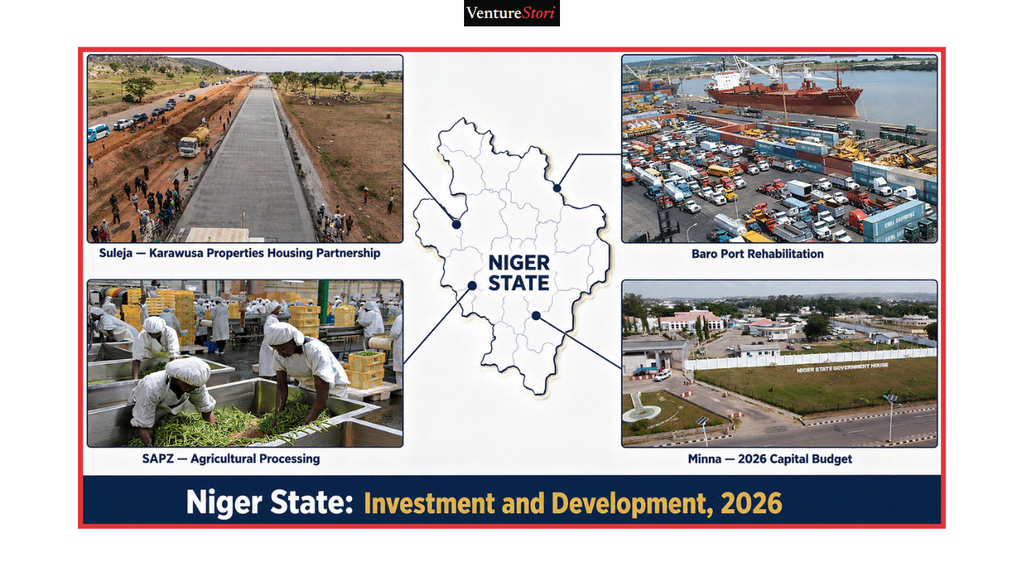
Investment and Development Activity.
Niger State features a robust 1.31 trillion naira budget for 2026, designated by Governor Bago’s administration as a Budget of Consolidation and tracked closely within economic projections in the Niger State business directory. The budget allocates 73.81% to capital projects instead of recurrent spending, a capital weighting that shows up most visibly in agriculture and infrastructure—the two sectors prioritized through 2026 and highlighted across the Niger State business directory.
The state government is not the only entity investing in the region. The African Development Bank is financing an agricultural processing zone, while the Baro Port undergoes rehabilitation to serve as an export route for minerals. Additionally, the government works with private companies like Karawusa Properties to build houses along the Abuja-Kaduna expressway to accommodate rapid growth in the Suleja commercial zone.
However, venture-capital funding remains scarce for technology startups within the state, primarily because the commercial ecosystem documented in the Niger State business directory is built on agriculture, power generation, infrastructure, and traditional enterprise rather than software or tech innovation.
Who Is Building Here
Who Is Building Here?
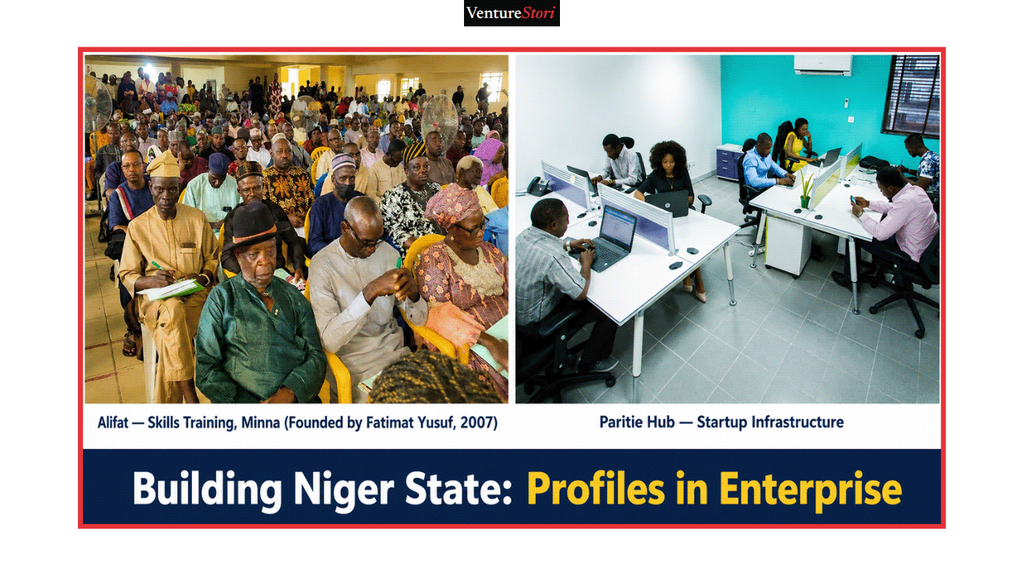
Alifat
Fatimat Yusuf founded Alifat in Minna in 2007, establishing a prominent enterprise featured within the Niger State business directory. The organization originally started as a specialized consultancy and catering business before expanding its reach. As the daughter of the 13th Emir of Agaie, Fatimat Yusuf has successfully grown Alifat into a multi-faceted enterprise that has trained nearly 3,000 young people across the region.
Operating alongside the commercial venture, the Alifa Foundation provides dedicated free skills training to widows and young women, extending the enterprise’s community impact well beyond standard listings found in a typical Niger State business directory.
Paritie Hub
Paritie Hub stands out as a premier technology and enterprise entry in the Niger State business directory, operating as a dedicated coworking and idea incubation space. Its core services span UI/UX design, web development, and specialized business advisory services tailored for growing ventures. By offering essential startup infrastructure locally, Paritie Hub ensures that entrepreneurs featured in the Niger State business directory do not have to travel all the way to Abuja just to access a functional coworking environment.
Niger State Company Listings
Sponsored Content Note: The following directory entries consist of paid commercial placements from enterprises operating across the Niger State business directory. All preceding editorial analysis and reporting by Venture Stori remain entirely independent of these sponsored listings.
Business name:
Category:
One-line description:
Contact details:
Website:
Location within Niger State: