Introduction
Before starting a registered business in Nigeria, you must choose between a sole proprietorship and a private limited company. Navigating the choice of a sole proprietorship vs private limited company in Nigeria is one of the most critical decisions an entrepreneur will make. The former is cheaper, faster, and simpler to run, while the latter is more costly and comes with heavier paperwork, but promises better long-term opportunities.
Choosing wrongly can result in you paying for compliance you don’t need or missing out on funding, contracts, and investors. It is even more important to understand a sole proprietorship vs private limited company in Nigeria in 2026 due to newly implemented tax rules, free CAC registration for 250,000 MSMEs, and funding programs that lean favorably toward registered corporate entities.
Sole Proprietorship vs. Private Limited Company: Side-by-Side
| Sole Proprietorship (Business Name) | Private Limited Company (Ltd) | |
| Liability | Unlimited liability | Usually limited to the unpaid amount on shares/investment |
| Ownership | It can be registered by an individual proprietor only. | One or more shareholders |
| Directors | No statutory board/director structure | Minimum of one director in qualifying private companies |
| Setup Cost | Registration with CAC costs around ₦11,000. However, SMEDAN and CAC partnership is handling free registration for 250,000 MSMEs. | Official registration cost is estimated at ₦48,500. However, total cost varies. |
| Setup Time | A simple name reservation can take about 30 minutes, while company registration can take anywhere between four days to two weeks. | A simple name reservation can take about 30 minutes, while company registration can take anywhere between four days to two weeks. |
| Compliance | Little compliance | Heavier compliance |
| Corporate tax 2026 | Personal Income Tax, instead of Companies Income Tax, for sole proprietors | 0% CIT for a qualifying small company; 30% for other companies under the Nigeria Tax Act 2025 |
| Banking | CAC registration supports opening an appropriate business/corporate account, but the requirements for the account differ depending on the bank | CAC registration supports opening an appropriate business/corporate account, but the requirements for the account differ depending on the bank |
| Funding Access | Minimum exposure | According to CAC, registering a business can give it more exposure and access to government and financial services. |
| Growth Ceiling | Quite limited | Better positioned to attract shareholders |
| Partners/Investors | Cannot easily add partners | Clear shareholder structure—can easily add investors/partners |
| Government Contracts | Difficult to get access to government contracts | A registered business is better positioned to get government contracts and access to government services. |
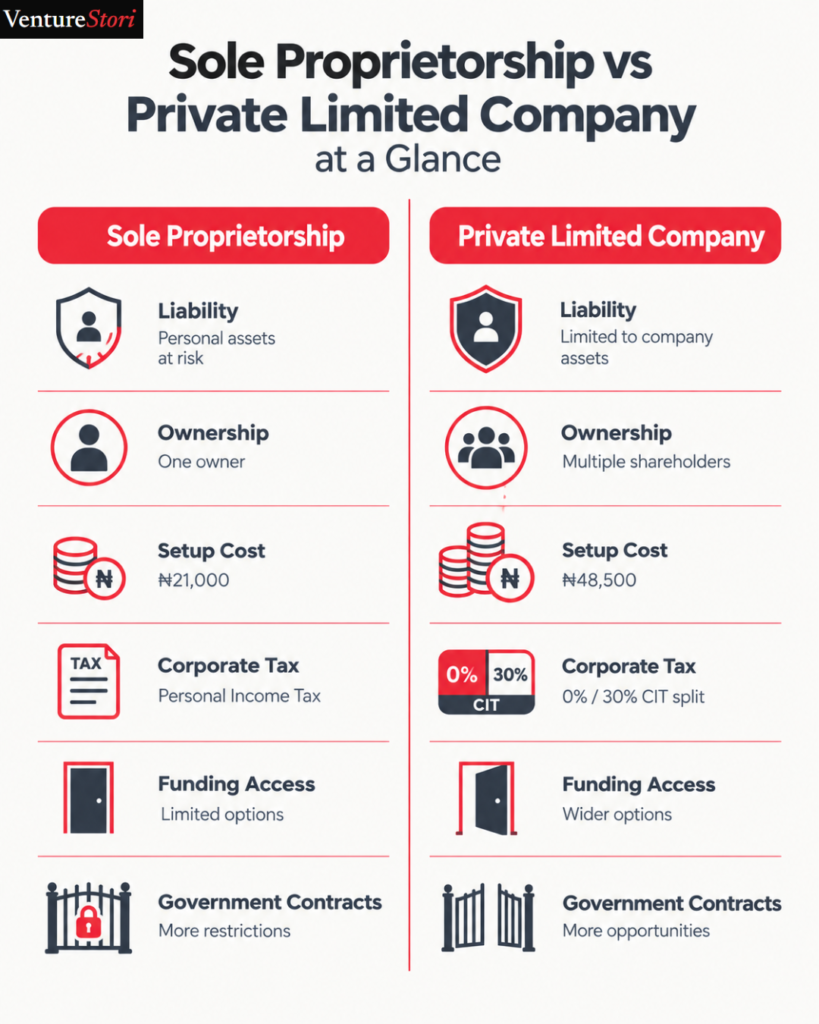
Liability: The Big Risk
Before you decide which business structure works in Nigeria, you need to understand the structures first:
Before you decide which business structure works best in Nigeria, you need to understand the structural differences:
- Sole proprietorship: Unlimited liability. If you own a business and it falls into a ₦5 million debt and cannot pay, your personal assets may and can be used to pay creditors.
- Private limited company: Limited liability. Under CAMA 2020, if a private limited company owes a debt of ₦5 million, the creditor can only recover the money from the company’s assets.
When evaluating a sole proprietorship vs private limited company in Nigeria, if you plan to borrow large sums, take on supplier credit, or protect your personal assets, the extra cost of registering an LTD buys you real legal protection.
What Registration Actually Costs in 2026
For a sole proprietorship, prices are as follows:
- Business Name reservation: ₦1,000
- Registration fee: ₦20,000
- Total cost of CAC filing: ₦21,000
For a private limited company, prices are as follows:
- Private Limited Company (Standard ₦1 Million Share Capital) Name reservation: ₦1,000
- Registration fee: ₦40,000
- FIRS stamp duty (0.75% of share capital): ₦7,500
- Total cost: ₦48,500
For any share capital of more than ₦1 million, the CAC fee goes up by an extra ₦10,000 for every additional ₦1 million, including the mandatory stamp duty fee.
Registering and retrieving your tax ID comes at zero cost.
The 2026 Tax Picture
On the 1st of January, 2026, the Nigeria Tax Administration Act was passed into law. But it is important to understand what the law says about small business thresholds. According to the Act, for small companies, there is a 0% Companies Income Tax (CIT), and its definition of a small company uses a ₦50 million turnover threshold along with the applicable fixed-asset condition.
According to the Nigeria Tax Administration Act, it separately defines a small business at ₦100 million or less for specified tax administration/VAT purposes. But this doesn’t automatically suggest that any company that has a turnover between ₦51 million and ₦100 million will get the 0% CIT rate. The general company tax structure for this year, 2026, is set at 0% for qualifying small companies and 30% for other companies.
For sole proprietors, things are done and handled differently. They’re not taxed under the Companies Income Tax but rather under the individual Personal Income Tax on business profit. In conclusion, deciding between a business name and an Ltd will have an effect on both liability and tax treatment.
Free CAC Registration Pathway
In September 2025, SMEDAN officially partnered with CAC to provide free business registration to 250,000 MSMEs, which is still ongoing.
To apply for the initiative, go to the official SMEDAN portal, create an account, and fill in the required business details. Click “No” when you’re asked if you have a CAC number when applying for the free registration. Submit your details and follow the necessary steps for CAC certification. After your registration has been approved, register for your tax ID on the official Nigeria Revenue Service portal.
If you qualify for the initiative, the cost for officially registering your business with CAC is removed. Make sure you don’t pay any agent or third party that claims they can give you a faster and easier route to get the slot—the initiative is free, and it is explicitly first-come, first-served.
Funding Access: Sole Proprietorship vs Private Limited Company in Nigeria
Sole proprietorship limitations: Registering a business helps, but having a business name doesn’t mean your business automatically has access to funding. Banks, institutions, and governmental agencies have their own rules and requirements. Some may ask for business registration, financial records, and collateral. Some may only consider sole proprietorships eligible, and some others have stricter corporate-structure requirements.
Private limited company advantages: A private limited company gives your business a formal shareholding structure. With that structure in place, it is easier to turn outside investors into shareholders with real equity. An example is how Adesuwa Rhodes was able to build Aruwa Capital.
It is important to understand that a private limited company status is not a guarantee of funding. Being eligible for funding depends on the lender and program. For example, the Nigerian Federal Government’s ₦75 billion MSME intervention expressly receives sole proprietorships alongside Ltd companies, while other BOI programs impose different requirements. Before you decide on a particular loan or grant, make sure you check the criteria for eligibility first.
Compliance Obligations: Sole Proprietorship vs Private Limited Company in Nigeria
A business name (sole proprietorship) and a private limited company aren’t compliance-free, but a business name carries a lighter administrative burden compared to an incorporated company.
Businesses registered with the Corporate Affairs Commission (CAC) have annual return obligations, and they are mandated to meet their tax requirements. However, a private limited company faces more formal corporate obligations. This means businesses structured under this category must maintain statutory corporate records, prepare financial statements, file annual returns, and meet corporate tax obligations.
Fortunately, not all private limited companies are faced with heavy expenses. Under CAMA 2020, qualifying small companies in Nigeria are explicitly excluded from statutory annual audit requirements.
When choosing between a sole proprietorship vs private limited company in Nigeria, the decision ultimately depends on whether you personally handle bookkeeping and filings or if you delegate those tasks to an accountant or tax adviser.
For solo entrepreneurs and small business owners, starting with a business name requires far less corporate administration. But if your venture plans to onboard investors, issue shares, secure formal financing, and manage complex reporting, an LTD structure becomes the much more practical option.
Foreign Ownership Rules for a Sole Proprietorship vs Private Limited Company in Nigeria
The rules regarding foreign participation differ significantly depending on the business structure you choose. When evaluating a sole proprietorship vs private limited company in Nigeria, foreign nationals must note that the sole proprietorship (business name) route is legally restricted and not open to non-citizens.
If you are looking to set up a corporate entity with foreign partners who own part or all of the business, a private limited company (LTD) can be incorporated across most sectors, though it comes with extra investment and immigration requirements.
Reports from the Nigerian Investment Promotion Commission (NIPC) indicate that foreign investors have the flexibility to own 100% of a business as long as it does not fall under the government’s Negative List.
However, under current CAC and Ministry of Interior regulations, the minimum share-capital threshold for any foreign-owned company is set at ₦100 million for business-permit and expatriate-quota purposes. Because of this stark contrast, foreign founders must account for higher initial capital requirements and the additional NIPC, business permit, and immigration compliances that apply specifically to an LTD structure compared to local sole proprietorship setups.
Decision Framework: Sole Proprietorship vs Private Limited Company in Nigeria
- For revenue projected to cross ₦100M within 3 years? Ltd. should be the preferred option.
- Do you have plans to seek bank loans or grants for your business? Ltd. should be the preferred option.
- Want investor partners or equity investors? Ltd. should be the preferred option.
- Protecting your personal assets? Ltd. should be the preferred option.
- Operating in a regulated sector (finance, oil and gas, government contracts)? Ltd. should be the preferred option.
- Starting small with no plans for loans? A sole proprietorship should be the preferred option.
- Comfortable with the cost of heavier compliance? Ltd. should be the preferred option.
- Foreign ownership involved? Ltd should be the preferred option.
Scoring:
0–2 YES—start with a free or affordable business name.
3–4 YES—borderline; let your funding timeline decide.
5+ YES—the Ltd registration cost is very likely justified by what it unlocks.
Real Scenarios
- Fashion E-commerce (Bootstrapped): ₦50M expected revenue, no plans for loans from commercial institutions like NIRSAL, and one founder with 2–3 contractors. A business name may be a good foundation. If the business qualifies, the CAC–SMEDAN free business registration partnership covers the cost of registration. However, if your business will potentially have huge debts, attract investors, be exposed to risks, or have more shareholders.
- Manufacturing Startup (SMEDAN Grant): ₦200M expected revenue in three years and a ₦50M equipment grant request. If this is the case and if the grant will only be given to or approved for Ltds, consider choosing that route from the start. Not all funding programs have the same requirements, so check them out before you decide.
- Tech Startup (Seeking Investors): ₦500M expected revenue in five years, multiple co-founders, and plans to raise equity. If your business falls under this category, register it as Ltd from the start. A Ltd has a clear ownership structure, and this makes it simpler for shares to be divided and investors to be brought into the business.
Common Mistakes: Sole Proprietorship vs Private Limited Company in Nigeria
- Starting as a business name to save money and then upgrading to a Ltd later on.
- Registering a Ltd without making any plans for ongoing compliance.
- Skipping tax ID registration.
- Assuming the ₦100M threshold automatically excludes your business from tax compliance.
- Deciding on a structure based on registration costs only.
When to Upgrade
Year 0–1: If you’re starting as a sole proprietor and you don’t necessarily have any plans to take loans or attract investors, a business name is a good starting place to test your business.
Years 1–2: Take note of the structure as the business grows and takes on more debt, searches for investors, goes into regulated sectors, and takes on bigger contracts that are all characteristics of a private limited company.
Years 3 and above: Don’t settle for the ₦100 million as an automatic incorporation threshold. Assess your liability, ownership, financing, and tax position as the business continues to grow.
If you have plans for the business to grow fast, register it as an Ltd from the beginning. It can help save the cost and stress that comes with creating a new business from scratch.
Conclusion: Sole Proprietorship vs Private Limited Company in Nigeria
There is no single structure that is universally accepted as the best one. The best structure depends on your current business model.
If your business is in the testing stage and you don’t intend to take loans, a free or affordable business name is the practical choice, and it comes without unnecessary compliance weight.
If you’re going after investors, government contracts, grants, or looking to protect your personal assets, registering as a private limited company is the more practical option. It gives your business limited liability and a structure to attract investors.
Ultimately, understanding the nuances of a Sole Proprietorship vs Private Limited Company in Nigeria ensures you position your enterprise for legal security and long-term financial growth from day one.
Frequently Asked Questions About Sole Proprietorship vs Private Limited Company in Nigeria
Can a foreigner choose a sole proprietorship vs private limited company in Nigeria?
No. Under current Corporate Affairs Commission (CAC) regulations, foreign nationals are legally restricted from registering a sole proprietorship (business name). If you are a foreign investor, your entry option when evaluating a sole proprietorship vs private limited company in Nigeria is strictly limited to an incorporated private limited company (LTD), subject to a minimum share capital of ₦100 million and NIPC compliance.
Which is better for bank loans and grants: a sole proprietorship or a private limited company in Nigeria?
It depends on the funding provider. While some government interventions and microloans accept both structures, institutional lenders, venture capitalists, and equity investors heavily favor corporate entities. When comparing a sole proprietorship vs private limited company in Nigeria for scaling, an LTD provides the formal shareholding structure required to onboard investors.
How does tax compliance differ for a sole proprietorship vs private limited company in Nigeria?
The tax mechanisms are completely different. Sole proprietors pay Personal Income Tax (PIT) on business profits through the FIRS. In contrast, private limited companies are subject to Companies Income Tax (CIT) under the Nigeria Tax Act, which features a 0% CIT rate for qualifying small companies and a standard 30% rate for others.
Can I easily upgrade my business name to an LTD later?
Many entrepreneurs start with a sole proprietorship to cut costs and later attempt to upgrade. However, you cannot simply “upgrade” a business name into an LTD; transitioning usually requires registering a brand-new private limited company from scratch, transferring assets, and going through a new setup process. That is why analyzing a sole proprietorship vs private limited company in Nigeria early on saves time and administrative stress.
Drive Sustainable Business Growth in Nigeria
Navigating currency fluctuations, supply chain shifts, and changing consumer demand requires tailored operational strategies. Discover high-impact expansion models, cost-optimization tactics, and market penetration frameworks built for the local economic climate in our guide to Business Growth Strategies in Nigeria.