The Gombe State Business Directory covers a key commercial centre in northeastern Nigeria. Gombe sits at the heart of the region and serves as a natural crossroads for trade. While Gombe City drives day-to-day commerce, the surrounding countryside supplies the crops and raw materials that power the state’s economy.
Things are changing quickly. With the new Muhammadu Buhari Industrial Park open at Dadin Kowa and Ashaka Cement expanding, Gombe is moving beyond basic farming and commodity trading. By linking local harvests directly to processing plants and improved roads, the state is steadily building itself into a modern industrial hub.
Gombe State as a Business State
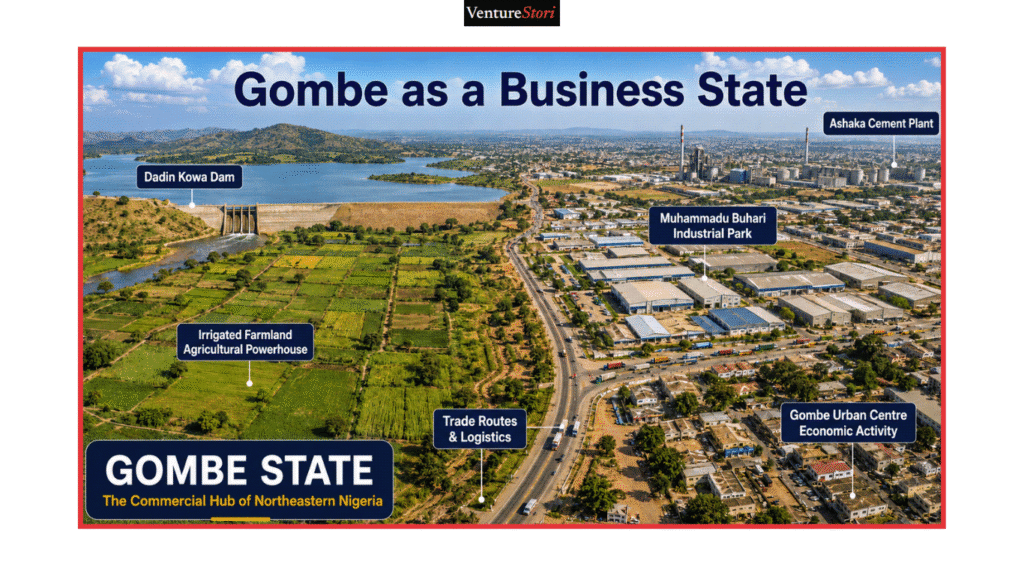
Gombe as a Business State.
Created in 1996 from portions of the former Bauchi State, Gombe occupies a strategic position in Nigeria’s northeast. The state covers 20,265 square kilometers across 11 local government areas, making it relatively compact compared to neighboring states. This compactness has shaped its commercial development, concentrating administrative and service functions in Gombe city while distributing agricultural and resource extraction across the wider territory.
Gombe City functions as the state’s administrative, commercial, and service center. Government offices, banking headquarters, major markets, and professional services cluster in the capital, drawing commerce from across the state and neighboring regions. The city’s growth reflects both its official status and its emergence as a genuine commercial hub for the surrounding agricultural hinterland.
Agriculture remains the economic foundation. The state’s farmers produce maize, millet, sorghum, beans, groundnuts, cotton, soybeans, vegetables, and livestock. This agricultural base feeds local consumption, supplies regional markets, and provides raw materials for emerging processing industries. The Nigeria Bureau of Statistics (NBS) data indicates agriculture remains a major source of employment in Gombe, particularly in rural areas, while self-employment and informal employment dominate the labor market overall.
The state’s location between major northeastern markets, Bauchi to the west, Borno and Yobe to the east, Adamawa to the south, and Taraba, positions it as a trading and transport point. Goods move through Gombe City in multiple directions, creating opportunities for logistics, warehousing, and wholesale distribution businesses.
Dadinkowa Dam represents critical infrastructure for agricultural development. The dam provides irrigation water that enables dry-season farming, supports the state’s agricultural production targets, and underpins the Muhammadu Buhari Industrial Park’s water requirements. The relationship between water infrastructure, agricultural output, and industrial processing defines much of Gombe’s current development strategy.
Ashaka Cement, located in Funakaye LGA, anchors the state’s manufacturing and minerals sector. The plant has operated for decades, providing employment. The company’s 2026 expansion plans signal continued investor confidence in the state’s industrial potential.
The Muhammadu Buhari Industrial Park at Dadin Kowa represents the state’s most significant recent industrialization project. Spanning 1,000 hectares in the Yamaltu-Deba LGA, the park is intended to concentrate agro-processing, manufacturing, and related industries in a single location with infrastructure support. Premier Seed Nigeria commissioned a seed-processing facility there in 2025, marking the transition from planned development to an operational industrial zone.
The state government has emphasized digital government, ease of doing business, and investment facilitation in recent years. Official platforms present Gombe as a leading ease-of-doing-business state and report significant growth in internally generated revenue. These claims require cross-checking against independent rankings before acceptance, but the policy direction is clear: Gombe is positioning itself as a commercially competitive northeastern state.
There are shades of security context. Relative stability is the reason Gombe is not experiencing such chaos as some neighboring states, and it has been a part of its investment offer. But the state government has recognized that security challenges to economic activities, such as threats from neighboring states and farmer-herder conflicts, are a risk. Security is not the same everywhere in the state or at any one time and impacts agricultural production both on an area-by-area basis and over time; decisions regarding market access and investment in a given area are influenced, but not uniformly, by the security situation.
The Active Sectors
Agriculture and Agro-Processing
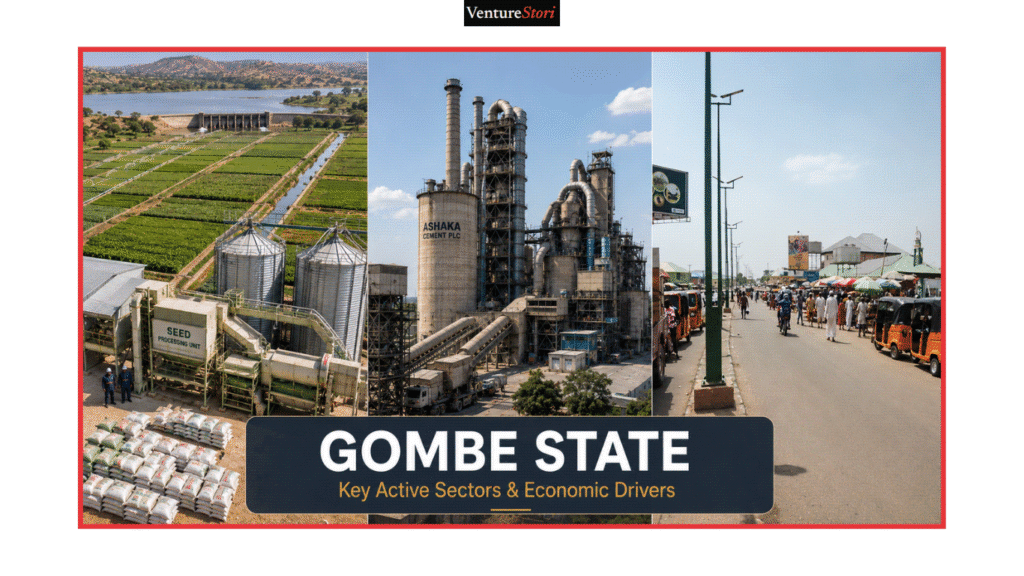
Gombe State’s economy relies heavily on agricultural production. Maize, millet, sorghum, beans, groundnuts, soybeans, cotton, and vegetables are the major crops in the state. There are a number of specializations in certain areas, with widespread production.
Kwadon, outside the city of Gombe, is an important vegetable trading center. The market for watermelon in Kupto and Dadinkowa is huge.
The irrigation facilities in the surroundings of Dadinkowa facilitate dry-season agriculture and extend the production period of crops that need reliable access to water. This irrigation capacity helps to support the agro-processing potential of the state. Processing plants need a regular supply of raw materials, which rain-fed farming cannot provide.
The processing opportunity covers the production of seed, commodity aggregation, cold chain logistics, storage, packaging, and food processing. The establishment of Premier Seed Nigeria’s own facility in Dadin Kowa Industrial Park is a good illustration of this shift from raw agricultural commodity exportation to processing them into higher-value products.
Industrial Manufacturing
Ashaka Cement is one of the significant manufacturing companies in Gombe State. In Funakaye LGA, the plant has been in operation for decades, turning local limestone and gypsum into cement for use in the local construction market. In February 2026, Lafarge Africa announced expansion plans that will see the plant’s capacity rise to around 2 Mtpa upon completion. Current reporting has also revealed that the ownership of the facility has been changing over and that there has been a renewed interest in investing in the facility.
It shows that industrial companies that are already in place recognize the potential for growth in Gombe.
Industrial Park and Agro-Industrial Businesses
Dadin Kowa is the Muhammadu Buhari Industrial Park, which needs to be given significant attention during any discussion of the Gombe industrial park. The 1000 ha site in Yamaltu-Deba LGA is strategically located as the State center for industrial and agro-processing.
The park’s first major operational anchor comes from Premier Seed Nigeria’s operational seed processing facility, which was commissioned in 2025. The centre cleans seeds for the farmers to grow, thereby creating the linkage between agricultural input supply and agriculture base in the state.
According to the state governor, 16 companies have been approved out of 380 applications as of 2025, with some companies in different stages of construction and operation. The numbers of companies operating, construction-stage projects, and approved applicants should be verified at current reporting until 2026.
Park infrastructure consists of roads, water supply and power lines to be used in agro-processing, manufacturing and allied industries. The park generates the need for suppliers, logistics providers, packaging, food processing, and professional services firms for local businesses.
Trade and Commerce
Gombe City is a regional commercial center. The capital is dominated by wholesale/retail trade, agricultural commodity marketing and transport services, food distribution, and SME activity and building materials supply. The Gombe Urban market and Tudun Hatsi area process a considerable amount of grain trade which links the rural and urban centers and inter state trade.
This trading activity provides opportunities for logistics companies, warehousing providers, commodity brokers and financial services companies in the field of trade finance.
Mining and Mineral Resources
The cement industry derives limestone and gypsum deposits as supporting materials in Funakaye LGA. There are also other mineral resources in the state, but only these are being commercially mined to a limited degree, depending on the mineral and location. The editorial angle here is the relationship between mineral resources verified and the existing manufacturing (Ashaka Cement) and potential future industrial development, not speculative resource estimates.
Logistics and Regional Trade
The logistics firms located in Gombe are benefited by the geographical location of the region in the center of the northeastern part of the state. Gombe’s production is linked to various markets in neighboring states through the services of trucking and warehousing as well as commodity movement and transport services. There is a constant demand for logistics services due to the transport of farm produce from the rural regions to processing centers and markets or intermediaries and state buyers.
Logistics services are also in high demand because farm produce must be transported from rural production areas to processing facilities, markets, and intermediaries or interstate buyers.
Technology and Professional Services
Gombe City has an expanding economy of professional services for the government, SMEs, universities, health services, real estate, and emerging businesses. The legal, accounting, consulting, digital services, telecommunications, education, and financial services sectors are growing but are still geared towards established markets, not venture-scale startups.
Tourism and Hospitality
Visitors come to experience the attractions of Dadinkowa Dam, Balanga Dam, Kaltungo’s hills, and accommodation, food service, events, and transport and recreation businesses. The commercial aspect is not just a listing of attractions but the hospitality industry that serves travellers.
The Business Districts and Key Area Support
Gombe City
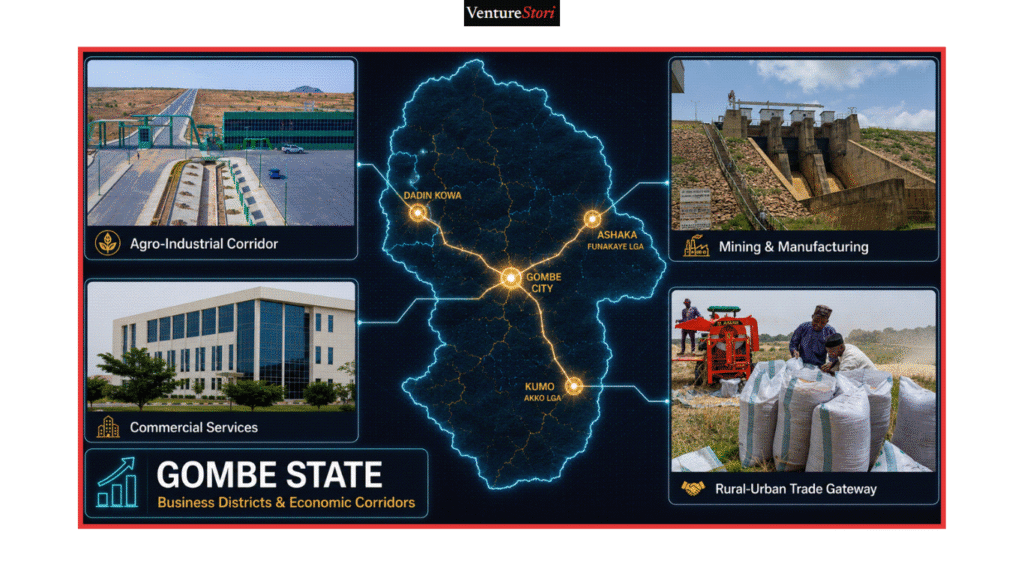
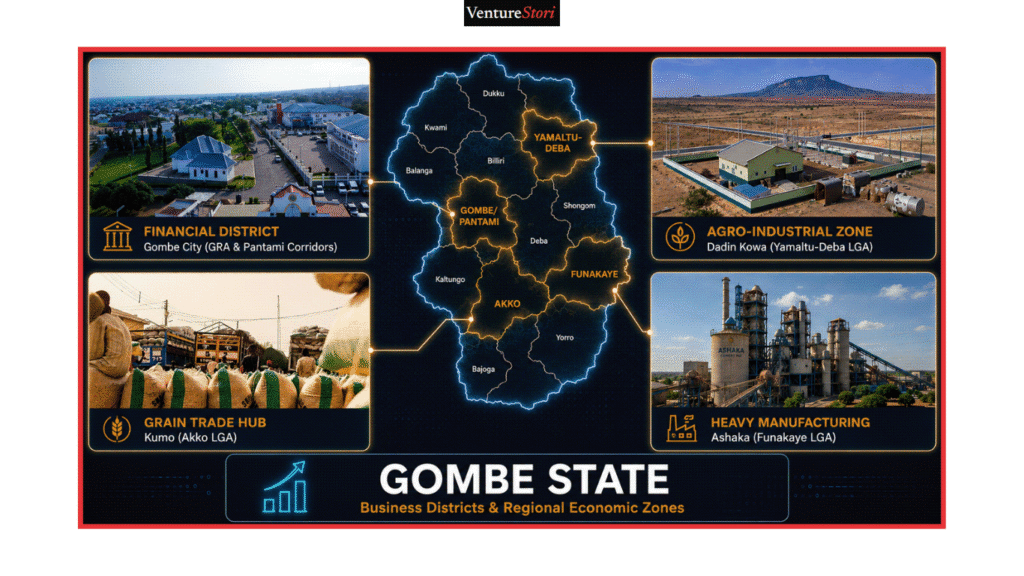
The financial center is the focus of the state’s trade. Retail, wholesale, banking, and day-to-day business are located in the central commercial district and in the major market areas. Offices, professional services, hospitality, and higher-value retail are found along the GRA and the major arterial corridors. GRA Road and the Pantami are clusters of government, institutional, and commercial activities.
Nassarawo and other existing trading areas dealdeal with commodity trading, food distribution, and the activity of SMEs. The Kwadon corridor is a little away from the immediate city center, conducive to agricultural production and vegetable-market activities.
They play various roles in the commercial ecosystem, including direct government contracting and providing professional services, trading in commodities, and retail distribution.
Dadin Kowa / Yamaltu-Deba
This is the building-up corridor of Gombe’s industrial and agro-processing zones. The Muhammadu Buhari Industrial Park, the agricultural processing infrastructure of Premier Seed, and the irrigation infrastructure of Dadinkowa Dam, which has related agricultural processing, are peculiar economic geographies that operate outside of the state capital. Most of the companies are concentrated around industrial processing, supply and logistics for the industrial park in the agriculture sector.
Kumo / Akko Corridor
Kumo is a big commercial and agricultural market center, where businesses are located. The town serves as a center for collecting goods from the rural areas nearby and distributing goods to larger markets. Dominating are the trading activities of agriculture and transport of goods and their retail sale, which link the rural producers to the urban and country buyers.
Ashaka / Funakaye
Ashaka is known as the state’s industrial and mineral corridor. The cement establishment and its gypsum-related activity have established a unique economic zone, which has shown that the industrial geography of Gombe is not limited to the state capital. Associated businesses are those that supply the cement and provide transport and provide services to the associated cement business.
Investment and Development Activity
This is most evident in the Muhammadu Buhari Industrial Park and Premier Seed Nigeria’s operational base. The expansion of Ashaka Cement is a tangible investment in the existing industrial capacity of the company for 2026. The stated goal of producing about 2 million tons of capacity annually when finished, point to the state’s ongoing commitment.
The Dadinkowa water supply system remains a base for the development of agriculture and for crop cultivation during dry seasons, thereby providing raw materials for the processing sector.
Through development finance programs in infrastructure, agriculture, and climate resilience, the State aims to encourage investment in priority areas through GoInvest and other agencies.
Road and transport infrastructure investments seek to link production areas to markets and/or processing plants, but not all investments are finished or of high quality.
Who Is Building Here ?
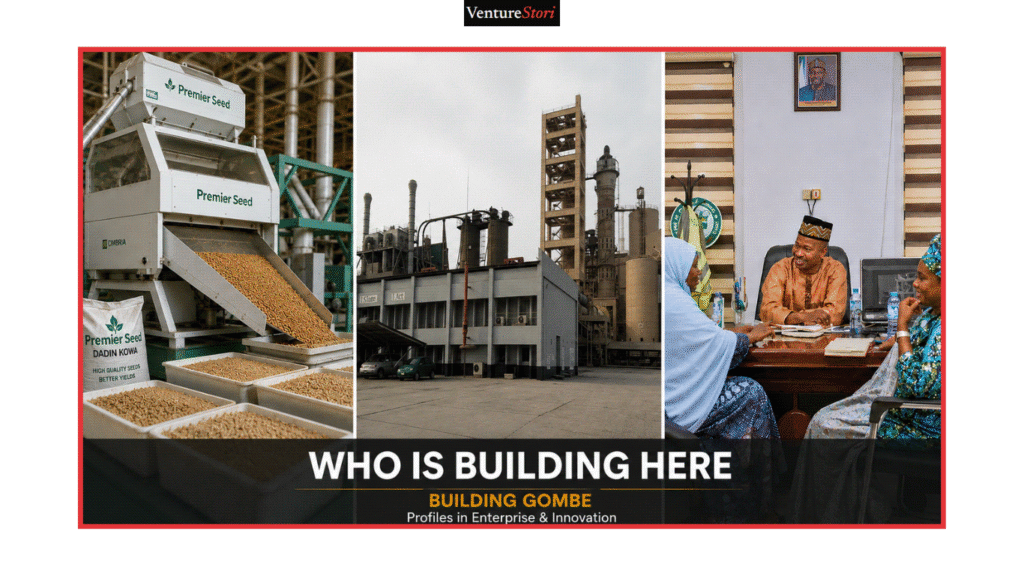
The seed-processing plant is located at the Muhammadu Buhari Industrial Park and is run by Premier Seed Nigeria. The company not only trades raw commodities to farmers; it processes seeds for distribution to farmers.
Ashaka Cement / Lafarge Africa is going to expand its Funakaye LGA plant in 2026 and is expecting an annual capacity of about 2 million tonnes. This is a successful industrial player showing that Gombe can maintain long-lasting industrial investment and continue to stimulate investments in growth.
The Paid Listings Directory
Gombe State Business Directory
The following listings are paid placements from businesses operating in Gombe State. Venture Stori editorial content above is independent of this directory.
Agro & Solid Minerals Hub
Explore Enterprise & Investment Across Bauchi State
From multi-billion dollar investment pipelines and solid mineral exploration to vast agricultural value chains and Yankari eco-tourism, access verified enterprise listings and commercial insights in Bauchi. Access the Bauchi State Business Directory →