The Ebonyi State Business Directory highlights a region rich in two major economic drivers: commercial agriculture and vast solid mineral deposits. Primary commercial enterprises featured across the Ebonyi State Business Directory range from large-scale rice production and processing in Abakaliki to industrial extraction of limestone, salt, lead, zinc, and granite. According to the Nigerian Investment Promotion Commission (NIPC), Abakaliki serves as a primary source of limestone and salt reserves in Southeastern Nigeria.
While Abakaliki has long stood as the central administrative and trading hub, regional centers such as Afikpo, Onueke, Ishiagu, Uburu, and Okposi actively contribute to the state’s expanding commercial economy.
Ebonyi State as a Business State
Ebonyi was created in 1996 from parts of Enugu and Abia states. It has 13 local government areas and covers about 5,935 square kilometers. Abakaliki, the capital, serves as the largest city.
The state is currently listed at about 3.2 million by NIPC. The population recorded is based on the last census, which was taken in 2006. This state is known to be major when it comes to agriculture. Produce like rice, yams, cassava, maize, groundnut, and other crops support farming communities and commercial activity. However, in Ebonyi State, rice is beyond just an agricultural commodity. In Abakaliki, it has become part of the state’s commercial identity and is supported by a long-established processing ecosystem.
The Abakaliki Rice Mill Industry has been in operation since the 1960s and is still a major center for milling, de-stoning, packaging, and sales.
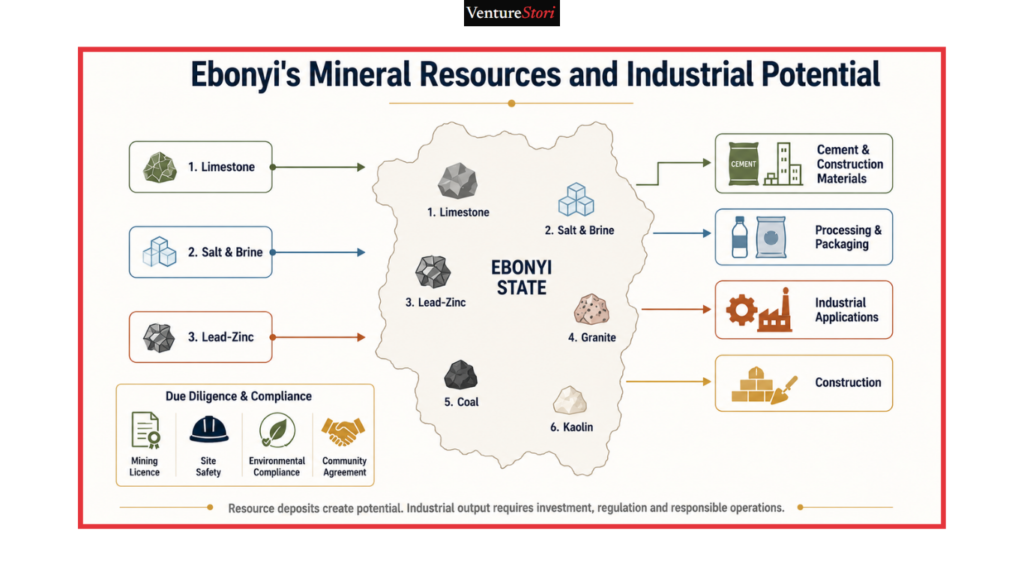
The mineral resources are another commercial pillar in Ebonyi State. NGSA’s geological map identifies limestone, salt, brine, lead-zinc, granite, coal, kaolin, and other mineral resources across Ebonyi. It also highlights the state’s relevance for investors in lead-zinc, limestone, and salt.
Meanwhile, the commercial geography of Abakaliki is undergoing change with the expansion of its infrastructure. NIPC mentions the Centenary City development and ring-road infrastructure in the state’s investment proposition.
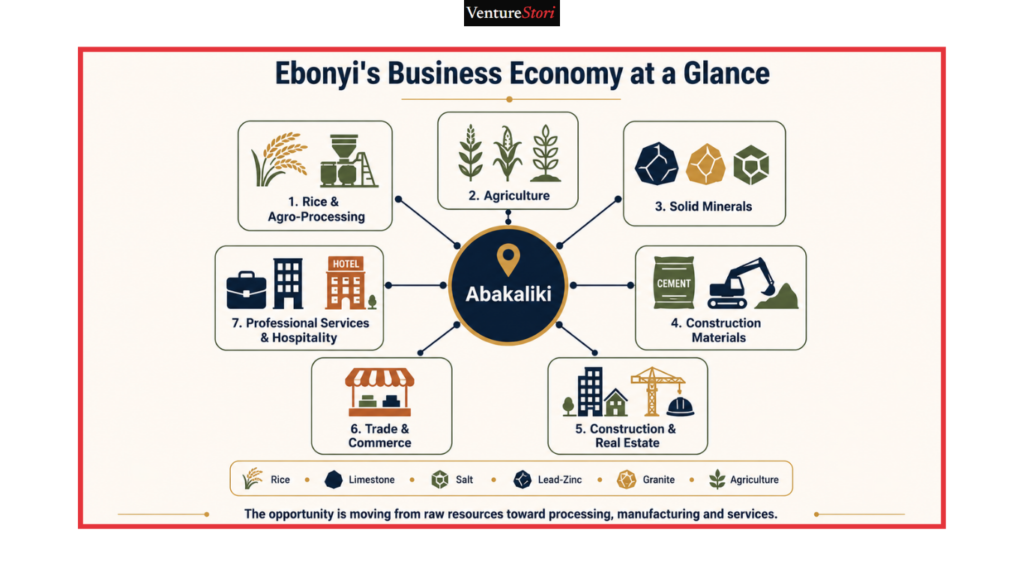
The Active Sectors in Ebonyi
Rice and Agro-Processing
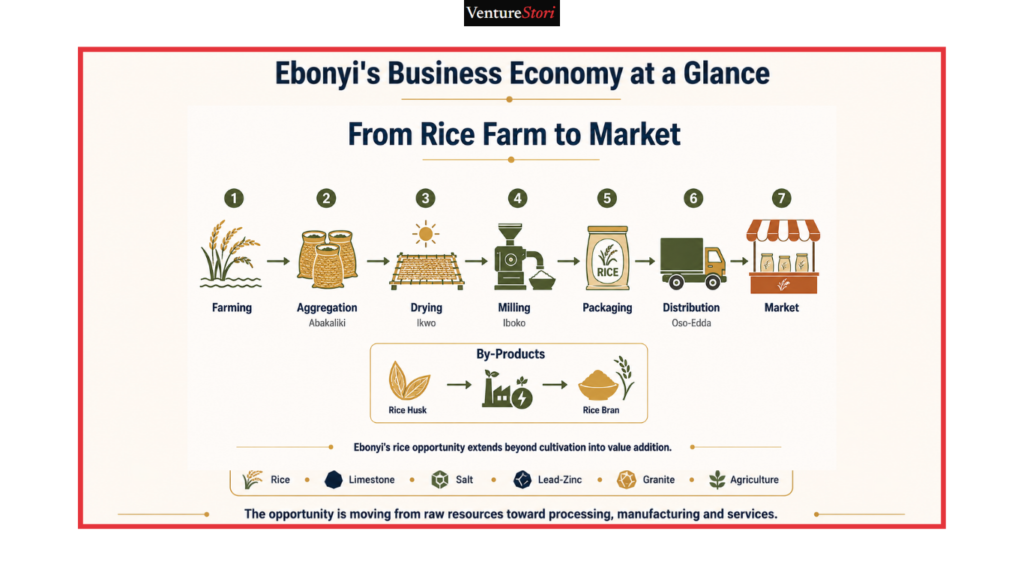
Abakaliki is known for rice production and processing, including the Abakaliki rice mill that has been in existence for a long time. Other modern processing clusters are also found in Ikwo, Iboko, and Oso-Edda. This opportunity now extends beyond milling.
The farmers, aggregators, and processors can participate in cultivation, threshing, drying, milling, packaging, storage, and distribution. Other by-products such as rice husk and bran have also shown potential for generating value.
One way to increase the value was an event that occurred on April 28, 2026: an investors’ forum organized by the Raw Materials Research and Development Council (RMRDC), EBSMEDA, and other partners. This forum examined rice processing, quality control, and converting rice by-products into marketable products. The Bank of Industry also participated in the forum by bringing financing into the investment discussion. This effort shows where Ebonyi’s agricultural strategy is heading, from field to factory.
The Ebonyi Investment and Property Company has identified partnerships with established processors, including Labana Rice, Dangote Mills, and BUA Rice, as part of its corporate strategy.
Private businesses already illustrate the processing opportunity. Enyi Industry operates in Ikwo and focuses on rice and cassava processing, while 3EK Rice Mill operates on the Enugu-Abakaliki Expressway.
Cassava, Yam and Other Agriculture
Even though rice dominates the market, there are other agricultural products in Ebonyi.
Different opportunities have been discovered from cassava, yam, maize, vegetables, and groundnut, which are found in processing, storage, animal feed, food manufacturing, and agricultural logistics.
Consequently, the businesses that solve the problem of distribution and post-harvest activities are as important as the activities on the farm itself.
Solid Minerals
Abakaliki soil is known to contain high-quality limestone and other mineral resources. Salt and brine resources are abundant in areas such as Uburu and Okposi, while lead-zinc resources can be found throughout the state. NGSA’s mineral map provides a useful geological reference for these resources.
However, the deposit should not be confused with industrial output. Mining and quarrying occur in certain areas of Ebonyi State, but the industry also faces regulatory, safety, and community concerns. A 2025 mining-pit collapse at Ihietutu in Ishiagu killed two people and left three people injured, and this led to the sealing of the site.
This is worth mentioning as it shows why investors should check licenses, operating conditions, and community agreements before considering mineral potential as a simple opportunity.
Cement and Construction Materials
Limestone is a raw material needed for cement and construction-material production.
NIPC identifies that the availability of limestone in Ebonyi and the dependence of the southeastern regions on it are potential manufacturing opportunity.
Construction and Real Estate
There are construction activities in Ebonyi State that are supported by infrastructure programs.
The road projects, public buildings, commercial developments and the Centenary City project all create demand for contractors, engineers, architects, building-material suppliers, property firms, and hospitality businesses.
There is also an industrial city under development at Izhiangbo in Ohaukwu which is identified by the state’s investment company, and this is ongoing alongside commercial infrastructure such as the Ebonyi International Market and Shopping Mall.
However, these projects should still be assessed according to their actual implementation stage rather than their announced objectives.
Trade and Commerce
Abakaliki’s markets help sellers, both wholesalers and retailers, to trade in food, agricultural commodities, building materials and consumer goods. These businesses also connect producers with consumers across Ebonyi and neighboring southeastern markets.
Afikpo and Onueke are other commercial hubs, especially for local services and agricultural trading.
Professional Services
With an increase in investments comes an increase in professionals such as lawyers, accountants, consultants, estate agents, engineers, architects and financial institutions. The services they render form an important support layer for farmers, traders, construction firms, manufacturers, and investors.
Hospitality and Tourism
In Ebonyi state, hospitality serves as a supporting rather than a dominant economic engine. The growing infrastructure generates demand for hotels, restaurants, event venues, and short-term accommodations. Tourism activities also provide opportunities for cultural and natural attractions.
Commercial potential is at its best when tourism is linked to the hospitality and food sectors and transportation and events.
Business Districts and Key Areas in Ebonyi
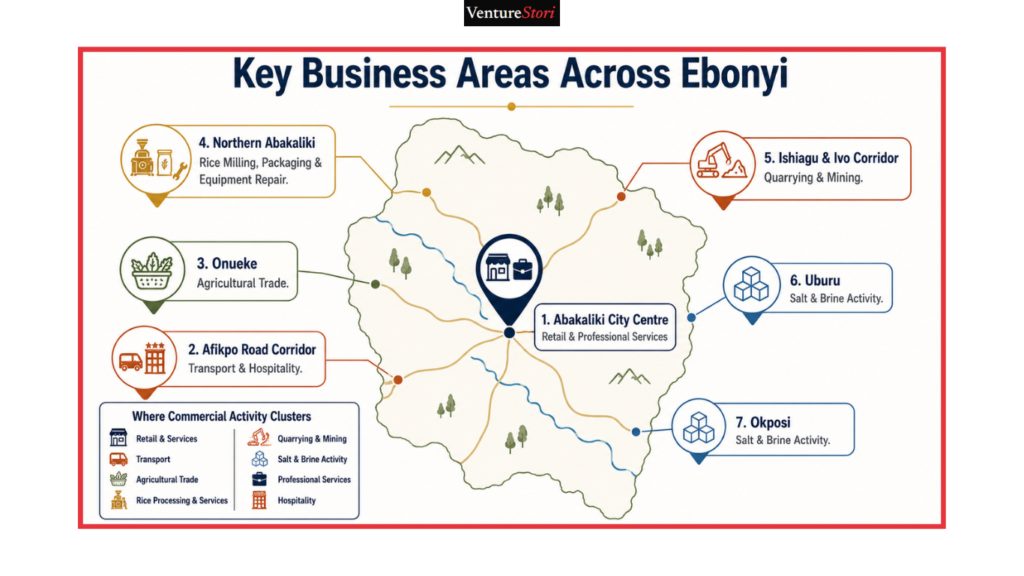
Abakaliki City Centre and Market Areas
The center of Abakaliki is where retail, wholesale, banking, government services and professional businesses are concentrated. This location is great for businesses targeting everyday consumers and traders.
Afikpo Road Corridor
This area joins commercial activity with residential communities and southern parts of the state. Businesses such as retail, transport, hospitality and professional services operate along the route.
Onueke Road and Onueke
This area is an important commercial center beyond the capital. Its economy is closely connected to agriculture, markets, transport, and surrounding farming communities. Businesses operating here can therefore access both local consumers and agricultural supply chains.
Rice-Processing Areas
The northern Abakaliki rice mill is known for agricultural businesses. Activities such as Milling, packaging, paddy aggregation, equipment repair, transportation and food trading operate around this ecosystem.
Ishiagu and the Ivo Corridor
This location is peculiar to Ishiagu, Ebonyi’s quarrying and mining economy. There is active
Quarrying and mining activities in this area, but since it is a regulated area, investors will have to conduct proper due diligence to ensure that regulatory and safety matters are taken into consideration. The commercial activity is illustrated by recent activity with Greenfield Metals and other operators.
Uburu and Okposi
This location is rich in salt and brine, and the existence of these resources creates opportunities in extraction, processing, packaging and industrial applications.
Investment and Development Activity in 2026
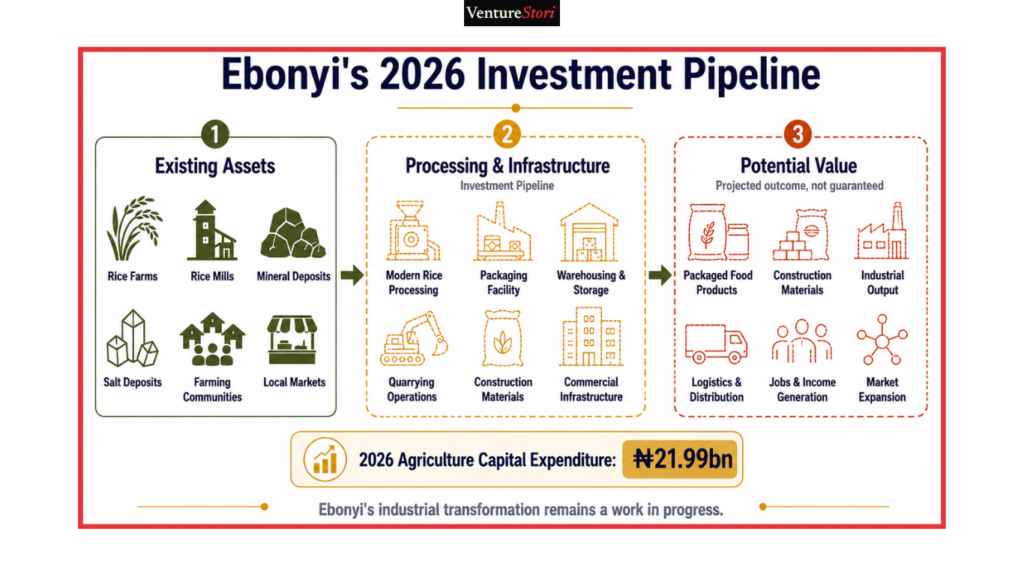
The current strategy of Ebonyi State is to convert natural resources into higher-value economic activity.
The investor forum that took place in April 2026, the rice investors’ forum, is one of the clearest examples. It brought together farmers, investors, entrepreneurs, financial institutions, and government agencies around processing and value addition.
The state’s investment company has also set ambitious targets for increasing rice production, expanding processing capacity, and developing export opportunities. These targets should be distinguished from completed projects. Business-environment reform is another part of the 2026 agenda.
In July, the Presidential Enabling Business Environment Council (PEBEC) hosted a state engagement with the Ebonyi Chamber of Commerce, Abakaliki rice-mill operators, mining unions, quarry owners, market associations, and transportation workers. The state’s 2026 budget also assigns significant capital spending to agriculture. The approved budget documents show a proposed ₦21.99 billion in capital expenditure for agriculture.
At the same time, Ebonyi continues to promote mineral investment. NGSA’s geological work provides technical information for investors investigating limestone, lead-zinc and salt deposits. The overall picture is promising: Ebonyi has real productive assets and growing infrastructure, yet much of the industrial transformation remains a work in progress.
Who Is Building Here?
3EK Industries
3EK Industries focuses mainly on modern food processing. Its rice mill is located on the Enugu-Abakaliki Expressway and focuses on processing and customized packaging rather than investing in raw agricultural production alone.
Enyi Industry
Enyi Industry’s operation is at Ikwo, and it combines agricultural production with rice and cassava processing. Its location outside Abakaliki makes it possible to distribute across the state.
Abakaliki Rice Mill Industry
The Abakaliki rice mill, which has been in existence for many years, is still one of Ebonyi State’s most important commercial institutions. Its presence connects farmers, processors, traders, transporters, technicians, and consumers.
Ebonyi Investment and Property Company
The state-owned investment company is engaged in investment facilitation and commercial infrastructure work. Agriculture and industrial infrastructure and private sector partnerships are included in its corporate plan.
Explore Ebonyi Business Categories
Ebonyi’s commercial opportunity is more than just being painted as a rice-producing state. Rice gives the state an established value chain, while minerals provide an industrial base that can be underdeveloped.
What’s more important for investors is what can be done in terms of processing and manufacturing locally. As more rice is packaged as food and more minerals are used for construction and industry, Ebonyi can realize significantly more value from the resources available.
For now, businesses in Abakaliki remain the most visible part of that transformation. However, the longer-term opportunity extends across the state’s agricultural, mineral and commercial centers.
Explore Enterprise & Investment Across Bauchi State
From multi-billion dollar investment pipelines and solid mineral exploration to vast agricultural value chains and Yankari eco-tourism, access verified enterprise listings and commercial insights in Bauchi. Access the Bauchi State Business Directory →