Carved out from Sokoto State on August 27, 1991, Kebbi State has grown into the primary agricultural heartland of Northwestern Nigeria. With a population exceeding 4.7 million and a strategic border sharing routes with Niger Republic and Benin Republic, accessing a verified Kebbi State Business Directory is crucial for businesses looking to tap into regional trade, commercial logistics, and industrial partnerships.
Situated in the fertile Sokoto-Rima River basin, Kebbi leverages extensive irrigation networks to drive the nation’s largest rice-producing economy. Commercial hubs like Birnin Kebbi and Argungu—home to industrial giants like Labana and WACOT rice mills—continue to attract buyers, input vendors, and investors. Utilizing an updated Kebbi State Business Directory connects entrepreneurs directly with registered companies, freight services, and agro-processors driving commerce across the state.
Kebbi as a Business State
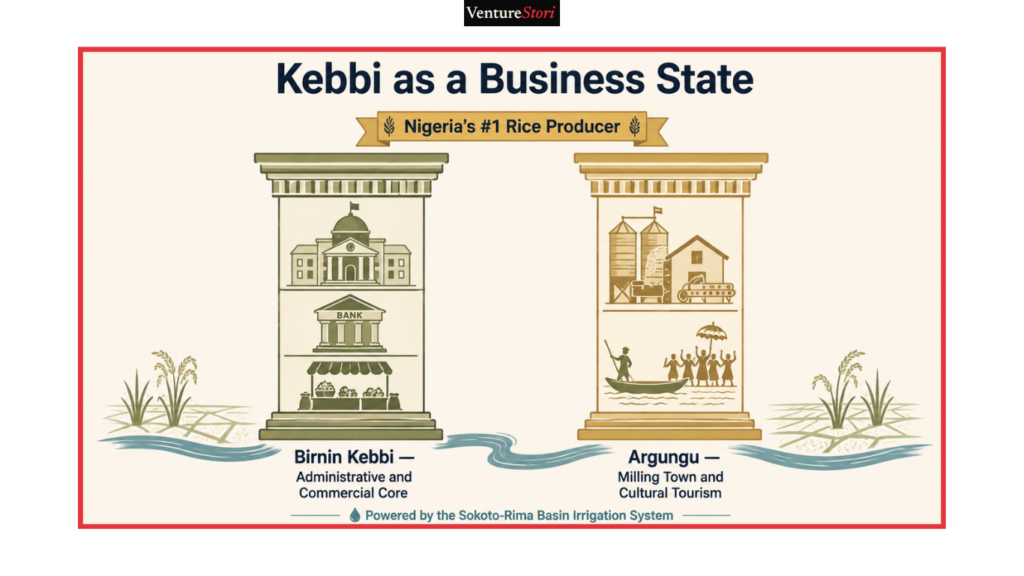
Kebbi’s borders are economically crucial for its cross-border trade and its agricultural sector.
Rice has remained a key factor of Kebbi State’s economy as the leading producer of rice in Nigeria. The annual Kebbi rice production increased from about 3.05 million tonnes in 2023 to about 3.15 million tonnes in 2024. The trend grew in 2025, with strong projections for 2026.
Kebbi has a rather unique edge in irrigated rice farming. In Argungu, farmers reportedly complete two rice cycles in the dry season. If you include the cycle during the rainy season, it sums up to three rice harvests in a year. Unlike the two rice harvest cycles that are common in many subtropical and tropical regions.
Kebbi’s rice production needs irrigation for better yields. On 1st July, 2026, the Governor of Kebbi State, Nasir Idris, confirmed that the state government handed out over 15,000 solar-powered irrigation pumps, 20,000 petrol-powered pumps, and 10,000 LPG-powered pumps. 110,000 truckloads of fertilizer and 100 metric tons of improved millet and rice seeds—carefully selected by agricultural experts—to about 120,000 farmers in a bid to reduce production costs, improve agricultural production, and improve the lives of farmers in the state.
The villain in Kebbi’s agricultural story is insecurity. Certain areas in the state have continued to experience insurgency from bandits and armed groups. The Yauri/Shanga/Ngaski axis is an area susceptible to insurgent attacks by armed groups from states along its borders, Niger, Zamfara, and Kwara states.
These attacks do not occur in every part of Kebbi State, but primarily in rural and border areas. However, the state still has a functioning commercial and agricultural sector in major areas of the state.
The Active Sectors
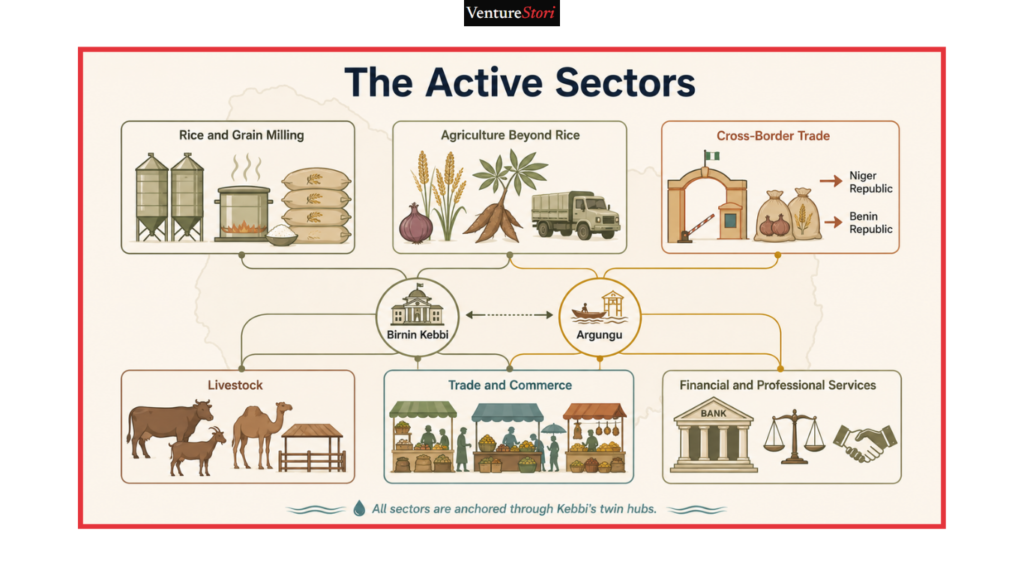
- Rice and Grain Production:
The heartbeat of Kebbi’s agricultural economy is rice. Rice cultivation happens in 15 of the 21 local governments in the state. The rice processing industry has grown in key towns in the state, including Birnin Kebbi, Argungu, and Kamba. Some of the state’s major rice mills include Labana Rice Mills in Birnin Kebbi, WACOT Rice in Argungu, and Dandi/Lolo Rice Mills in Kamba/Dandi. There are also other rice milling operations run by Olam and Umza.
Labana Rice Mills Ltd, located in Birnin Kebbi was founded in 2012 and operations resumed in November 2014. According to the company, the Rice Mill has two plants in operation with a combined capacity of 400 metric tonnes per day. Provisions have been made for an additional 300 metric tonnes per day plant to take its total capacity to 700 metric tonnes per day — which will make Labana the largest rice mill in Africa.
Presently, WACOT Rice Limited in Argungu, commissioned in 2017, is one of the biggest rice mills in Sub-Saharan Africa. The Rice Mill started operations with a yearly production of 120,000 metric tonnes, but its expansion has doubled its production capacity to 250,000 metric tonnes per year.
- Agriculture Beyond Rice:
Rice doesn’t make up the whole of Kebbi’s agribusiness sector, the state has favorable conditions for all-round farming. According to Kebbi’s Investment Promotion Agency (KIPA), the state has about 1.6 million hectares of cultivable land and an extensive major and intermediate river network — the Niger, Rima, Gulbin Ka, and Zamfara — that runs through the state and helps with irrigated farming. Year-round agricultural production happens in Kebbi, and it complements the rainy season with its massive irrigation system.
KIPA reports that, aside from rice, the other main agricultural products in the state include millet, sorghum, wheat, sugar cane, maize, onion, pepper, tomatoes, groundnut, sesame, cassava, and beans. Highlight the state’s diversity in agriculture
Kebbi is one of the largest producers of onion in Nigeria. Commonly grown in Aliero, Maiyama, and Gwandu. The state exports onions, vegetables, and other farm products to markets across Southern and Western Nigeria.
- Cross-border Trade:
Kebbi shares its borders with two neighboring countries, Niger Republic and Benin Republic, and that makes the state a major player in regional trade. In 2021, the state government called the state a hub for agricultural exports. The Director General of Kebbi Investment Promotion Agency (KIPA), Dr. Muhammad Kabir Kamba has said “The agency has continued to position Kebbi as a competitive investment destination and gateway to the West African market through strategic engagements, partnerships and advocacy initiatives.”
- Livestock:
Kebbi State is the second-largest producer of livestock in Nigeria after Yobe State. Cattle rearing and other forms of livestock farming play a major part in the state’s agribusiness economy. A report by the Ministry of Animal Health, Fisheries, and Husbandry estimates that there are about 1.8 million cattle, 2.2 million sheep, 2.8 million goats, and 50,000 camels, among other livestock.
- Fisheries:
KIPA estimates that there are about 320 fish species in the state and it is the largest producer of freshwater fish in Northern Nigeria and second in the country. The Ministry of Animal Health, Fisheries, and Husbandry says over 100,000 fishermen in over 500 fishing settlements in the state use the rivers in the state for their fishing.
- Trade and Commerce:
Argungu market is one of the major commercial hubs in the state and it has historically been a regional commercial hub and grain market where rice, millet, sorghum, and maize are sold to traders from Kebbi and neighboring states.
- Financial Services:
Birnin Kebbi, the state capital, is home to a couple of formal banking institutions. The Kebbi State Investment Promotion Agency says the commercial banks operating in the state capital include Access Bank, Zenith Bank, and First Bank, among others. The state also has its own financial institution — Kebbi Home Savings and Loans/Microfinance Bank.
- Professional Services:
Birnin Kebbi is home to a number of legal, financial, and privately owned businesses. The state capital is also home to several state-owned institutions.
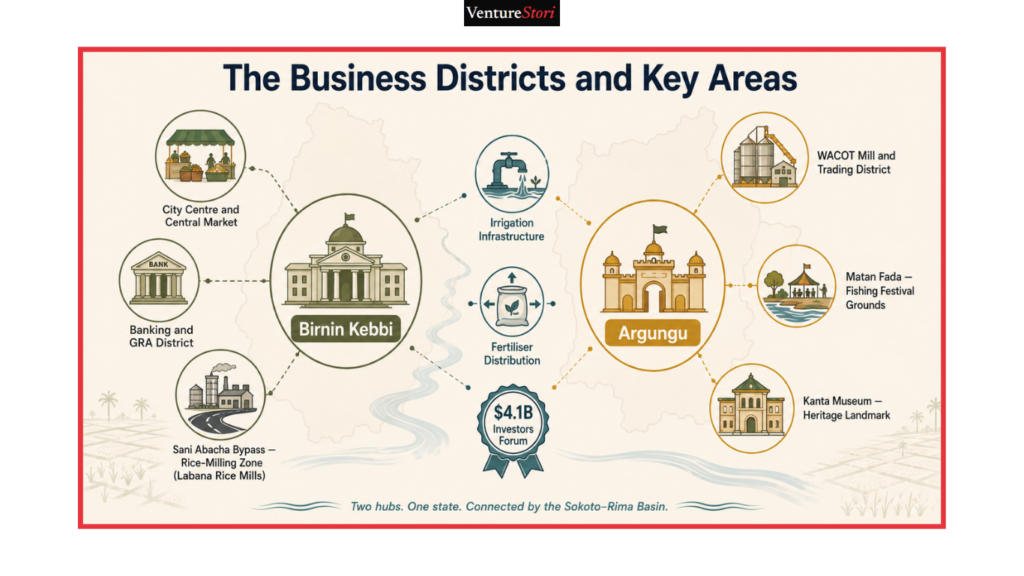
The Business Districts and Key Areas
- Birnin Kebbi
The state’s capital also serves as the administrative and commercial capital of the state. Its central market and grain market make it a trading hub, while the state’s governmental institutions in the city govern the state.
In addition, there are also industrial companies in the city. One of which is Labana Rice Mills — one of the state’s agro-processing facilities — located at Km2 off Sani Abacha Bypass, Harasawa, Birnin Kebbi.
- Argungu
Argungu is one of the major commercial and agricultural hubs in the state. The market attracts and connects local buyers and buyers from neighboring states to traders in the market, it is similar to how Sabi Marketplace links suppliers and merchants on its platform.
It is not only known for its rice production but also for its tourism. WACOT Rice Limited in Argungu has a yearly production capacity of 250,000 metric tonnes that serves customers and farmers alike.
Commerce and agriculture aside, Argungu hosts the Argungu International Fishing Festival that started in 1934. The fishing festival has become not just a symbol of cultural unity but also one of the most popular tourist attractions in Nigeria.
The festival which last took place from the 11th to the 14th of February, 2026 had previously been paused in 2010 and 2020, and attracted thousands of fishermen and spectators. The fisherman who won caught a croaker weighing 59kg.
Investment and Development Activity
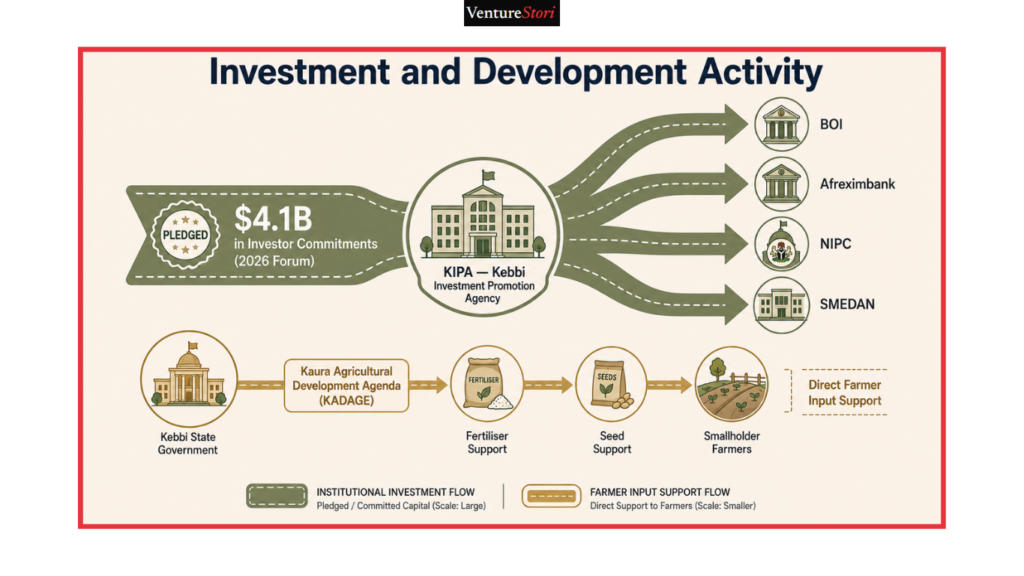
In June 2026, the Kebbi Investment Promotion Agency (KIPA) hosted the inaugural Kebbi Investors Forum in the state. The Director General of KIPA, Dr. Muhammad Kabir Kamba, disclosed that the agency has attracted global investors since its inception in 2023 and it has received about $4.1 billion in investment commitments across all sectors.
He also disclosed that the agency has partnered with the Nigerian Investment Promotion Commission (NIPC), Bank of Industry (BOI), SMEDAN, amongst others, as part of its plans to link Kebbi State with national and regional frameworks.
While speaking on regional coalition, he said that investment promotion agencies in all seven Northwestern states are jointly working to build an energy plant that would serve them all.
About 120,000 farmers have received free fertilizer and improved seeds ahead of the 2026 wet season through an intervention program under the Climate Change Adaptation Seed Support Programme and the Kaura Agricultural Development Agenda (KADAGE). The state is looking to revolutionize its agricultural sector the same way Releaf is revolutionizing palm oil processing in Nigeria.
Note: Venture-backed startups in Kebbi are not publicly disclosed on the Kebbi business directory.
Who Is Building Here
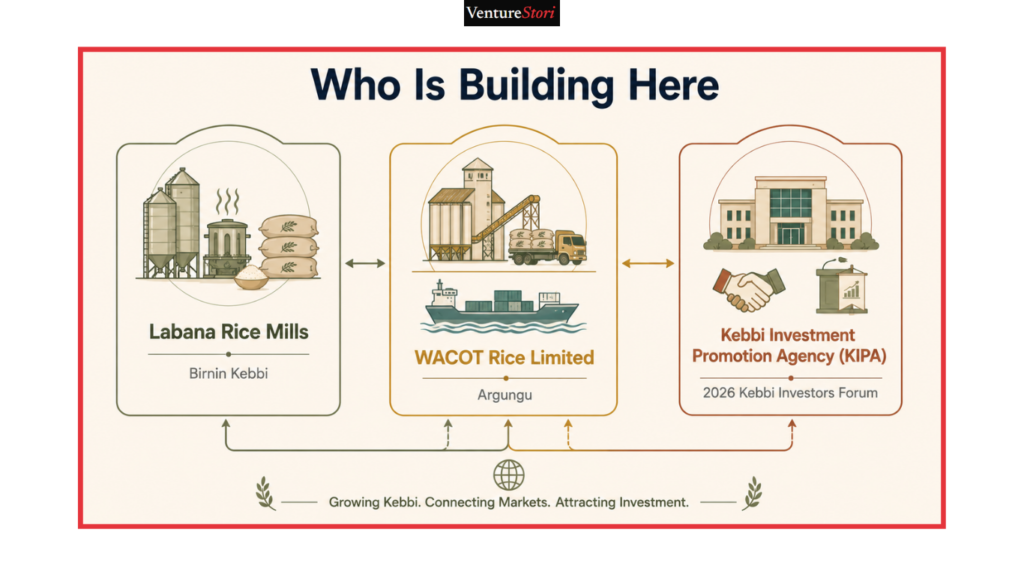
- Labana Rice Mills is one of the indigenous Rice Mills in Kebbi. Labana was one of the rice mills involved in the Lagos-Kebbi rice partnership and production of Lake Rice.
- WACOT Rice Limited is one of the largest rice mills in Sub-Saharan Africa. Big Bull and Patriot brands — two leading brands of parboiled rice — are produced by WACOT and exported beyond Kebbi’s borders.
- Kebbi Investment Promotion Agency (KIPA).
Kebbi State Company Listings
Note: The following listings are paid placements from businesses operating in Kebbi. Venture Stori editorial content above is independent of this directory and is not influenced by, or contingent on, directory placement.
Listing template:
- Business name:
- Category:
- One-line description:
- Contact details:
- Website:
- Location within Kebbi: