How to create a marketing plan for Nigerian business is a challenge many entrepreneurs face because their marketing is often not consumer-specific. The process starts with a more important question than “which social media platform should I use?” It begins with understanding your target audience and why they should choose you over other sellers.
If you get these answers right, attracting customers becomes much easier. If you get them wrong, you risk spending your marketing budget with little or no results. This guide walks you through a practical approach to building a marketing plan that works in the Nigerian market.
Why Generic Marketing Plans Fail the Nigerian Buyer
The average Nigerian buyer is not price-sensitive or discount-focused as many marketing plans claim. They believe that Nigerian buyers just want the cheapest option, which is not true. They want quality, but they also want something that feels respectable, so they need convincing to make them go for it.
A buyer in Nigeria would pay for quality when she knows why it costs what it costs. She believes a friend’s recommendation more than a social media ad. She wants to see a product before she pays for it because she is aware of online fraud. Many Nigerians want to see testimonials. They want to see reviews. They want to see the before and after of a product, not just the feature list. That’s why they pay more attention to products that show the reality than a brand that just recycles global messages.
Digital marketing in Nigeria is expanding fast, and PwC projects that 84% of the total money spent on ads will be moved to digital channels by 2029, which is ahead of South Africa and Kenya. Many Nigerian businesses pour more and more money into digital ads every year, but many of them don’t see the results. More spending doesn’t mean better results because these ads are made for global audiences instead of a Nigerian audience.
A fashion brand can spend fifty thousand naira a week on just generic ads and may get five hundred clicks and two sales. During that same period, a competitor can spend twenty thousand naira a week on ads, but instead of just focusing on generic ads, the competitor focuses on customer testimonials and WhatsApp community activation and gets about two hundred clicks and fifteen sales.
The difference here is not about the budget. The difference is that the other brand understands their consumers.
How to Create a Marketing Plan for Your Nigerian Business: The 7-section Framework
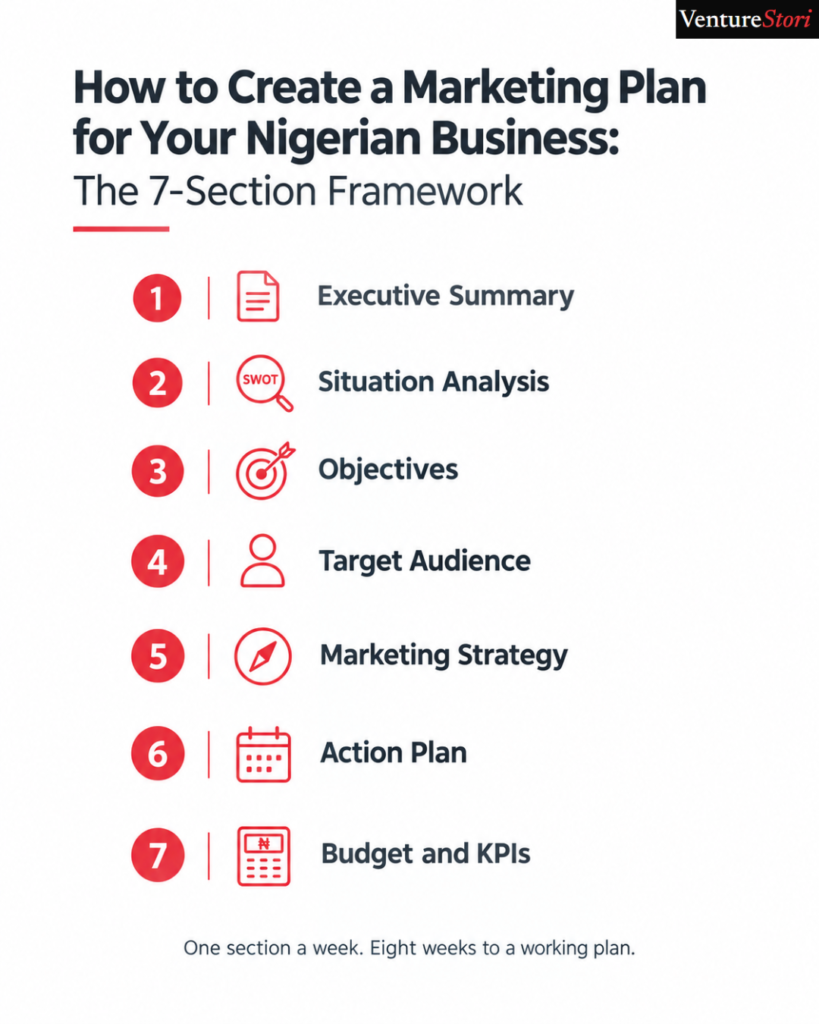
This is not a theory lesson. It’s filling the gap. You do a session every week, and by the end, you’ll have a working plan instead of a bunch of ideas just sitting in the notebook.
1. Executive Summary
It is a paragraph showing the name of the business, what the business is about, the opportunities, and the marketing goals in plain and simple English. So you would know what you’re doing, and another person who reads it would be able to understand what you’re doing.
2. Situation Analysis
It uses the SWOT formula. You look at your strengths, weaknesses, opportunities, and threats. If a wholesaler’s strength is a recipe, our weakness is unreliable supply. Our opportunity is a Lagos office worker needing lunch, and our threat is a new competitor nearby.
3. Objectives
Your objectives should be SMART. It should be specific, measurable, achievable, relevant, and time-bound. “Getting more customers” is not a goal, because it’s not specific. A specific goal is something like, “You get fifteen new customers every month, tracked on WhatsApp Business,” or “You grow from a hundred to two hundred and fifty customers in six months.” A goal should have a deadline and a number; it shouldn’t just be a plain sentence.
4. Target audience: for your target audience, you have to be specific. You have to talk about where she lives, if it’s on the island or the mainland, Lagos or Abuja, whether she would pay in cash or by transfer, and whether she would want to trust and pay before the item she purchased is delivered. These details are very important, and it shows how you should market your goods to your target audience.
5. Marketing Strategy
Firstly, your positioning has to be defined. Do you want to be seen as a premium, affordable, or trustworthy brand? Whichever one you decide, you build everything around that identity. For example, a fashion brand that is positioned as affordable but trusted could have priced items starting from four thousand to fifteen thousand and sell on Instagram and WhatsApp, promoting using real customer reviews.
6. Action Plan
Each activity should be well documented. You should assign real hours to the channels that you’d be using to advertise, and real timelines should be attached to them, not just vague intentions. For WhatsApp, you could schedule two to three hours per week. For Instagram, you could schedule three to five hours per week. The timeline should be stated.
If we don’t assign time to it, it won’t happen. Even the best plan won’t get done, because most activities that are not specific don’t get achieved.
7. Budget and KPIs
This is to track what you’re actually working on: how much it costs to get a customer, how many people end up buying the product after clicking, and how many people end up coming back. A realistic monthly marketing budget for a Nigerian SME is about three hundred thousand to five million naira, depending on the size of the business.
Channel Selection Matrix: What Works for Nigerian SMEs
| Platform | Price range | Time | Reach | Conversion | Best for | 2026 Reality |
| WhatsApp Business | Free to 5000 naira | 1 hour | 500 – 5,000 contacts | Very high | Primary sales, customer service | Most SMEs’ No. 1 channel |
| 5,000 naira to 100,000 naira | 2 hours | 1,000 – 100,000 plus ads | Medium and needs follow-up | Discovery and brand building | Still strong but the algorithm favours Reels | |
| TikTok | 5,000 naira to 100,000 naira | 2 hours | 5,000 – 500,000 | Medium-high | Trend-driven, Gen-Z and Viral campaigns | Growing fast |
| Google Business profile | Free | 1 hour | Local area | High | Local discovery and credibility | Essential for retail and service |
| Email/Newsletter | Free to 10,000 naira | 1 hour | Existing customers | Very high | Repeat sales, loyalty | Underused and has high return |
| 5,000 naira to 100,000 naira | 1 hour | 1,000 – 1 million with ads | Medium | Older demographic and targeting | Still relevant for detailed targeting | |
| Influencer | 10,000 naira to 500,000 naira | 2 hours | 10,000 – 500,000+ | High if the audience matches | Rapid reach and social proof | Creator led campaigns outperform brand ads |
| Offline | 50,000 naira to 500,000 naira | Varies | 100 – 10,000 Per event | Very high, face to face | Premium positioning | Still converts better than online |
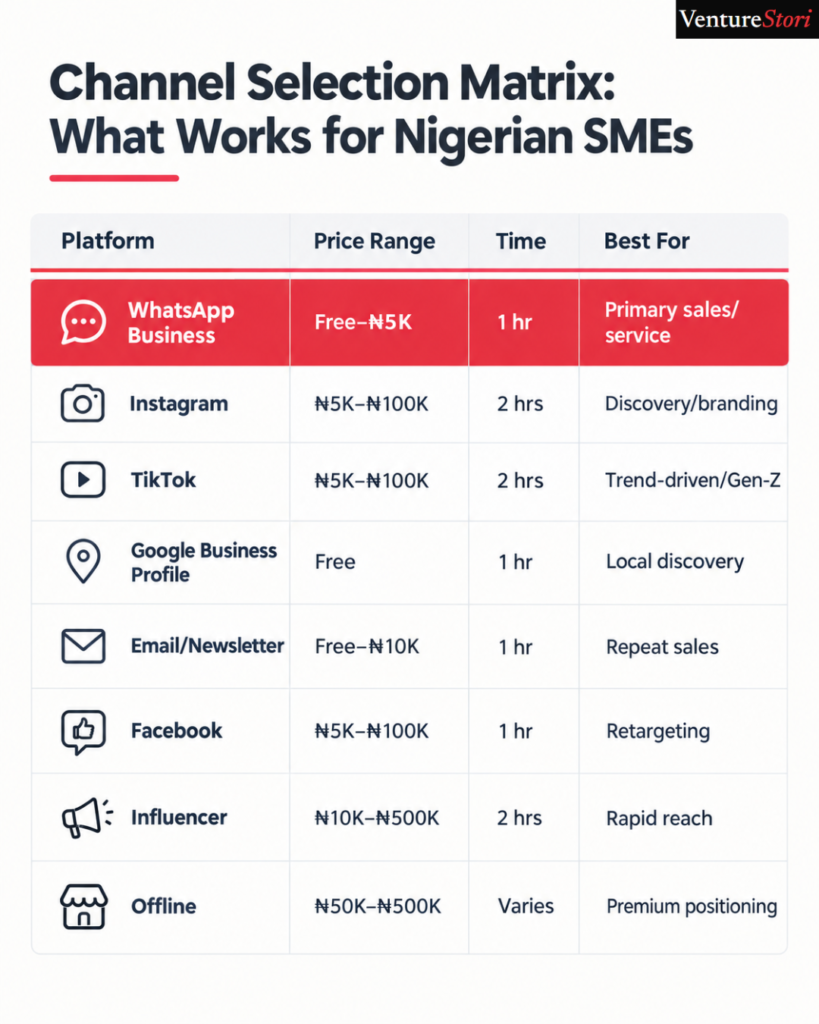
WhatsApp is considered the number one, trust-based channel with a very high conversion rate because 96% of Nigerian internet users are active on WhatsApp, according to DataReportal’s 2026 report on Nigeria.
WhatsApp is used for both personal and business conversations. So a business with a relatively low budget should start with WhatsApp and Google Business Profile, because both of them are free; then they can put the remainder into Instagram ads as a test, instead of dividing the money into all the social media platforms at once.
The Purposeful Positioning Framework: Answer This Before You Spend a Naira
Before you spend your money on marketing plans, there are five questions that you need to answer that play an important role in how the consumer perceives your product.
Question one: Who are you positioning yourself as, or what are you positioning your product as? Is it a problem solver, innovator, trusted friend, or status symbol?
Question two: Exactly who are you speaking to? Who is your target audience? You’ve got to be specific. It could be working-class women between the ages of twenty-eight to forty, earning about three hundred thousand or more, and who buy online.
Question three: Why should I choose you over our competitor? You give a specific reason as to why they should choose you. You give something that makes you stand out.
Question four: How do you want the consumer to feel? Do you want them to feel supported? Do you want them to feel stylish, trusted, or savvy?
Question five: What cultural reality are you speaking into? Is it Lagos traffic? Is it hustle culture? What is specific to the consumers you’re speaking to?
For example, a Lagos meal-prep service answered these five questions, and this was their marketing strategy: “Tired of Lagos food outlet prices? We bring you quality restaurants to your office at half the price.” This is not a tagline. This is not a phrase that is pulled from a template. It comes from knowing who the buyer is—corporate workers who are tired of eating out but still want a nutritious meal.
The majority of Nigerian SMEs skip this process of answering these questions and go straight into running ads, and this is why most of their ads do not convert. Clear positioning drives more sales than untargeted ads.
2026 Marketing Trends for Nigerian SMEs
Five things are changing in what Nigerian businesses need to market this year.
People buy the experience, not just the product. They want to see behind the scenes. They want to see unboxing clips. They want something that feels real, rather than something that feels polished or stitched together.
When prices change, customers want to be informed. They don’t want to find out when they’re about to purchase a product. They don’t want prices that just quietly rise. So when a price increase happens, give your customers a heads-up. Do not let them feel left out, find out on their own, or feel blindsided.
Optimize AI to the best of your capacity, because AI is doing a majority of the work now. AI can reply to WhatsApp messages, can even suggest content ideas to you when you feel stuck, and tell you which post or content is performing well, so you don’t end up guessing.
Nano influencers, with ten thousand to a hundred thousand followers, who have a real and engaged audience, get more results than celebrity influencers who just put out vague content.
The last thing to change is: do not put all your money into one channel; you are practically setting yourself up for loss. You need to learn how to split your budget. Put forty percent into paid ads, thirty percent into organic content, twenty percent for offline stuff and events, and then ten percent should be used in keeping existing customers happy. Most businesses that spread their budget across these different channels are the ones still standing when the algorithm changes overnight.
Three Nigerian SME Marketing Case Studies
Kai collective, a fashion brand founded by Fisayo Longe, moved from being her personal passion project to a global brand. They didn’t just post clothes on Instagram; they used Instagram as a runway and a community instead of a billboard. Andrea Iyamah, a Lagos-born designer, credits the same approach for her brand’s expansion into North America and Europe. She didn’t need the enormous money traditionally required to advertise internationally. She told Pulse that social media gave emerging designers a stage they couldn’t buy.
Lesson for businesses: build an audience, not just advertisements.
Swoop, a Nigerian food delivery company, built their ordering process inside WhatsApp instead of directing people to another app. They didn’t try to teach customers an entirely new behavior. The logic was that since customers are already using WhatsApp, they might as well be able to order their food there too.
The lesson of businesses: do not make your customers work unnecessarily hard to buy from you. Maximize a social media platform that they already use instead of making them accept a completely unfamiliar system.
Bumpa is a platform that helps businesses manage their business digitally. Instead of relying heavily on paid advertising from the beginning, they used things like cold emails, communities, and content from its founders. The founders were also posting online about themselves and their work. This visibility alone helped people become familiar with Bumpa.
The lesson for businesses: the trust built through founders showing up consistently online can outrun a bigger ad budget.
Your 8-Week Roadmap to Create a Marketing Plan for Your Nigerian Business
Week One: Position yourself. Ensure you know your strengths, your weaknesses, your opportunities, and threats. Note the outer trends.
Week Two: Know exactly who you want to sell to. Know your target audience, and it should be location-specific for Nigerians. You should know their location, their earnings, and their peculiarities.
Week Three: Set SMART objectives for what you want to achieve.
Week Four: Choose two or three channels for marketing, not ten channels. Using all channels would give lower results.
Week Five and Six: Pin down an actionable plan. It should be a real, actionable plan with timelines, not just ideas.
Week Seven: Have a budget. Decide how much you will spend, and also what you’ll use to measure your success.
Week Eight: Launch it. Watch it. Go back to your drawing board if it’s not working.
Where to Get Professional Help Building Your Plans
Getting Professional Help with Your Marketing Plan
When learning how to create a marketing plan for Nigerian business growth, you do not have to navigate advertising or strategy execution alone. Leveraging established industry bodies, regulatory guidance, and fractional experts can significantly streamline your campaign rollouts and ensure compliance.
1. Professional Marketing Organizations
If you are determining how to create a marketing plan for Nigerian business operations without prior industry experience, professional bodies offer valuable mentorship, networking, and direct access to qualified talent:
- National Institute of Marketing of Nigeria (NIMN): The primary professional body for recognized marketers across the country. Business owners can leverage NIMN resources to master ethical promotion, access certified consultants, and standardise strategic frameworks.
- Lagos Chamber of Commerce and Industry (LCCI): Connects enterprise founders with seasoned marketing executives, agency partners, and B2B growth networks through regular trade expos and commercial workshops.
2. Regulatory Compliance & Advertising Standards
Understanding regulatory constraints is a critical component when researching how to create a marketing plan for Nigerian business audiences:
- Advertising Regulatory Council of Nigeria (ARCON): Replaced APCON in 2022 as the primary authority governing commercial publicity. Any paid advertisement, broadcast, or public campaign must comply with ARCON vetting rules to avoid regulatory penalties.
- Meta Business Verification: Digital platforms like Facebook and Instagram require a verified business profile before running local ad accounts, making early CAC documentation and tax compliance essential.
3. Budgeting for Marketing Execution
Depending on your operational scale, executing your marketing strategy can involve varying budget levels:
- Fractional Marketing Consultants: Independent strategists typically charge from ₦100,000 per month for targeted campaign management and advisory services.
- Full-Service Marketing Agencies: End-to-end creative and media buying agencies charge up to ₦5,000,000 per month for large-scale corporate retainers.
Complete Your Official Tax Compliance Setup
Whether you need a Tax Identification Number (TIN) to open a corporate bank account, apply for government licenses, or ensure FIRS and Joint Tax Board compliance, getting registered is straightforward. Follow our step-by-step guide on How to Get Your Tax Identification Number (TIN) in Nigeria to navigate online verification, required documents, and corporate vs. personal registrations.