The Kano State Business Directory highlights one of Northern Nigeria’s most important commercial centres. Kano is widely regarded as the commercial capital of the North. It is one of the most populous cities in Nigeria, with a trading history that stretches back centuries before the country itself existed. For generations, its markets served as a key link between West Africa and the trans-Saharan trade routes.
Built on textiles, leather, agriculture, and trade, Kano once ranked as Nigeria’s second major industrial city after Lagos. Today, it remains a vital trading hub. This guide covers the key sectors driving Kano’s economy, the main business areas, and the Kano State Business Directory — from the historic Kurmi Market to the city’s industrial base.
Kano as a Business City
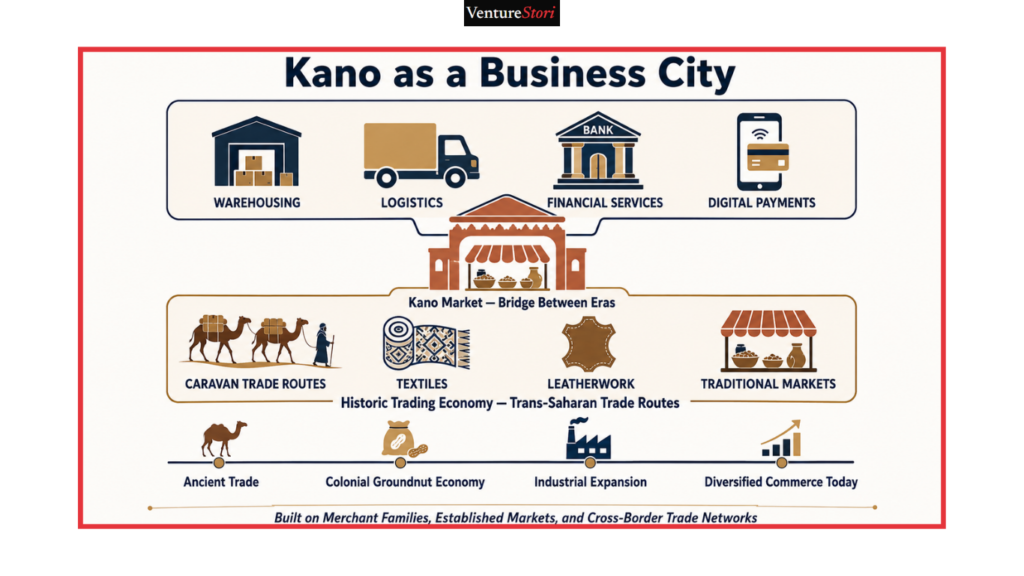
According to the World Population Review, Kano has over 17 million residents in 2026. Its massive numbers show it is one of the fastest-growing cities in Nigeria as well as the 9th most populous city in the world. Kano’s expanding population is attributed to natural population growth, migration, commerce, and its position as a major commercial hub in Nigeria.
Kano has an estimated gross domestic product (GDP) of about $20 million. Between 2023 and 2025, the state experienced a 150 percent increase in internally generated revenue, going from ₦40 billion to ₦120 billion. Kano has a centuries-long history of trade, commerce, and business, making it a leading investment and commercial market in Nigeria.
Bagauda, traditionally considered the founding father of the Kano dynasty, became king around 999 CE. Kano started to fully develop during the 11th and 12th centuries It started as a stop for traders taking the trans-Saharan trade routes, transporting goods like salt, textiles, and other commodities between North Africa and West Africa. Afterwards, Kano became a trading hub for the groundnut trade, becoming a key part of the economy during the colonial era.
Kano is based on an ancient trading culture that has endured over centuries: a market culture built and preserved by trading families, cross-border trade, and established markets. These have helped Kano retain its relevance and influence as the commercial capital of Northern Nigeria through the colonial era, independence, the oil boom, and years of industrial neglect.
Kano State’s business hub, first, as an ancient trading capital. Secondly, as a 21st-century city that is making efforts to modernize itself without losing the commercial culture that has made the city unique for centuries.
Kano’s Markets and Business Environment
The Kurmi Market, established in 1463 CE during Muhammad Rumfa’s reign, is one of the oldest active markets in Sub-Saharan Africa, not just a historical relic. Its five-century history exemplifies Kano’s rich market culture, which has survived for over half a millennium and remains a major commercial strength in the city.
Security and Economic Policy in Kano
Kano’s commercial environment suffers from insecurity like most states in the North. These issues vary in different parts of the state. Kano is located in the northwest part of Nigeria, a region under massive attacks from bandits. But security reports have suggested Kano is safer than neighboring states such as Zamfara, Katsina, Kaduna, and Sokoto.
A couple of rural local government areas in Kano have suffered several bandit attacks on their farms over recent years. In urban areas, cases of robberies and gang-related crimes have been on the rise, with theft linked to sects associated with the city’s Yan Daba gang culture. Hotoro and some other urban areas have been heavily affected by the banditry and crime rate that has affected businesses and displaced communities.
In a bid to combat these security issues, the governor of Kano State, Abba Kabir Yusuf, established the Kano State Neighbourhood Watch Corps in December 2025. The 2000-person force was tasked with eliminating crimes and providing vigilance across the state. The group was also empowered with 88 patrol vehicles and 440 motorcycles to be deployed in all 44 local government areas. This comes after the Kano State Government established the Special Anti-phone Snatching and VIP Protection Guards to combat phone theft and crimes on the streets of Kano in 2024.
For business owners who are potentially considering Kano as an option, view this as an ongoing, monitored situation, not a resolved or worsened situation.
On the economic side, the Yusuf administration has channeled its resources into agriculture—distributing about 90,000 bags of fertilizer to farmers in July—agro-processing, security, and railway infrastructure.
The Active Sectors
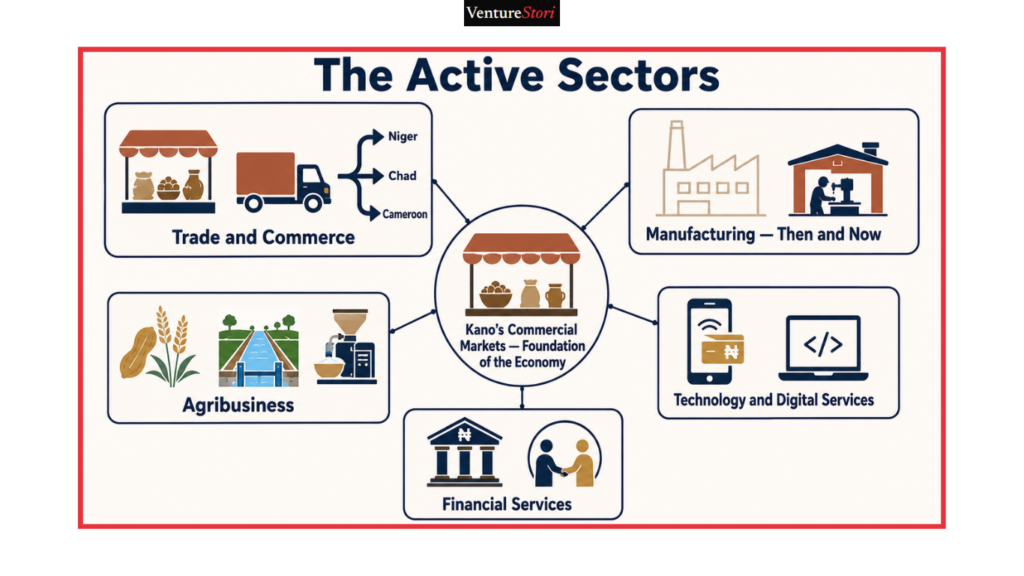
- Trade and Commerce
Trade is firmly at the center of Kano’s economy and one of the city’s foundations. The city is a commercial hub for all types of trading. Goods are transported to different parts of Nigeria and neighboring countries such as Niger, Chad, and Cameroon.
Major markets like Kurmi and Sabon Gari are some of the important trading centers. But Kano doesn’t just rely on its physical markets. Centuries upon centuries of trading families and merchant businesses have contributed to building strong relationships, networks, and trust that help businesses buy and sell. Groundnuts, hides, skins, and other agricultural products have historically been and are still major parts of Kano’s export trade.
- Manufacturing
During its peak in the 1970s and 1980s, Kano used to be the leading textile manufacturing hub in Nigeria. There were lots of textile factories all over the city that created jobs for thousands of people. In the 1990s, the textile industry started declining. Cheap imported goods were smuggled into the country, and unstable electricity and general industrial problems were contributing factors to the decline.
As a result, many textile factories in the Sharada and Bompai estates have either closed down or now operate on a small scale. Kano still has a textile and leather industry, accounting for approximately 80% of all leather produced in Nigeria. However, it is made up of smaller factories and artisans. However, Kano’s leather products continue to enjoy an export reputation.
- Agribusiness
Kano is one of Northern Nigeria’s major agricultural states with large production of groundnuts, sorghum, millet, cowpeas, sesame, and vegetables. Its developed irrigation network helps production that supports farming in areas where there is little rainfall.
The Kano government is making plans for the state to start processing its agricultural products instead of having them done elsewhere. This would create more jobs and businesses and increase the value of the agricultural products.
- Technology and Digital Services
Kano is part of the leading startup cities in Nigeria (Tech Cabal). Some notable tech companies in Kano include Zainpay, an online and offline digital bank, and Kallo.ng, self-described as the first streaming platform in the Hausa language.
Startup Kano, founded in 2016, was the first tech innovation hub in Kano.
The Kano Digital Innovation Network is another center that does technology training, incubation, and entrepreneurship.
- Financial Services
Kano’s large trading community supports a strong banking sector. The city has one of the most developed Islamic banking sectors in Nigeria, in an environment where religion and trade have major historical ties.
Aside from traditional banks and even newer banks like Coronation Merchant Bank, businesses get loans from other financial powerhouses in Nigeria like loan cooperatives, microfinance banks, and others to sustain their operations, which is a crucial part of Kano’s business economy.
The Business Districts and Key Areas
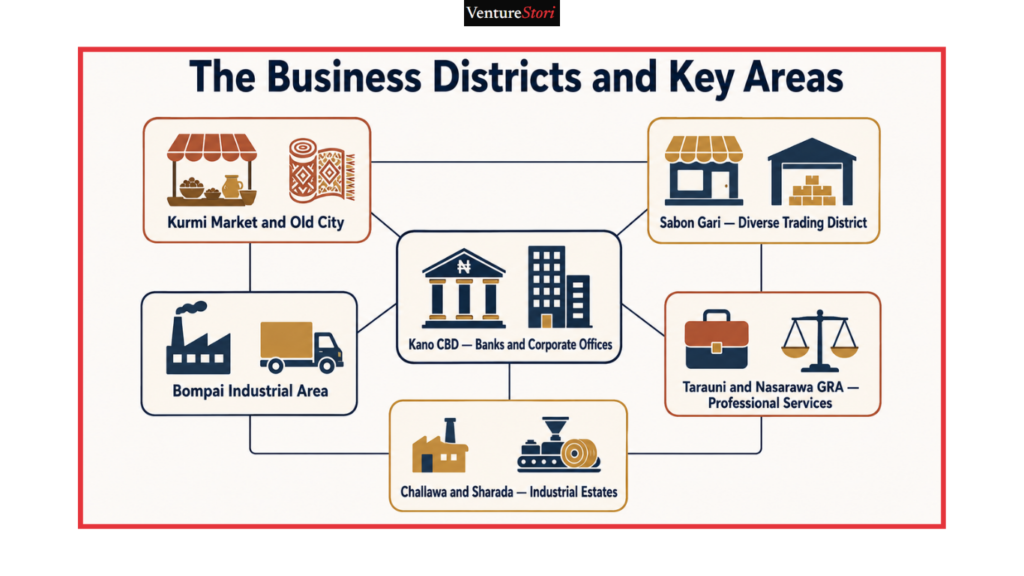
- Kano Central Business District:
This is the commercial center of the city. It is home to many banks, government offices, and corporate businesses.
- Kurmi Market and the Old City:
This is the historical market of Kano, established in 1463 CE. The market still functions, and its traders sell textiles, leather goods, spices, traditional medicines, and other goods in the area.
- Sabon Gari:
Sabon Gari was built in 1913 during the colonial period to accommodate veterans of the West African Frontier Force and the workers of the Lagos-Kano railway line. Before it became a place for non-indigenous, non-Hausa traders and migrants. Over the years, the Igbo, Yoruba, other tribes in Nigeria, and people from West Africa have made this place their home. For over a century, it has been a diverse market in Kano that is now a key area for trade.
- Bompai Industrial Area:
Bompai is one of Kano’s main industrial areas, which is home to factories, warehouses, and logistics businesses. It is part of Kano’s formal industrial base.
- Tarauni and Nasarawa GRA
These districts are mainly residential areas in Kano. These districts are the closest things Kano has to a professional-services district.
- Challawa and Sharada Industrial Estates
These are the industrial districts of Kano, located on the city’s outskirts. They used to be home to many of the big factories in the city but not anymore. However, some textile companies, food-processing companies, and other light-manufacturing companies still operate from there.
Investment and Development Activity
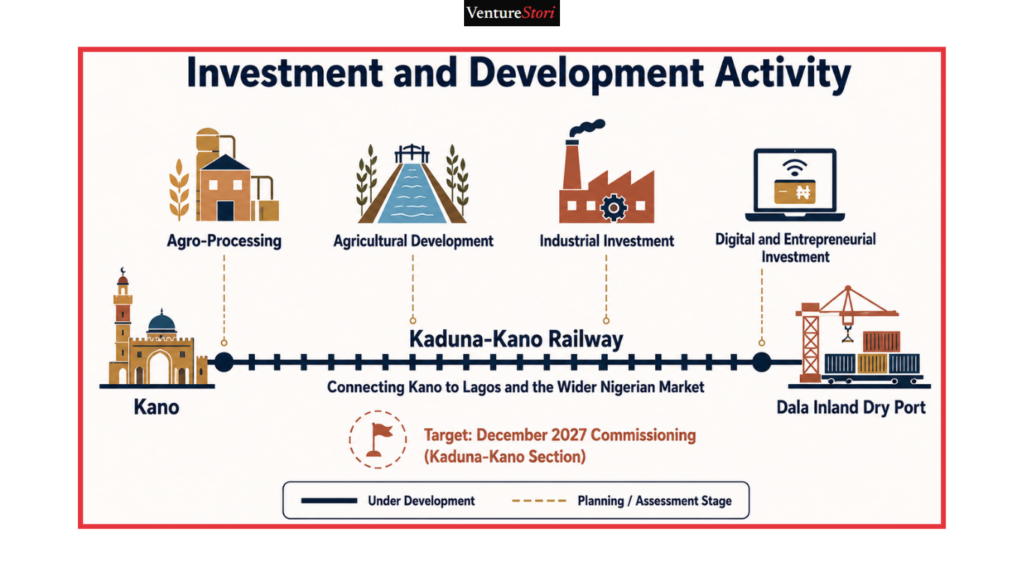
- Rail Connectivity
Rail development remains one of the biggest infrastructure stories in Kano’s business story this year. But there is no completion date yet.
The Kaduna–Kano standard-gauge railway is part of the larger Kano–Maradi railway project. According to reports, it is 63% completed and work is still ongoing. Last month, federal officials hinted at commissioning the Kaduna–Kano and Kano–Daura–Katsina sections by December 2027.
In May 2026, the Federal Executive Council approved $2.99 billion for the construction of several rail projects, including the Kaduna State Light Rail project, Lagos Green Line, and a separate Kano State Metro City Rail project. As soon as it is completed, the Kaduna–Kano line will connect to the Dala Inland Dry Port and is expected to make transportation of goods between Kano and Lagos easier, faster, and cheaper compared to transporting by road.
Due to the numerous delays and constant changes to the completion date, businesses keeping an eye on the “December 2027” proposed commissioning date should treat it as a target, not an assurance.
- Investment and Funding
The Kano State Government is open to investors to its projects, with agro-processing as one of its main priorities. Kano’s agricultural production base serves as an opportunity to attract food-processing investment.
Development finance institutions have shown significant interest in Kano’s potential agro-processing opportunities. The SAPZ program in Kano is supported by the African Development Bank, the International Fund for Agricultural Development, and the Islamic Development Bank. The contribution from these institutions to develop Kano’s agro-processing projects is similar to how Releaf Nigeria is revolutionizing palm oil processing.
Who Is Building Here
- Zainpay
Zainpay founded and headquartered in Kano is an online and offline digital bank for businesses across Nigeria. The platform is one of the biggest examples of a Kano startup expanding beyond Northern Nigeria.
- Kallo.ng
Kallo.ng is Nigeria’s first Hausa-language streaming platform. A prime example of how Kano’s tech sector is evolving and designing products peculiar to Northern Nigerian languages and its culture.
- Startup Kano
Startup Kano is a training and incubation space that promotes entrepreneurship and agribusiness for businesses. It also teaches strategies on how to secure funding from potential investors.
- Kano Digital Innovation Network (KDIN)
KDIN is a new hub that prioritizes technology training, entrepreneurship, and community building. It shows that Kano is committed to keeping developing innovative hubs that are trying to support digital skills and startups in the city despite little to no funding.
Despite the insecurity faced in some parts of the state, Kano’s main commercial areas have been stable. To fully understand Kano’s business environment, one must consider both the state’s economic opportunities and its insecurity issues.
Kano Business Directory
Note: The following listings are paid placements from businesses operating in Kano. Venture Stori editorial content above is independent of this directory and is not influenced by, or contingent on, directory placement.
Listing template:
- Business name:
- Category:
- One-line description:
- Contact details:
- Website:
- Location within Kano:
Venture Stori Insights
Discover Northern Nigeria’s Rebirth
Beyond the headlines, Kaduna is driving major economic reforms, digital tax platforms, and an emerging tech ecosystem. Explore our comprehensive breakdown of Northern Nigeria’s industrial power center. Read the Kaduna Business Directory Guide →