The Yobe State Business Directory provides a clear overview of one of Northeastern Nigeria’s important commercial centres. Potiskum is home to one of the busiest livestock markets in West Africa. Every market day, traders from across Nigeria and neighbouring countries gather to do business. Despite a long history of conflict, commercial activity in Potiskum has continued to operate.
This Yobe State Business Directory examines Yobe as a business location, with a focus on Damaturu as the state capital and Potiskum as the main commercial centre. It also looks at how conflict has affected trade, farming, and daily life across the state.
Yobe as a Business State
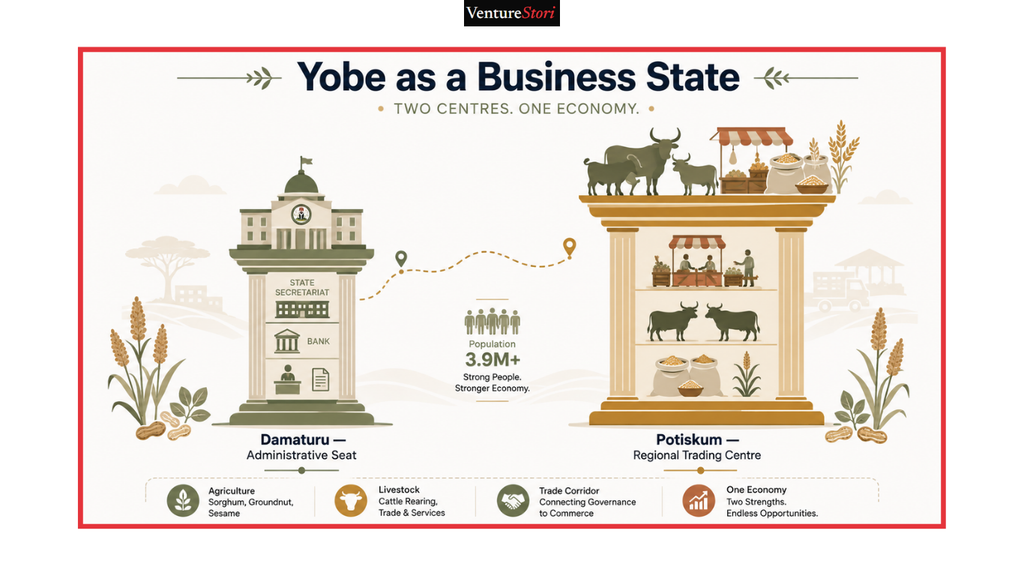
Yobe as a Business State.
Yobe State is situated in the northeastern part of Nigeria, carved out from the western half of Borno State in 1991 after the state was divided. It shares its borders with Borno (East), the Republic of Niger (North), Bauchi (West), Jigawa (Northwest), and Gombe (Southeast). According to a 2022 report by Britannica, the state population is estimated at 3.6 million people.
While Yobe is one of the least-populated states in the North, its strategic location has made it a commercial center, especially due to Potiskum’s grain and livestock markets and its cross-border trade links. Damaturu is the capital of the state. It houses the Government House, civil service, banks, and other administrative offices linked to government activities. About 100 kilometers west is Potiskum, Yobe’s largest city by population and also the main commercial center in the state. Damaturu rules the state; Potiskum leads its trade and commerce.
History cites that Potiskum became a major market for livestock and grain trading in Northern Nigeria in the 20th century. Potiskum is located along major regional and trade routes. Before the Boko Haram insurgency spread into Yobe and neighboring areas during the 2010s, Potiskum had already established itself as a regional trading hub in Northeastern Nigeria.
The Boko Haram attacks over the years have left a bitter tinge in Yobe’s trading businesses. Yobe, along with Borno and Adamawa, has been one of the hardest hit states by the insurgency. However, not all areas of Yobe have been equally affected. Rural and local government border areas like Geidam, Yunusari, Tarmuwa, and Gujba have suffered more attacks, deaths, and displacement compared to other areas.
In contrast, the way of life and security situation in urban areas in Damaturu and Potiskum are significantly different from life in the rural border areas. In January 2026, the Yobe State Secretary to the State Government, Baba Malam Wali, said that the government had secured 14 of the 17 local government areas in the state against the Boko Haram insurgency and other criminal activities.
While certain parts of the state still face insecurity and displacement, Damaturu and Potiskum markets are fully functioning. Earlier this year, a ₦3 billion ultra-modern market was commissioned in Damaturu to serve thousands of traders. Governor Mai Mala Buni’s administration made significant contributions to investments in agriculture, roads, infrastructure, and other projects to boost trade and economic development in the state. Yobe’s 2025 state budget included projects like the Potiskum Modern Market and Damaturu industrial infrastructure, while the approved 2026 budget is making provisions for more funding for more infrastructure projects.
Despite the years of conflict, Potiskum’s livestock market has continued to function. The market has attracted traders from across Nigeria and sub-Saharan Africa, accommodating over 3,000 animals every market day. Potiskum’s operations share certain traits with Sabi Marketplace—they serve as a trade hub for customers beyond Nigeria.
The Active Sectors
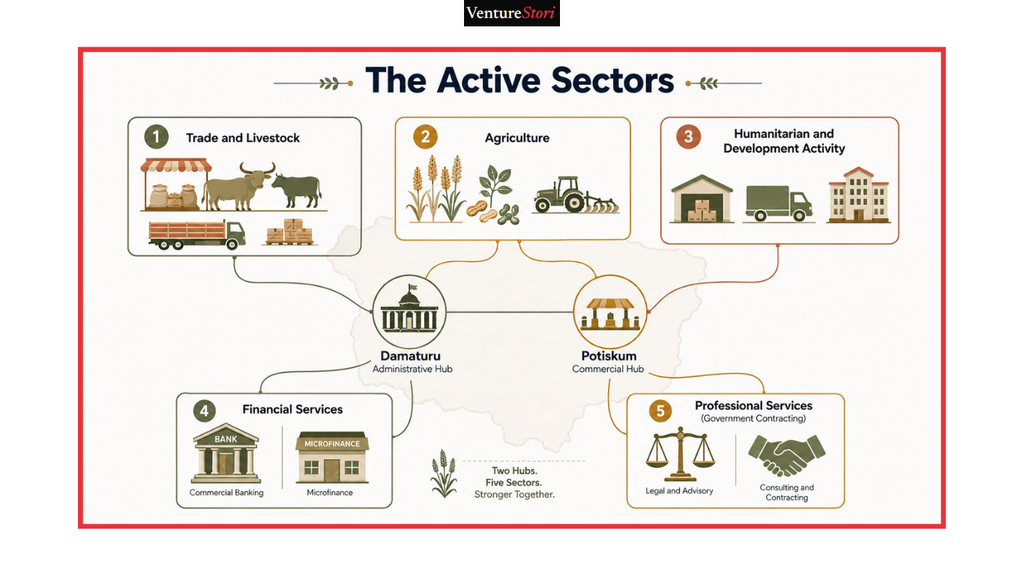
- Trade and Livestock
One of the major factors of Yobe’s commercial economy is the Potiskum livestock market—regarded as one of the largest cattle and livestock markets in sub-Saharan Africa. Traders come in from across Nigeria and neighboring countries to buy livestock and sell in their respective markets.
- Agriculture
Agriculture is the backbone of Yobe’s economy—over 80% of the population in the state is engaged in it as their source of livelihood. As a result, Yobe has become one of the major food producers. The major crops in Yobe’s agricultural sector include sorghum, millet, groundnut, cowpeas, maize, sesame, and cotton.
However, the insurgency in rural and border areas has affected agricultural production in the state. FEWS NET reported in May 2026 that the attacks in Yobo and Borno were affecting cultivation and adding to the ever-growing number of displaced persons in rural communities.
As part of the state government’s efforts to improve socio-economic development in the state, ₦28.53 billion for agricultural tools and equipment under the 2026 Mega Agricultural Empowerment Program was approved by the State Executive Council in July 2026.
- Humanitarian and Development Activity
Damaturu is home to a handful of major humanitarian and development agencies because of the wider Northeast response.
The United Nations Office for the Coordination of Humanitarian Affairs, the International Organization for Migration, and Mercy Corps are agencies that have operated and are still operating in the city and have recruited local staff as well.
- Financial Services
Yobe Microfinance Bank, with its headquarters in Damaturu, is a financial institution with ties to the state. It provides financial services and assistance to civil servants and business owners. Most recently, in June 2026, the state government pledged to pursue an additional ₦1 billion recapitalization of the bank as part of its restructuring plans to improve its operations and spread its impact across the state.
- Professional and Business Services
Damaturu is at the heart of Yobe’s promotion of the state’s readiness for investment and business development. The state has introduced the Yobe State Agency for Public-Private Partnership and Investment Promotion (YAPPPIP) to initiate and facilitate public-private partnership (PPP) initiatives.
The Business Districts and Key Areas
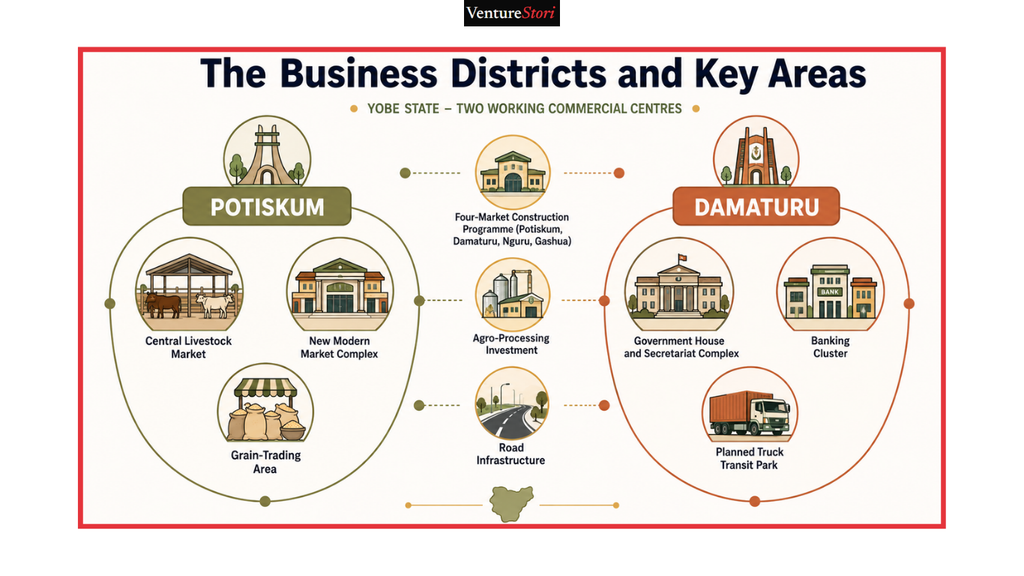
- Potiskum
Potiskum doesn’t just have one of the biggest livestock markets in sub-Saharan Africa, it also functions as the commercial capital of Yobe State. Its commercial activity goes beyond the livestock market; it also includes grain trading and general merchandise. The African Development Bank sees Potiskum’s grain market as a major regional market that sells and exports grains to markets across Nigeria and also neighboring countries like Chad, Niger, Cameroon, etc.
The state government has also built four modern markets in Potiskum, Damaturu, Nguru, and Gashua—with each market having about 800 shops.
Yobe Flour and Feed Mills is also situated in Potiskum. The Yobe State Government officially handed ownership of the company, alongside three other industrial companies, to the Nigerian Food Corporation in August 2026 as part of its efforts to restructure the state’s agro-industrial sector, like Releaf is revolutionizing palm oil processing in Nigeria.
- Damaturu
Damaturu is not only the capital of Yobe State, but it is also its administrative headquarters. In 2023, the state government established the Yobe State Agency for Public-Private Partnership and Investment Promotion (YAPPPIP) to attract and connect investors to government-funded projects and local suppliers. Also, to promote public-private partnerships (PPP).
As part of its commitment towards building infrastructure in the state, the approved 2026 Yobe State budget makes provisions for the proposed ₦2 billion for 20.4 kilometres of Damaturu urban-renewal roads.
Investment and Development Activity
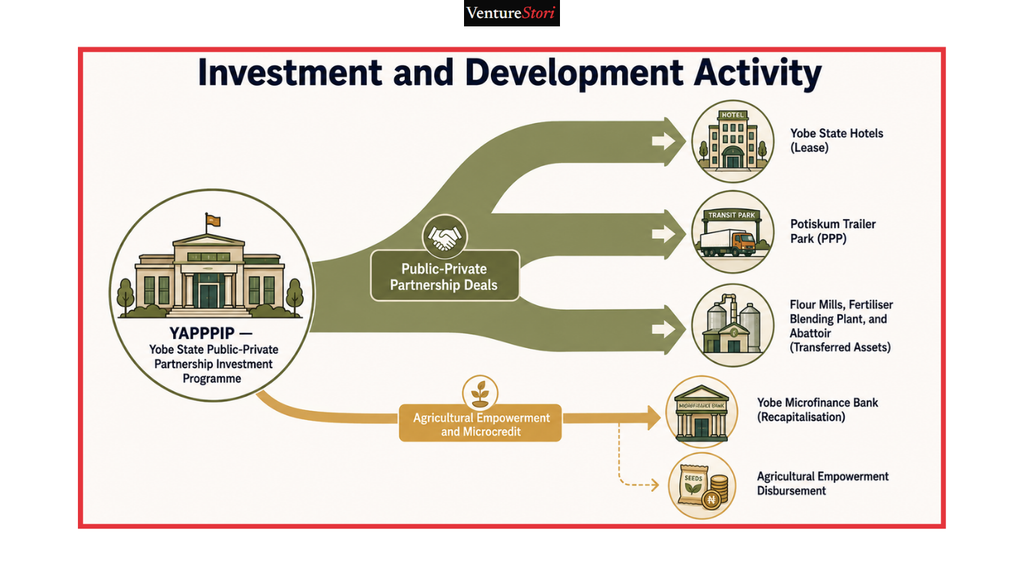
Yobe’s investment plan for 2026 is to build around public-private partnerships (PPP) and to redevelop the state’s assets for commercial purposes — all part of the broader strategy to revive its economy. According to YAPPPIP, the state is looking to aggressively attract investors and simultaneously coordinate PPP transactions happening in its agricultural, energy, and infrastructure sectors amongst others.
YAPPPIP also has a business and financial plan for its Financial Year 2026 PPP pipeline projects. The proposed seven projects will cover irrigation, renewable energy, sesame processing, a livestock hub, water supply, cement manufacturing and soybean production and processing. The total project is expected to cost an estimated ₦1.424 billion.
In addition, the Yobe State Government signed a Memorandum of Understanding (MoU) with Trucks Transit Park Ltd, Lagos to boost the development of the Potiskum Trailer Park— another one of the state government’s commitments to developing the city’s commercial infrastructure.
Who Is Building Here
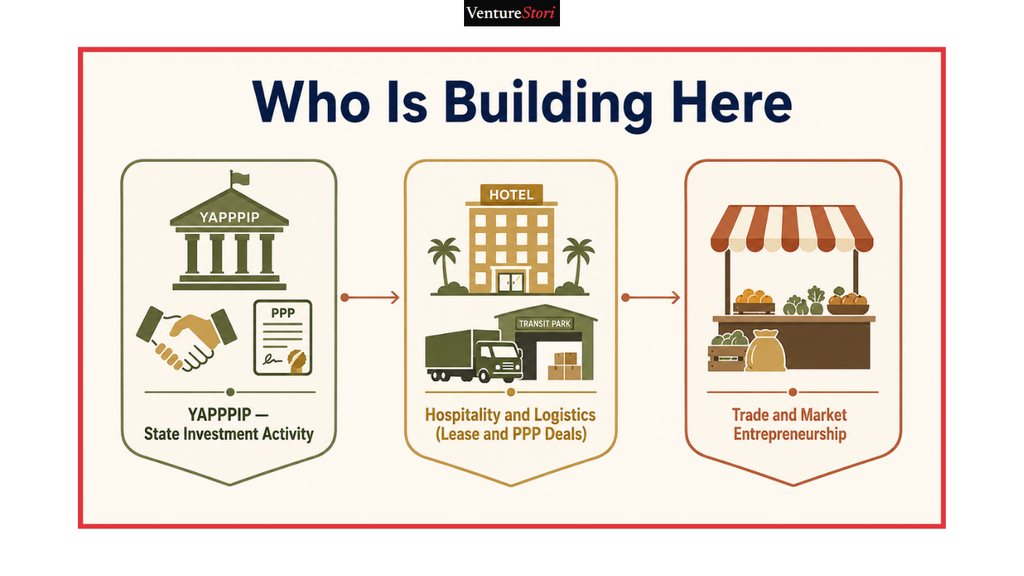
The investors in Yobe currently are split between public institutions and private companies — highlighting the state’s decision to use PPPs to bring in investors to the state by commercializing its public assets.
Dr. Aliyu Isa Chikaji, Director-General of YAPPPIP, is one of the leading voices behind the state’s investment drive.
“Yobe is open for business, not just in aspiration but in practice. We are already at advanced stages of discussions involving site visits, due diligence and negotiations. We expect that before the end of this year, Yobe will witness a genuine breakthrough in investment inflows through our PPP window.” Says Dr. Aliyu Isa Chikaji, reported by the People’s Gazette.
On the PPP side, YAPPPIP has confirmed that it has finalized the official handover of Yobe State Hotels to Yamaji Grand Impex Ltd under a lease agreement. Also, the Memorandum of Understanding with Trucks Transit Park Ltd for the Potiskum Trailer Park.
The insurgency in certain local government areas in Yobe that has cost many families the lives of their loved ones, their lands, sources of livelihoods, and safety cannot be overlooked. But at the same time, Potiskum’s story as a leading commercial market in Northeast Nigeria, which has kept functioning through the insurgency that has rocked the state for over a decade and Damaturu’s position as the administrative capital of the state cannot be dismissed either.
Investors and businesses that are considering coming into Yobe need the full picture to understand the situation before making a decision and becoming a part of Yobe’s business directory.
Yobe State Company Listings
Note: The following listings are paid placements from businesses operating in Yobe. Venture Stori editorial content above is independent of this directory and is not influenced by, or contingent on, directory placement.
Listing template:
- Business name:
- Category:
- One-line description:
- Contact details:
- Website:
- Location within Yobe:
Explore Enterprise & Processing Hubs in Abakaliki
From Abakaliki’s high-capacity rice milling clusters to limestone quarrying, lead-zinc mining, and regional commodity trade, access verified company listings and key commercial sectors in Ebonyi State. Access the Ebonyi State Business Directory →