The latest Ankara styles for women have moved far beyond aso-ebi and Owambe occasions. Today, Ankara is a versatile choice for office wear, casual outings, and even business meetings. Designers are blending traditional African prints with modern fashion to create pieces such as corset tops, palazzo pants, and two-piece co-ord sets.
Behind every new look is a network of designers, traders, and entrepreneurs driving the industry forward. Industry estimates project the global Ankara market to reach $4.2 billion by 2033, confirming that this is now both a major fashion and economic sector. For women seeking fresh and stylish options, the latest Ankara styles for women continue to set the pace in Nigerian fashion.
What’s Driving Nigeria’s Ankara Trends Right Now
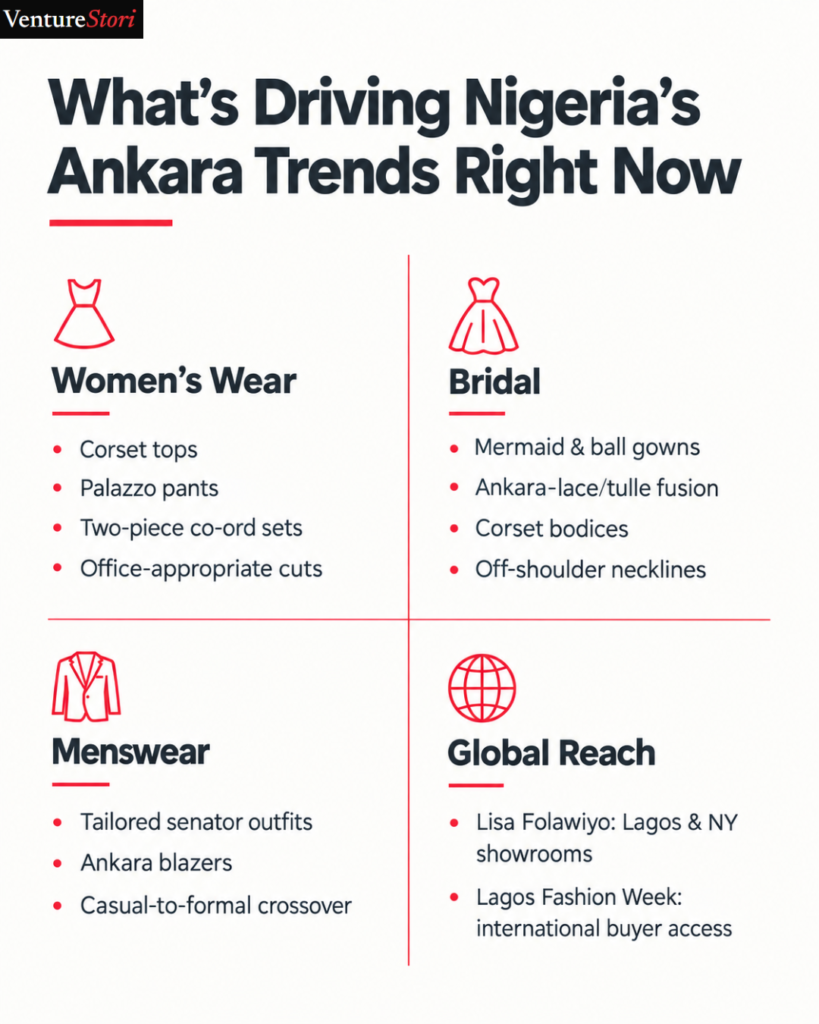
Designers are no longer making Ankara in one or two familiar styles; they are now more creative with the fabric. Instead of making an entire outfit from one Ankara print, they could combine Ankara with a plain fabric, and Ankara print A with Ankara print B.
Office-appropriate outfits and sophisticated casual clothing have changed the narrative of Ankara being an Owambe outfit. Bridal gowns have also joined the line-up. According to Ttrell Fashion House’s Abuja bridal trend coverage, designers are now incorporating Ankara into mermaid gowns, ball gowns, Ankara plus lace combinations, and Ankara plus tulle combinations, using modern features such as corset bodices and off-shoulder necklines. Men’s Ankara is becoming more acceptable; the perception is moving from being mostly women’s wear to men’s casual, semiformal, and formal clothing, according to Legit. ng’s menswear trend reporting.
Ankara fashion isn’t confined to Nigeria anymore. Nigerian designers now compete as global brands. Lisa Folawiyo, for example, has a brand presence in Lagos and New York. Her pieces are stocked by Selfridges and her work has been shown at London’s V&A Museum. Lagos Fashion Week also gives Nigerian designers opportunities to get in front of international buyers and fashion audiences.
The Designers Turning Ankara Into Global Brands
Lisa Folawiyo started her fashion label in 2005 with just 20,000 naira and a small workspace at home with her mother. Her approach is to take Ankara and make it look luxurious and sophisticated. She adorns her Ankara with hand embellishments and heavy beading, ensuring they have detailed craftsmanship in pieces that are locally produced.
Her pieces are made more like luxury/atelier fashion. Lisa Folawiyo has carried Ankara beyond Nigeria, with a presence in Lagos and New York. Her clothing isn’t just sold directly from her own studio. It has reached established international fashion retailers at Selfridges, Matches Fashion, and Moda Operandi. Her pieces were also exhibited at the Victoria and Albert Museum in 2022.
Teekay Fashion, founded by Adebola Jumoke Raji, became a recognized Nigerian embellishment-focused label, which earned her the nickname of “Queen of Embellishment” from City People magazine. Her celebrity clientele includes Mercy Johnson, Yemi Alade, Iyabo Ojo, and many more. Teekay’s growth has been centered more on direct customers and custom/studio work than on putting huge quantities of clothes into stores.
Tesslo took Ankara even further from home. It was founded by Tessy Oliseh-Amaize, sister of former Super Eagles captain Sunday Oliseh. Tesslo has Nigerian roots, but its base is now in Washington, D.C. The story has moved from Nigerian designers making clothes for Nigerian customers to taking Nigerian cultural inspiration into the American fashion market.
Tessy approaches some of her designs almost like a mathematics problem to create unusual three-dimensional effects. Each piece takes four to eight weeks to construct. Tesslo has gained international exposure. It was shown at the Ankara Festival in Los Angeles and Philly Fashion Week. This is a deliberate push for Ankara to sit in the global fashion hierarchy.
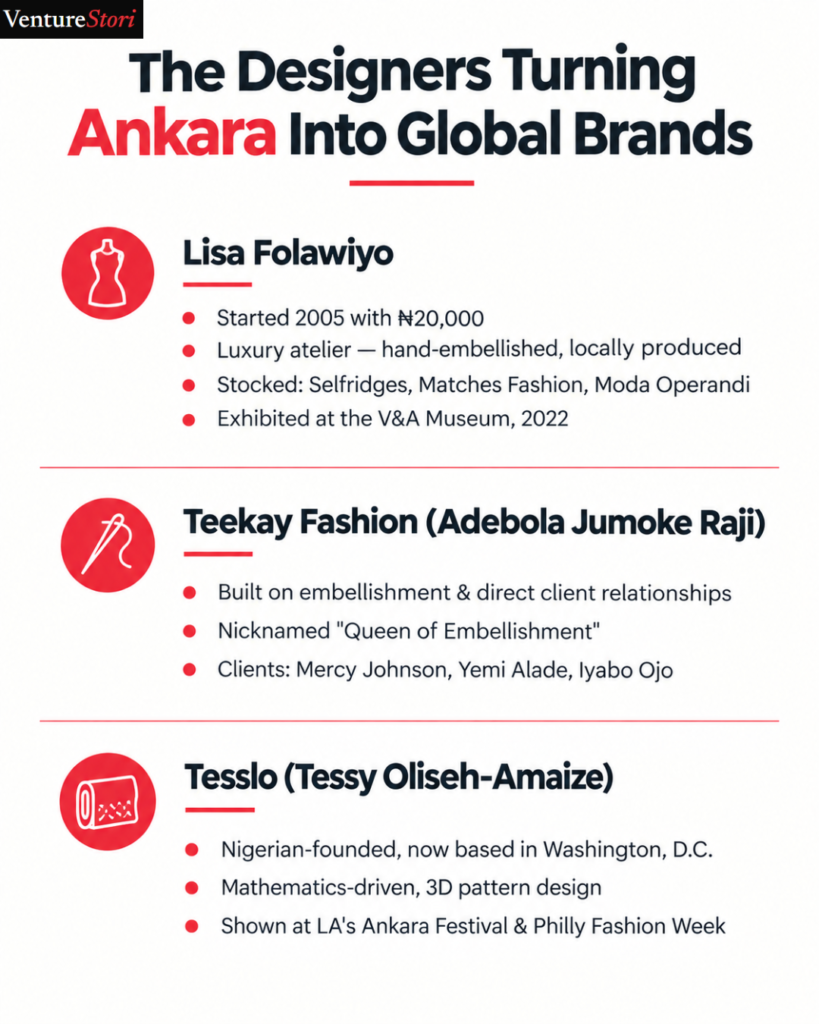
Three different business models, but they all use one fabric.
How Two Founders Built Ankara Businesses From Market Stalls
Endroit
TimiJay’s Endroit didn’t start with millions of naira, a shop, employees, or investors. It started with 10,000 naira. In 2020, the founder of TimiJay’s Endroit, Oguntosin Jolomi, took a part of her salary to start a business. She went to the market and bought ten Ankara pieces. She didn’t have a formal business plan. She started by buying products and testing whether people would buy them. By 2023, she moved from being a fabric seller into ready-to-wear fashion using Kampala prints.
In two years, she served more than 800 women, and in 2024, she expanded into men’s clothing. The path wasn’t smooth. Her biggest obstacle was finance; she had no access to grants or investors. Every penny she earned was reinvested back into the business. Jolomi ran the brand alone, from the creative direction to styling to content and modelling.
Hiring a team wasn’t feasible at the moment. Her lowest point came after preparing more than 150 outfits for a trade fair, only to discover she had missed registration. She recovered by showcasing through another opportunity and sold out the collection.
Her advice to others is to be patient—do not enter a business for profit alone—and to find mentors to learn from rather than copy.
Lahjiz Signaturez
Omobolaji Esther Adediwura, founder of Lahjiz Signaturez, also started by selling Ankara fabric before moving into designing finished clothing.
Both founders followed a particular pattern: buy small, sell direct, reinvest everything, and then scale into ready-to-wear once demand proves itself.
Where Designers and Entrepreneurs Source Their Fabric
Anyone searching for where to buy Ankara fabrics in Lagos usually starts from one of these places: Idumota, Yaba, or Tejuosho.
Idumota is one of Lagos’s oldest and busiest markets. It sells Ankara, lace, Aso-Oke, and other fabrics both wholesale and retail. Prices in Idumota Market are negotiable, though quality varies by vendor, which is why buyers need to inspect fabric closely before purchasing.
Yaba and Tejuosho are close, but they somewhat serve different markets. Yaba is popularly known for cheap, bend-down select thrift, especially for younger buyers.
Tejuosho, on the other hand, is nearby and more organized, with shops arranged within a multi-story market complex. It has wholesalers selling Ankara and ready-to-wear clothes. Student sellers from UNILAG and Yabatech buy in bulk here and resell through Instagram and WhatsApp. The Guardian Nigeria describes this as one of Lagos’s most reliable sourcing relationships for young sellers.
Ariaria International Market is a major commercial and manufacturing center in Aba. It is sometimes called “the China of Africa.” It is used to describe the rapid manufacturing, imitation, craftsmanship, replication, and entrepreneurial production of the market. A tailor in Aba can sometimes replicate a design within days, according to reporting on Aba’s tailoring economy.
How The Fashion Designers Association of Nigeria and Local Tailors Fit In
One person does not handle everything in the Ankara fashion business. Different people have different jobs, but some of these roles support each other rather than happening in a strict order. Understanding the role of each gives an insight into why some designers succeed early, and others don’t.
The Fashion Designers Association of Nigeria, founded in 1989, exists to help new fashion designers by providing fashion exhibitions, workshops, state chapters, and opportunities to meet other industry professionals. A new designer is given a chance to be seen by buyers and peers instead of relying on word of mouth.
Once a designer has a design, the next question is, “Where will it be sold?” This is where a boutique comes in. A boutique stands in the gap between a designer and the consumer’s desired clothing. Alara by Reni Folawiyo perfectly portrays this. Instead of selling every kind of clothing, Alara carefully chooses the products it thinks its customers would like.
This chain of process isn’t complete without the tailors that bring the designer’s idea to life. This is the part of the chain that rarely gets attention, but it is where the ideas are converted into physical garments. Around Yaba and especially on the production floor in Aba, tailors make the designs for clients and small brands that aren’t manufactured in-house.
A Guide to Buying Ankara in 2026
Buying Ankara depends on what you care most about: originality, speed, price, or starting a business.
If you buy directly from a designer, it is the most expensive option, and it takes the longest. Couture-level pieces, they are highly detailed, carefully constructed, and often custom-made. They take about four to eight weeks but guarantee originality and fit.
Boutiques in Lagos, Abuja, and Port Harcourt offer a middle option. They sell curated ready-to-wear clothes. The prices range from mid-level to premium.
For independent designers, Instagram and WhatsApp are major selling channels. Unlike established e-commerce platforms, there is no centralized system protecting you if something goes wrong. Before placing an order, check the previous customer reviews, photos, or videos of completed orders and how long they have been operating.
DIY tailoring is the cheapest route. It doesn’t mean that you make the fabric yourself. It means you buy the fabric and give it to the tailor yourself. The quality of cloth you get depends on the tailor you choose.
If you are buying wholesale, places like Aba, Yaba, or Tejuosho can significantly reduce the cost per yard compared with retail buying. But it requires a minimum order before you are given the pricing.
Retail buying is useful when you are testing an idea, and this is the same low-risk approach TimiJay and Lahjiz Signaturez used before they scaled their business.
Elevate Your Traditional Nigerian Fashion Profile
Looking to complement your professional presence with modern African tailoring? From premium silk and heavy embroidered cuts to contemporary minimal designs for corporate events and weddings, explore our curated showcase of the Best Agbada Styles for Men to refine your wardrobe.