Sole proprietorship registration in Nigeria is the simplest way for most solo entrepreneurs to formalize their business. One person owns, runs, and remains fully responsible for the business, with no separate legal entity standing between the owner and the operations. The process currently costs ₦20,000 and usually takes between two and five days to complete.
As straightforward as it is, a sole proprietorship also has clear limitations. Because the business is not legally separate from the owner, you personally carry all financial risks and liabilities. Before choosing this structure, it is important to understand both the advantages and the drawbacks.
This guide explains everything you need to know about sole proprietorship registration in Nigeria, including the step-by-step process, costs under the 2026 rules, and the tax obligations that apply once the business is operational.
What a Sole Proprietorship Actually Is
A sole proprietorship isn’t a company, but a person doing business under a registered name. If you register a proprietorship name with the Corporate Affairs Commission, you haven’t created a new legal person. You are still the legal person behind the business. You are the one making the decisions. You are the one taking all the financial risk. There is no board, no stakeholders. Every risk or damage the business incurs, the owner also incurs.
Why the Owner Carries the Business’s Debt
For a sole proprietorship, you and your business are legally connected. If your business owes a supplier two million naira, the owner is not protected because the supplier is able to pursue your personal assets depending on the circumstances and the applicable law. The case is different for Limited Company, the financial exposure of the shareholders is limited to what they have invested or agreed to contribute, and it is subject to exceptions under the law.
That’s where the word limitation comes from. It refers to the limitation on the shareholders’ liability. A sole proprietorship doesn’t have this liability shield. If a business incurs a very serious debt, the owner of the business would have to pay for it. So the personal assets of the owner may be exposed, and the severity depends on the kind of business you are running.
The 2026 Tax Picture for Sole Proprietorship
From the 1st, January, 2026, the new Nigerian tax rule says that if the government can’t determine how much income you made because of inadequate records, your business turnover will be used to calculate the tax. The business will be assessed under a presumptive tax of 1% of turnover. This rule doesn’t apply to nano businesses with a turnover of 12 million or below. A registered sole proprietorship that keeps proper books isn’t automatically placed in this category because it’s small. Businesses like this fall under the standard Personal Income Tax.
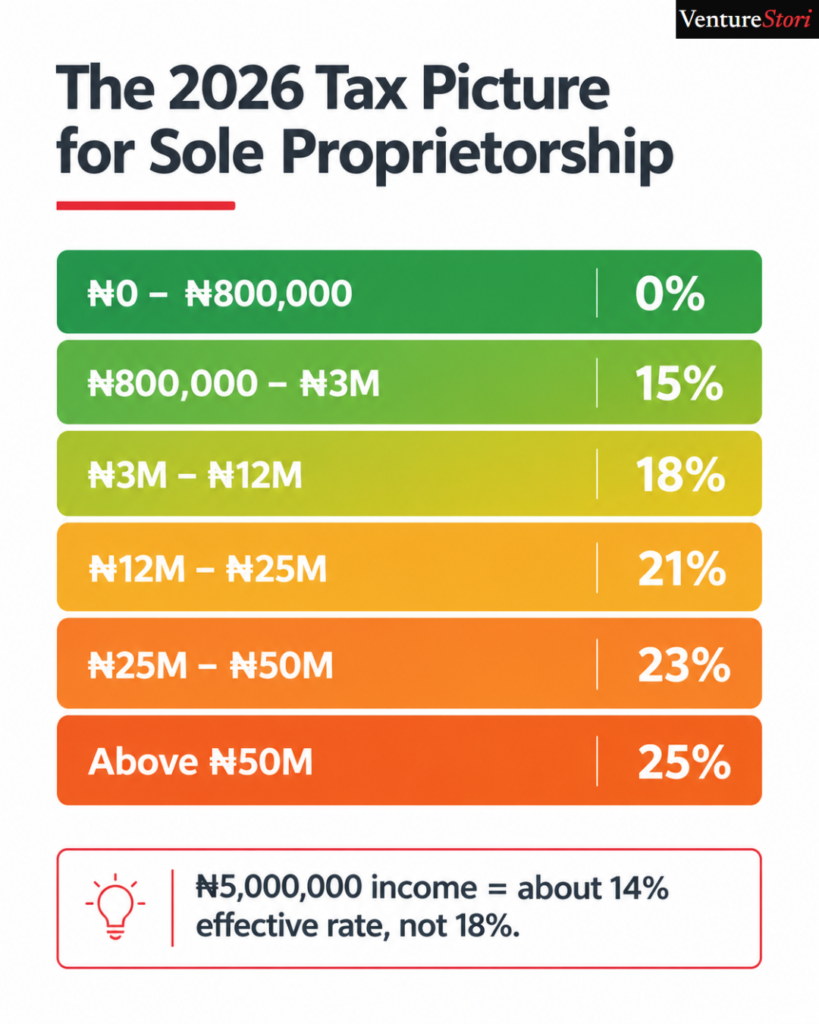
Under the Nigeria Tax Act 2025, the tax bands changed. Your first 800,000 is tax-free, taxed at 0%. After that, different portions of your income are taxed at different rates. The portion between 800,000 and 3 million naira is taxed at 15%, between 3 million naira and 12 million naira is taxed at 18%, between 12 million naira and 25 million naira is taxed at 21%, between 25 million naira and 50 million naira is taxed at 23%, and more than 50 million naira is taxed at 25%.
One rate isn’t applied to your entire income. If you earn 5 million, it would be wrong to say you pay 18%, that’s not how marginal rates work. Instead, divide it into portions. Your first 800,000 naira gets a tax rate of 0%. Your next 2.2 million naira (from 800,000 naira to 3 million naira) gets a tax rate of 15%. The remaining 2 million naira (from 3 million naira to 5 million naira) gets a tax rate of 18%. The 18% isn’t paid on the entire 5 million naira.
After calculating the total tax paid, you will discover that the effective rate on 5 million naira is closer to 14% not 18%. If you end up owing no tax, you still need to file your tax return. The filing period is from January to March, using FIRS TaxPro Max or through a tax consultant.
How to Register a Sole Proprietorship with CAC
You don’t need a lawyer or business expert to register your business name. You only need to meet the basic requirements; this includes: being 18 years or older, having a BVN and having the required identification and tax information. No startup capital or business education is required.
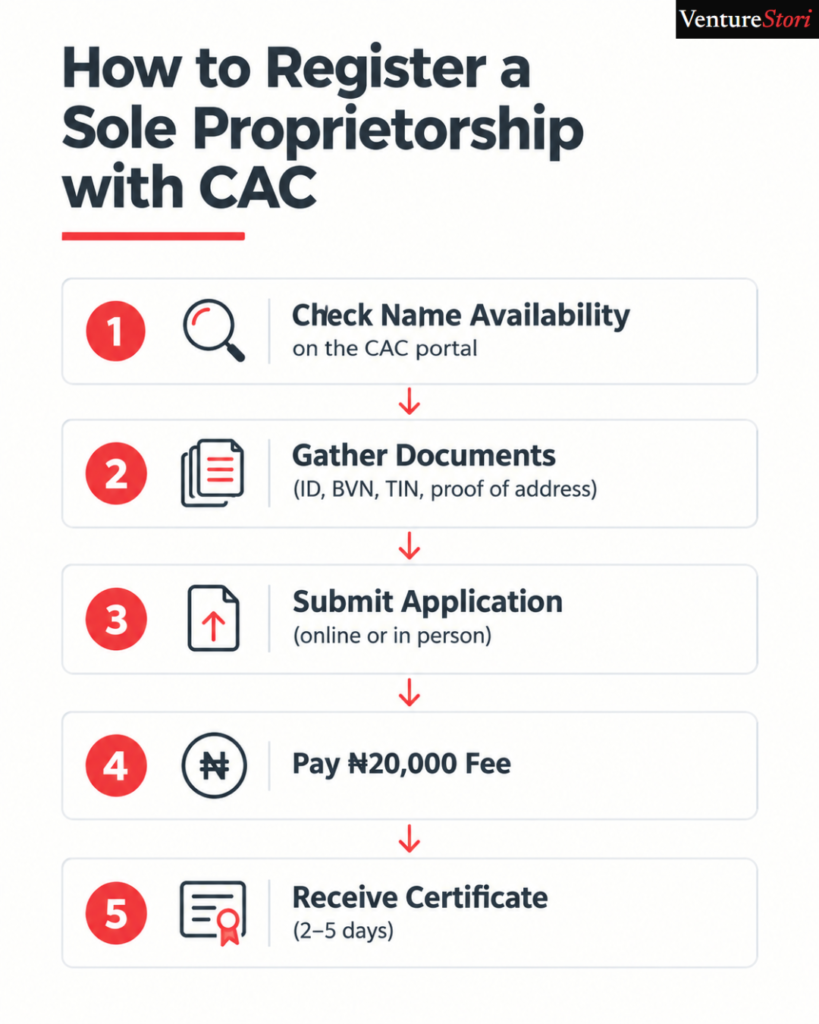
Step 1: Check if your business name is available
Before you can register, CAC needs to confirm that someone else hasn’t already registered that name, so you search the proposed name on the CAC portal. If the name you intend to use is on the portal, you have to choose another one.
Step 2: Gather your documents.
Once you have found an available name, you need to provide a standard means of identification. You will be required to submit your government-issued ID, proof of address, BVN and TIN. These documents verify your identity, address and tax information.
Step 3: Submit the application.
You could either submit the application through the CAC portal or by going to a CAC office in person, depending on what is available in your state. You don’t necessarily need a separate address for your business address. In-person submission takes thirty minutes to two hours, while the online route takes under 15 minutes.
Step 4: Pay the registration fee.
After submitting your application, you have to pay the applicable CAC registration fee of 20,000 naira either through the CAC portal or by bank transfer.
Step 5: Receive your certificate
Once CAC approves your application, you will receive your Business Name Certificate. This proves your business has been registered. The certificate typically arrives within 2-5 business days.
Registering with CAC is not the same thing as completing all the requirements your business may have. After registration, there are three things you’re meant to do within one to two weeks:
a. Register with SMEDAN to become eligible for certain government programs and support opportunities.
b. Register with FIRS for tax purposes
C. Open a business bank account: this makes it easier to separate your business transactions from your personal account.
Sole Proprietorship vs Limited Company
| Factor | Sole proprietorship | Limited Company |
| Setup cost | 20,000 naira | 30,000 naira – 100,000 naira+ |
| Processing time | 2-5 days | 5-14 days |
| Legal entity | The owner and business are legally the same. | The company is legally separate from you. |
| Liability | Your personal assets can be exposed if the business can’t pay its debts. | The shareholders are not personally responsible for the company’s debt beyond their investment. |
| Tax track | Your business income is treated as your personal income, so personal tax applies. | Companies’ income tax (30% above threshold). |
| Small-business exemption | 800,000 naira tax-free floor | Certain companies with a turnover under 50 million may be exempted from Companies Income Tax. |
| Accounting complexity | Few accounting requirements. | Often requires an auditor. |
| Scalability | Works better with small business owners but can become complicated when investors are brought in or the structure becomes complicated | Built for growth and investment |
The amount paid for tax shouldn’t entirely be a deciding factor for choosing sole proprietorship. Just as a sole proprietorship gets the first 800,000 naira, tax-free, so do limited companies who make under 50 million get exempted from the 30% company tax. The deciding factor should also depend on the amount of protection you want if something goes wrong and how much paperwork you are willing to deal with to get the protection.
What Determines Which Structure Fits Your Business
Sole proprietorship points to three things; you’re running the business alone with no co-founders or partners; you are selling either a skill or a service instead of a physical good; you are not borrowing large sums of money to run the business.
If that is you, you are carrying a low risk. Sole proprietorship is simpler. You don’t have much to lose if anything goes wrong, and this single fact is worth more than the legal protection a limited company would give you. A freelance writer with no big debts, service-based, going through the extra course of paperwork of a limited company doesn’t buy them much because there is not much risk to protect against in the first place.
As the business begins to grow bigger and the risk begins to add up, a limited company is a smarter choice. As it scales up, it takes on more financial exposure, and the risk of something going wrong becomes very expensive.
You don’t have to start with a limited company just because in the near future you hope to grow big. A lot of successful business owners start as a sole proprietor because it’s simple and it’s cheap. After the business grows, they convert into a limited company, where the extra protection is worth the extra cost and the paperwork.
Choosing a structure depends on where your business is at right now, and then you can change it when the business changes.
The Support System Around a Registered Business
After your business has been registered, you may not want to handle everything on your own. So there’s help available, both paid and free.
1. Pay professionals to help you. Once your business starts making money, you may want to hire accountants and bookkeepers. Their job is to balance the account, in order to help you plan your taxes. When your business gets to a certain stage, the tax situation may get complicated, so you may want to bring in a tax consultant that specializes in tax matters. The rate they charge depends on where you stay and how much work your business needs.
2. Free government support. There is a government agency for small business known as SMEDAN that helps you register your business for free. They give a non-repayable amount of fifty thousand naira to small businesses with a condition that you’d create at least one job with it.
3. Joining a business association that would help you look credible. Some of the business associations include NACCIMA and LCCI. They are trade organizations for business owners that give you credibility. They also connect you with business owners and help you find government programs or opportunities that on your own you wouldn’t normally find.
None of this is required, but most entrepreneurs that use resources like this — like the SMEDAN grants, or a trade organization like NACCIMA and LCCI — tend to have an easier time as they grow their business because they are not figuring it out alone. They are doing it with a group of organizations that have seen similar cases or that specialize in what they are going through.
Registration Checklist
- Decide on a business name you would like to use
- Check the CAC Portal to see if the name is available
- Gather your documents: ID, proof of address, BVN and TIN
- Submit your application either in person or online
- Pay the registration fee of 20,000 naira
- Receive the Business Name Certificate (normally happens within 2-5 days)
- Register with SMEDAN
- Register with FIRS for tax purposes
- Open a business bank account
- Bring in an accountant or tax consultant once revenue justifies it
Registering a business name is still the fastest and cheapest way to make a business official in Nigeria, and if you are running things alone with modest income and little debt, staying a sole proprietorship can be the right call for years, not just at the beginning as long as you understand the financial risk you are taking on.
Elevate Your Traditional Nigerian Fashion Profile
Looking to complement your professional presence with modern African tailoring? From premium silk and heavy embroidered cuts to contemporary minimal designs for corporate events and weddings, explore our curated showcase of the Best Agbada Styles for Men to refine your wardrobe.