You can be at the airport two hours before your international flight, join a meeting with your foreign counterparts on time, and meet a US-based deadline. But you may arrive late to your meeting in Lagos or end up postponing it. If this feels familiar, you may not be facing poor time management. You’re capable of handling it, but the problem is consistency.
Nigerian work culture places a lot of value on relationships and flexibility, while the global culture runs on deadlines. This guide explains the difference, time management in Nigeria, how to differentiate important work from distractions, and how to use practical time tools.
The Two Clocks Paradox
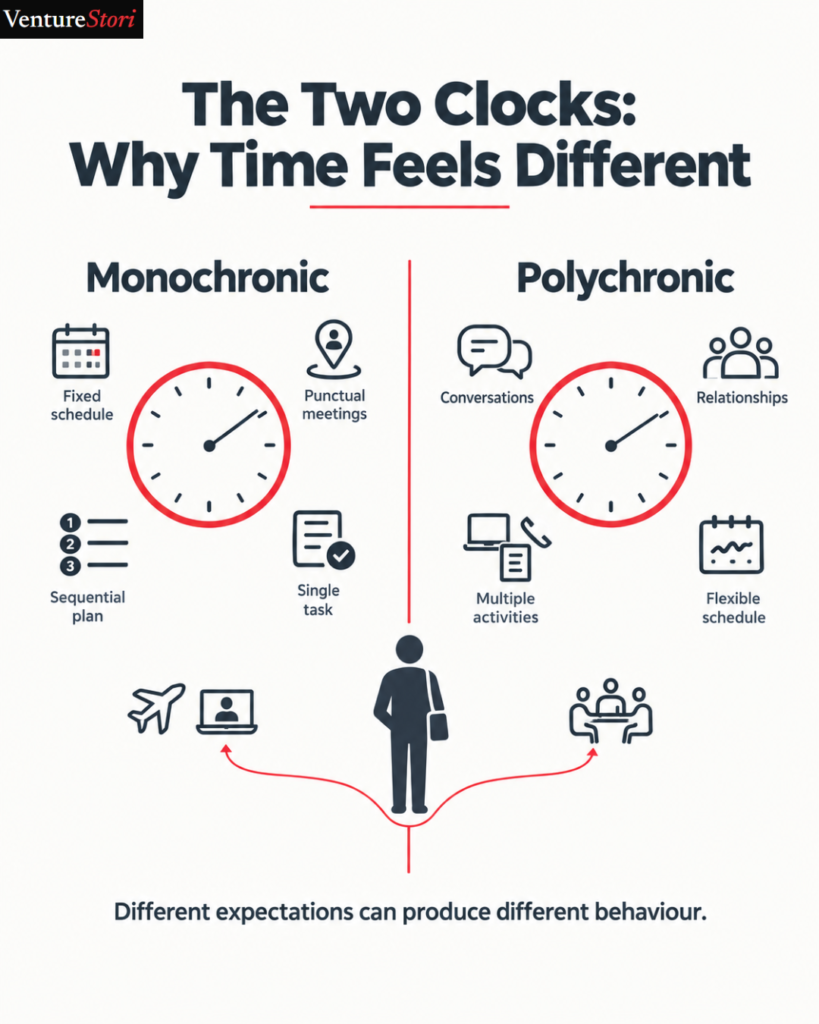
Most people facing this contradiction tend to assume it’s a discipline problem. However, it’s not. Research carried out on time orientation shows there’s a difference between monochronic approaches, which lay emphasis on schedules, punctuality, and finishing tasks in order, and polychronic approaches; that gives room for more flexibility and lay emphasis on relationships and competing activities.
According to research carried out on 577 public workers in Nigeria, lateness depends on the aim of the meeting and the person or persons they were meeting.
This provides more context for why a person can be punctual for a scheduled flight or a virtual meeting with someone overseas but choose a more flexible plan when it comes to local meetings and appointments. The person can operate and stick to a strict clock; however, the surrounding expectations and consequences may simply be different.
The solution would be to ensure internal deadlines are more specific—set a fixed date, a specific time, decide what happens if the deadline is missed, and be accountable for the commitment. Specifying where, when, and how an action will take place can improve goal achievement.
Signal vs. Noise: Busy Isn’t the Same as Building
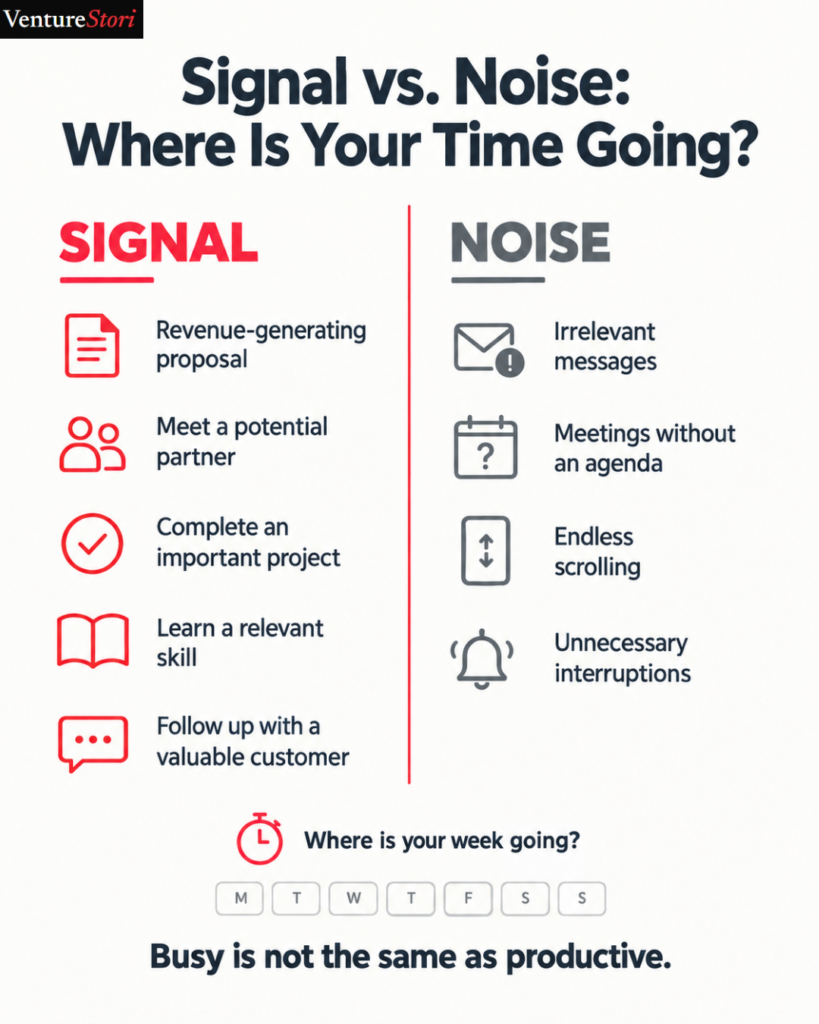
Signal and noise are two different things. A signal can be defined as work that takes you directly closer to your goal. Noise is an activity that consumes your time and attention with zero progress towards your goal. The distinction isn’t centered on what activity is productive but on the outcome of that activity.
A proposal that has the potential to lead to revenue generation is a signal. Taking tons of irrelevant messages with no aim is noise. A meeting that may yield a productive partnership is a signal. A meeting that has no clear agenda, aim, or purpose is noise. Learning a skill or registering for a course is a signal; leisurely scrolling through LinkedIn without any real intention is noise.
These same principles work when it comes to hustle. Always being present may be taken for being productive while there’s still unfinished work. Productivity should be measured by projects completed, revenue generated, goals reached, etc., and not simply by work hours or number of meetings. Sabi Marketplace is an example of a company that has thrived on productive numbers and not just working hours.
The Founder Dependency Trap
This happens to be one of the most expensive forms of noise. For many SMEs, the founder is also the salesperson, operations manager, finance lead, HR person, and customer-support specialist simultaneously. If the business grows, this can become a huge challenge.
The solution is to reduce founder dependency and delegate some of the business responsibilities to capable people. Founders who share responsibilities with others will have time to handle responsibilities that only the founder can handle. Being overly involved in routine tasks may keep them chained to operational work.
Picture this scenario: If a founder puts his monthly income from his business at ₦200,000 after working for 60 hours a week, that amounts to roughly ₦770 per hour.
Assume that the founder employs an assistant who costs ₦3,000 per hour. If the assistant works for 20 hours a week, it amounts to ₦240,000 monthly. The main question is whether the 20 hours being paid for will allow the founder to make more revenue through sales, strategy, or other high-value work if the founder channels their effort elsewhere. Of course, this is purely hypothetical, and there are no guarantees, but the calculation makes the trade-off visible.
Founders are usually reluctant to delegate work to someone else because of a number of concerns. However, the most practical approach is to delegate simple, repetitive tasks, state an expected result, and record and review the person’s work until they can do it excellently and independently.
A Practical Time Management Framework
Step 1: Identify Signal vs. Noise (Week 1)
Keep a record of your time for a week—preferably in a five-minute increment sequence. Describe each block as either signal or noise, then calculate your signal percentage. After the week, calculate how much time you spent directly working towards your goals. Use that percentage as your baseline, then set a realistic target for improvement.
Step 2: Time-Blocking (Week 2)
Delegate fixed blocks to signal work and avoid interruptions. Time-blocking is part of the productivity tips for Nigerian entrepreneurs.
A practical starting schedule for an eight-hour workday may resemble:
- 7:00-8:00 a.m.: Prepare for work
- 8:00-11:00 a.m.: Intensive work
- 11:00 a.m.-12:00 p.m.: Meetings and calls
- 12:00-1:00 p.m.: Lunch break
- 1:00-3:00 p.m.: Intensive work
- 3:00-4:00 p.m.: Reactive work
- 4:00-5:00 p.m.: Review work done and plan for tomorrow
Step 3: The Eisenhower Box (Decision Framework)
| Urgent | Not urgent | |
| Important | Do first. | Schedule |
| Not important | Delegate | Delete |
Urgency doesn’t always tell the full story. Whenever you come across an urgent situation, always ask, “If we take care of this problem tomorrow, what happens?”
Questions like this will help you figure out the difference between an actual deadline and someone’s hasty decision to make a decision.
Step 4: The Pomodoro Technique (Execution)
Pomodoro technique gives focused work a clear start and stop using a 25-minute work period and a five-minute break afterwards.
Productivity Tools Worth Knowing
| Tool | Best For/Price | Nigerian Built |
| Ginja | Ginja is best used when you want to transform scattered thoughts into tasks. | Yes. Launched this year by Nigerian engineer Emmanuel Onwubuya. |
| Lumely | Lumely is helpful when it comes to habit tracking and community accountability. | Yes. Launched by Segun Tekun. |
| Radiant diGiLog | Radiant diGiLog is better suited for organizational workforce management over individual task management. | Yes. |
| Notion | Current official pricing shows the free plan costs $0. Plus costs $10 per member monthly. Business plan costs $20 per member monthly. | No. |
| Todoist | Todoist covers basic personal productivity like scheduling and task management. The Pro feature is currently listed at ₦9,900 monthly and ₦99,900 yearly on the Nigerian App Store. | No. |
| Asana | Asana is best used for handling joint projects. tracking instead of a personal to-do list. Current official pricing has a free personal plan for two users. The Starter plan costs $10.99 per user monthly, which is billed yearly. The Advanced plan costs $24.99 per user monthly, which is billed yearly. | No. |
| Google Calendar | Google Calendar covers basic personal productivity like scheduling and task management without any subscription paid. | No. |
| Forest | Forest is best used if you need a distraction blocker or focus timer and not a full task-management system.It is currently listed at ₦9,900 monthly and ₦59,900 yearly on the Nigerian App Store. | No. |
A 30-Day Implementation Roadmap
| Week | Focus | Action | Outcome |
| One | Assessment | Keep a record of your time at intervals and classify it as either signal or noise. | Have a clear baseline that shows what happens to your time. |
| Two | Structure | Have a calendar that works with protected time for important work and pick one time-management tool. | Have a clear schedule and only a few competing priorities. |
| Three | Focus | Experiment with a structured work and break schedule. | Have fewer distractions during ongoing important tasks. |
| Four | Delegation | Delegate the repetitive and minor tasks to employees or remove them completely. | Record how many hours you saved after delegation for more important tasks. |
At the end of day 30, compare your fourth week’s results with your first week’s results. The goal is to show that you now use a large bulk of your working hours for your goals. This roadmap can serve as a guide to time management for professionals in Lagos. Mastering time management was one of the ways Chowdeck was able to scale and beat Lagos traffic.
Real Scenarios
Freelancer to agency:
A freelancer with a monthly salary of ₦200,000 spent about 80% of their working hours handling admin tasks, and the rest went to dealing with actual clients. A virtual assistant placed on a monthly salary of ₦100,000 took over handling scheduling duties, and the freelancer was able to free up about 30 working hours weekly to deal with client work and business development. In six months, monthly revenue generated was about ₦1,000,000.
Founder burnout to structure:
A founder working over 70 hours weekly was feeling the effects, yet the business was stagnant. It was a sign of 50 things being done at 30% capacity. The solution was to find a schedule that worked: 8:00-11:00 a.m. for deep work only, 11:00 a.m-1:00 p.m. for meetings, and 3:00-4:00 p.m. for reactive work. It resulted in better focus, and more work was done with the help of Google Calendar and the Forest app.
Team manager to senior manager:
A manager with a monthly salary of ₦600,000 couldn’t get promoted. It wasn’t because he lacked results, but because of the 20 hours he spent every week at work attending meetings that had no vision, and he wasn’t able to come up with the strategic initiatives that promotion requires. However, by using the Eisenhower Box to delegate the unimportant meetings and cutting the time spent in them in half, and securing Thursdays for strategy, the founder was able to come up with one strategic initiative monthly, and they soon got promoted.
Common Mistakes
- Seeing every urgent situation as something important.
- Spending more time picking tools/software instead of actually using them
- Not safeguarding deep-work time
- Measuring working hours over results gotten
- Skipping delegating work duties because of the founder dependency trap
- Zero attention to breaks. Working without recovery is just burnout waiting to happen
Conclusion
Time management in Nigeria isn’t down to lack of discipline—it is a two-clock problem. The moment you realize this, you understand that the solution is putting the right structures in place: keep track of your signal-to-noise ratio, secure a real block of deep-work time, and delegate the extra work that’s weighing the founder down to help them manage time effectively.
By doing this, you’re deliberately deciding which clock gets to run your calendar. Founders and professionals who take this initiative are the ones who get promoted, close more deals, and grow past depending on one person to run the business. The two clocks aren’t going away. But you can decide which one wins.
Master Modern Business Management Principles in Nigeria
Looking to optimize operational efficiency, streamline team workflows, and navigate complex market dynamics? Discover essential leadership strategies, financial planning frameworks, and performance tracking models in our complete guide to Business Management in Nigeria.