The Nasarawa State Business Directory covers a state that sits just east of Abuja and runs on two distinct economic engines. Areas such as Karu, Keffi, and Mararaba, which lie within Nasarawa State, are close enough to the capital that people and businesses priced out of Abuja have moved there, turning these locations into busy commuter suburbs. Deeper into the state, places like Lafia, Awe, and Kokona hold deposits of barite, lithium, and rare earth minerals that are now attracting significant investment.
This Nasarawa State Business Directory explores both sides of the economy: the growth driven by Abuja’s expansion and the development coming from the state’s own mineral resources. For anyone looking up Nasarawa business listings, companies in Lafia, or broader state opportunities, understanding these two drivers is an important starting point.
At present, Nasarawa’s most visible growth comes from Abuja’s overflow. Real estate, retail, and services in Karu, Keffi, and Mararaba generate immediate cash flow and respond directly to the capital’s housing pressure. The mineral economy operates differently. Large investments have been announced, yet much of the activity still centres on foreign-owned processing plants with limited local supply-chain integration.
Nasarawa’s independent commercial story is still developing. The key question is whether the lithium plants will help build a wider industrial base or remain largely isolated export facilities that bring revenue but limited structural change for local businesses.
Nasarawa as a Business State
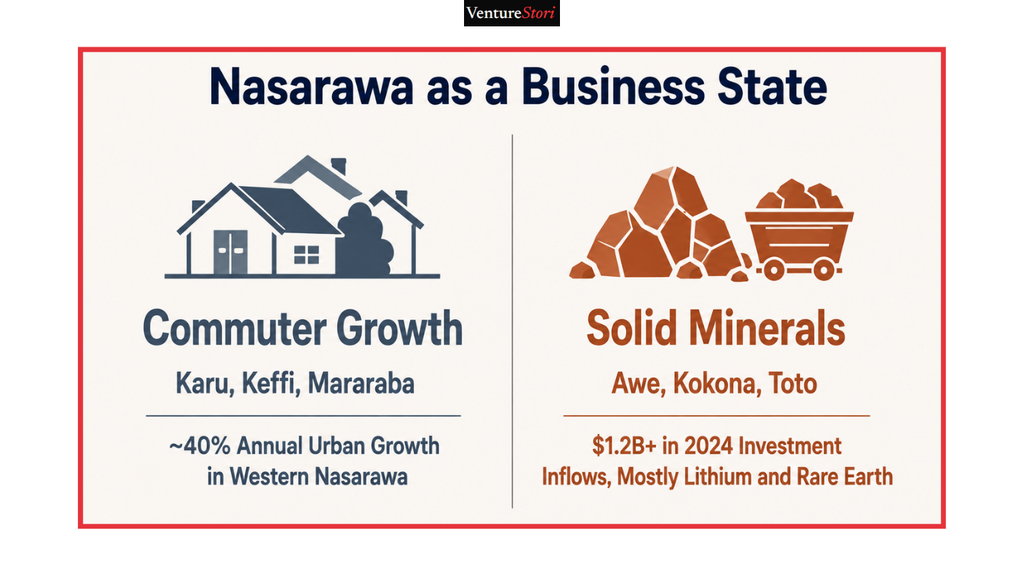
In 1996, Nasarawa was created from Plateau State and Lafia became the capital. It has 13 LGAs, spanning from Karu and Keffi in the west to places like Awe, Kokona and Toto, where most of the mining activity takes place. In 2006 when the last national census was conducted, Nasarawa had a population of 1,869,377.
Nigeria’s Investment Promotion Commission cites a later figure close to 2.7 million and the current estimates are even higher. However, since there has been no recent population census, this figure should be treated as an estimate and not confirmed a fact. Places like Karu in western Nasarawa have expanded because they are close to Abuja. This is mainly because of the influx of people leaving Abuja due to the high cost of living.
Karu Urban area has reportedly been growing about 40% annually. Nasarawa calls itself the home of solid minerals because of its mineral resources. However, for years now, this has become more of a slogan than a reflection. Awe LGA has more than 700,000 tonnes of barite deposit but Nigeria reportedly loses about 5 billion naira every year because it isn’t processed locally.
The story began changing in 2024 and 2025. Nasarawa officials reported about $1.2 billion in investment inflows in 2024, with most of the investment going into lithium and rare earth processing instead of old minerals like barite.
The Active Sectors
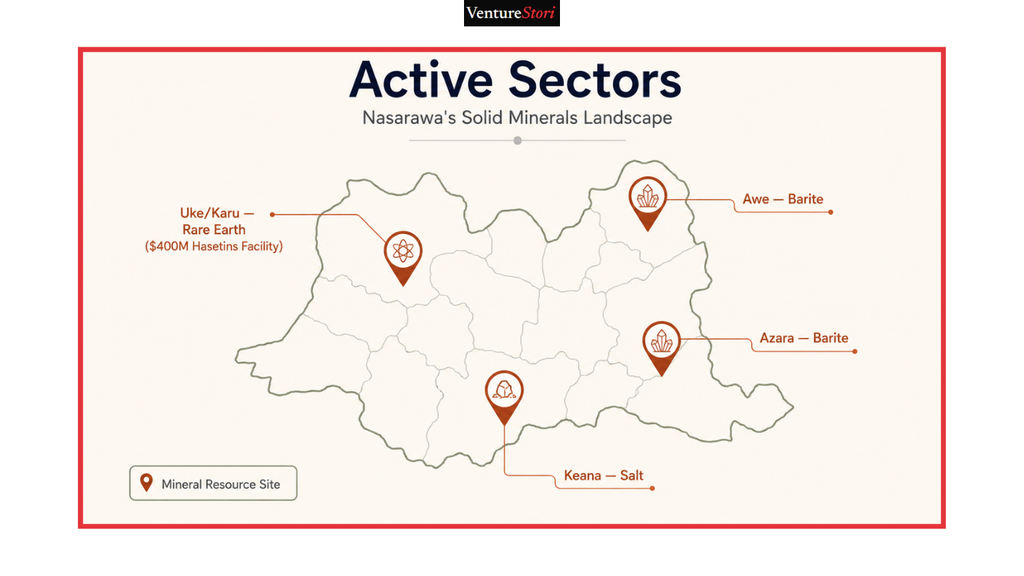
Active Sectors.
Solid Minerals
Lithium and rare earth processing are now the biggest new activity in Nasarawa rather than the older mineral the state is traditionally known for. These new minerals have attracted huge investments. A Chinese company, Avatar New Energy Materials, is investing $100 million in a lithium processing plant that processes 4,000 tonnes per day. Canmax Technologies is also investing another $200 million in a nearby lithium plant.
Hasetins Commodities started a $400 million rare-earth and critical metal facility in Uke, Karu LGA, with 12,000 tonnes of processing capacity. It is described as the largest of its kind in Africa and was formally inaugurated by President Tinubu. But Barite has not experienced this level of industrial development.
Azara has more than 700,000 tonnes of barite deposit but most of the mining is still done manually, instead of with large industrial operations by large companies. This is also the problem that salt production around Keana and Awe has. Nasarawa state is a state blessed with natural reserves but there is not much large-scale industrial activity around them yet.
Real Estate Near Abuja
Real estate is growing to be the next major sector in Nasarawa, especially around Karu, Masaka and New Karu. These areas are close to Abuja. As housing becomes expensive in Abuja, people move into nearby Nasarawa communities where they are affordable. As people move there, land prices increase and the areas that once had the low income housing are beginning to develop middle range housing estates. This real estate growth is largely coming from Abuja ‘s economy. As Abuja is expanding outwards, Nasarawa is benefiting from the expansion.
Agriculture
Mining isn’t the only important sector in Nasarawa State. In fact, Agriculture is one of the State’s largest employers. Nasarawa State is one of Nigeria’s major producers of rice, soybean, groundnut, and sesame. The agricultural sector has also gained a lot of private investment. The Lee Group has committed $35 million to rice, sesame, sugarcane and peanut production. Their plans include developing 5,000 hectares of rice farmland and building a modern rice mill. Another company known as Green Sahara Farms, has been working with local sesame producers since 2009. The work includes helping farmers with distributing and access to markets.
Trade
Lafia and Keffi serve as regional trading centres where people come to buy, sell and conduct business.
Finance and Banking
Because people and businesses are active here, banks operate to provide services such as transfers, accounts, loans and payments. Banks like Zenith Bank, GTBank, First Bank, UBA, Access Bank and Fidelity Bank all operate branches across Lafia, Keffi and Karu. These banks don’t just serve one type of customer, their banking activity is connected to both the mining economy, agricultural economy and the people commuting between Nasarawa and Abuja.
Professional Services
On the professional service side, Nasarawa’s legal sector centres on Lafia and Keffi rather than in the mining towns; Kana & Co, founded by current state Attorney General Abdulkarim Abubakar Kana is among the state’s established local firms. Nasarawa State University’s business faculty in Keffi also provides a steady supply of finance professionals into the banking and public sector
The Business Districts and Key Areas
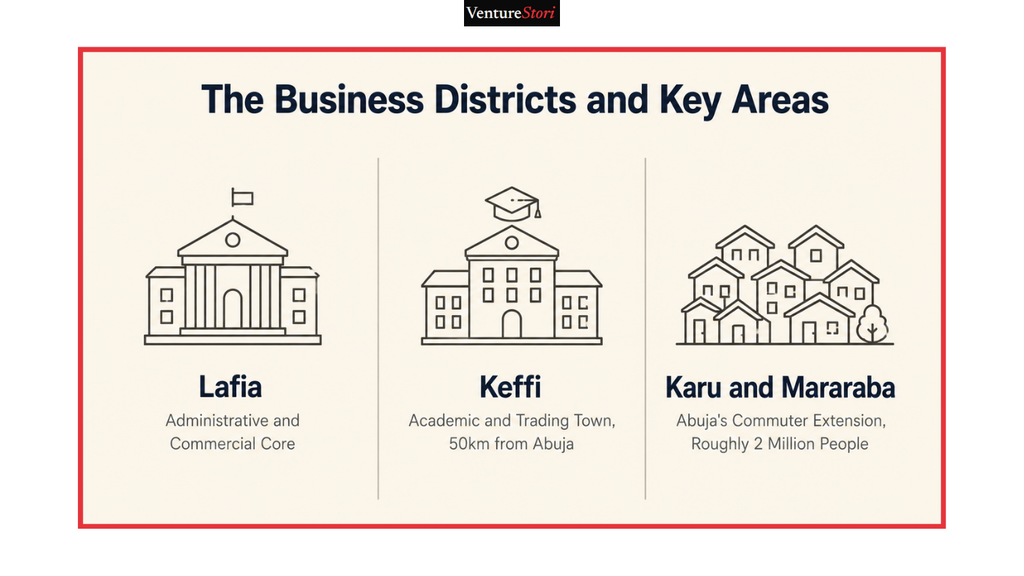
Lafia
Lafia is the capital of Nasarawa and it’s where a lot of government and commercial activity happens. The Lafia City Centre and Central Market are the main administrative and commercial areas in Lafia. They are located near government offices and the Emir’s palace.
Shabu Road is now a busy commercial area where traders and small businesses serve people’s everyday shopping needs.
Keffi
Keffi is important for two reasons. For business and for education, not just because people travel from there to Abuja. Keffi has its own commercial and academic economy. The main campus of Nasarawa State University is in Keffi. Because of this, businesses like restaurants, student housing and other student focused businesses have a steady stream of customers. Keffi is about 50km from Abuja, so it benefits from people traveling to Abuja, while still maintaining its identity as a trading town. In history, the economy of Keffi was connected to tin, columbite mining and farming.
Karu and Mararaba
Karu is where Abuja ‘s influence is the strongest. It includes Old Karu, New Karu, Maraba, Masaka and Ado. Karu is estimated to inhabit about 2 million people, with a growing rate of almost 40% per year. Most lands and housing in Karu functions as an extension of Abuja ‘s property market, because of how expensive Abuja is. The same thing applies to businesses like banks and hotels.
Investment and Development Activity
Nasarawa held its third biennial investment summit in 2026, from late April to early May. The summit was titled “Bold Transitions: Building a Legacy for Sustainable Futures”. Governor Abdullahi Sule presented this as the last investment summit of his administration because of the upcoming 2027 political transition. The strongest evidence that Nasarawa is gaining momentum is in solid minerals.
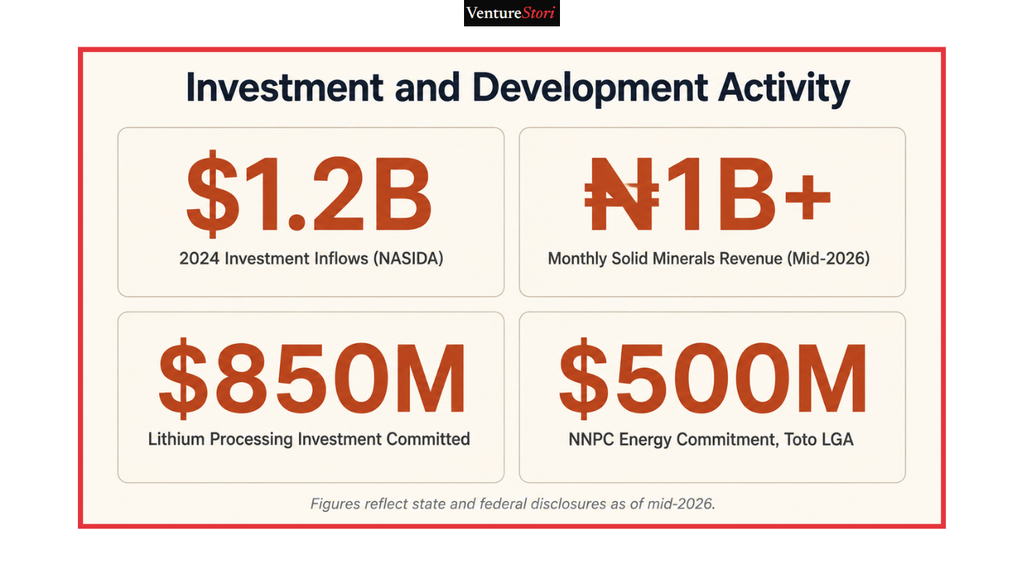
By mid-2026, state officials said that the monthly revenue generated from Nasarawa’s solid minerals had passed 1 billion naira. Governor Sule also pointed out that Nasarawa is on its way to earn at least $10 million from lithium by the end of 2026. This is connected to about $850 million worth of lithium processing investments that have been established in the state. These figures are gubernatorial disclosures and should not be treated as independently verified numbers.
Currently, Nasarawa is attracting big investors but the investments are not spread evenly across all types of businesses. NASIDA’s 2024 report revealed that Nasarawa received about $1.2 billion investment inflow in that year. The money went into areas like Free trade zone development, lithium processing, Real estate, compressed natural gas and general agriculture.
NNPC (Nigerian National Petroleum Company Limited) also invested in Nasarawa State. It committed $500 million to energy projects in Toto LGA.
In relation to agriculture in Nasarawa State, Doma Agrocity carried out a project worth 6.4 billion naira. This project is a partnership between Lower Benue River Basin Development Authority and Amisek Industrial company. The project is developing 950 hectares of irrigated sesame farmland. It operates under a 15-year concession and also promises guaranteed offtake for 1000 small holder farming households.
Who Is Building Here
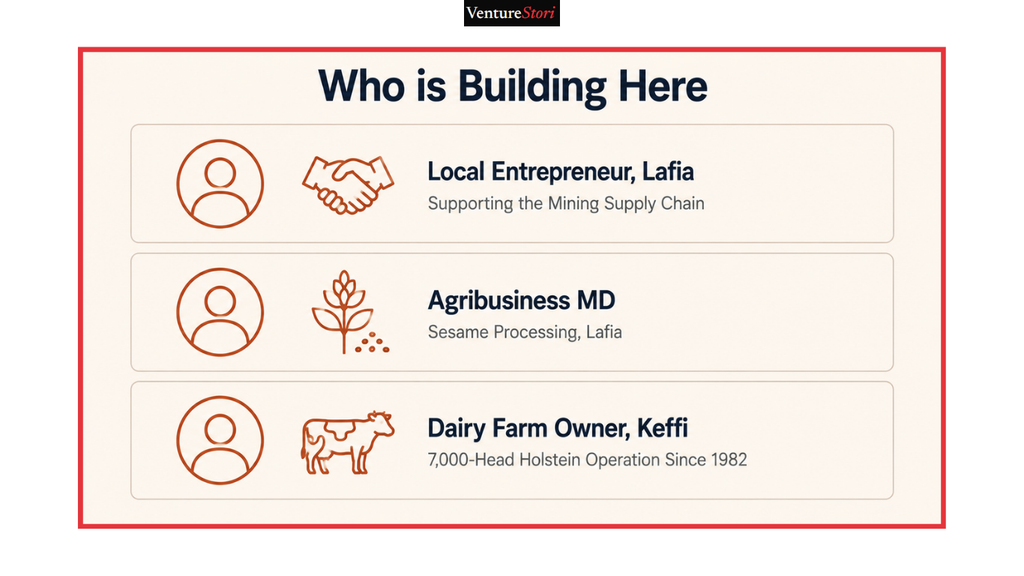
There is a Nigerian ownership gap in Nasarawa’s mineral boom. According to the reports made by Vanguard, no Nigerian investor currently has a significant position in the state’s lithium sector. The companies doing the majority of the processing are Chinese owned while Nigerian participation is mostly limited to artisanal mining. Below are three profiles that operate inside the gap.
Onyebuchi Ikechukwu
Onyebuchi Ikechukwu is an entrepreneur based in Lafia. He identified this gap. During an interview with Businessday, he told them that local businesses are going from just buying and selling of goods to providing the services that support the new mining industry. Instead of trying to build a $100 million or $400 million lithium-processing factory, the local businesses are looking at the things the factories need. So, Nigerian businesses are not competing directly with the Chinese companies. They make money by supporting them. This is a small, less capital intensive way into Nasarawa’s mineral economy than trying to compete with it outright.
Abubakar Usman Gutomu
He represents a different kind of business. Instead of supporting foreign mining companies, his company is focused on agriculture and processing. Abubakar Usman Gutomu is the managing director of Gudale Farms Processing Nigeria Limited. In 2024, his company signed an MoU with the Nasarawa State government to build a sesame processing plant in Azuba, Lafia. The plant will produce 10 tonnes of sesame per hour. Currently, farmers produce sesame domestically but send it to different states to get it processed, which adds an extra cost to the goods.
Senator Abdullahi Adamu
Senator Abdullahi is a former governor of Nasarawa. He owns Nagari Integrated Dairy Farm in Keffi. The farm was established in 1982, so this is not a business created because of the current investment increase. The Nagari Integrated Dairy Farm has about 7,000 Holstein cattle, 1,200 hectares of land and a production of dairy and meat products. It is one of the largest single integrated dairy operations in Africa. The produce doesn’t only serve Nasarawa but goes beyond the state. These three profiles say more about Nasarawa’s real economy than any funding could.
Nasarawa State Company Listings
Note: The following listings are paid placements from businesses operating in Nasarawa State. Venture Stori editorial content above is independent of this directory.
Business name:
Category:
One-line description:
Contact details:
Website:
Location within Nasarawa State:
Enhance Your Business Visibility with Digital Marketing
Leveraging online platforms is essential for modern business growth. Consider listing your Ebonyi-based enterprise on reputable directories to boost discoverability. Explore our comprehensive Ebonyi State Business Directory to connect with local customers and grow your digital footprint.