The Zamfara State Business Directory covers a state with an unusual economic profile. Agriculture supports most livelihoods, while mineral resources such as gold and lithium provide a valuable economic base. At the same time, security risks, informal mining, and environmental damage make the overall picture more complex.
For anyone researching the Zamfara State Business Directory, businesses in Gusau, or company listings across the state, the key question is not simply what resources exist. It is how effectively the state is turning those resources into productive and sustainable businesses.
Gusau serves as the administrative and commercial centre of Zamfara State. Beyond its role as the capital, the surrounding agricultural communities and mining areas form a wider commercial network. Recent investment in lithium processing also shows that Zamfara is beginning to move beyond basic raw material extraction toward more value-added activity.
Zamfara as a Business State
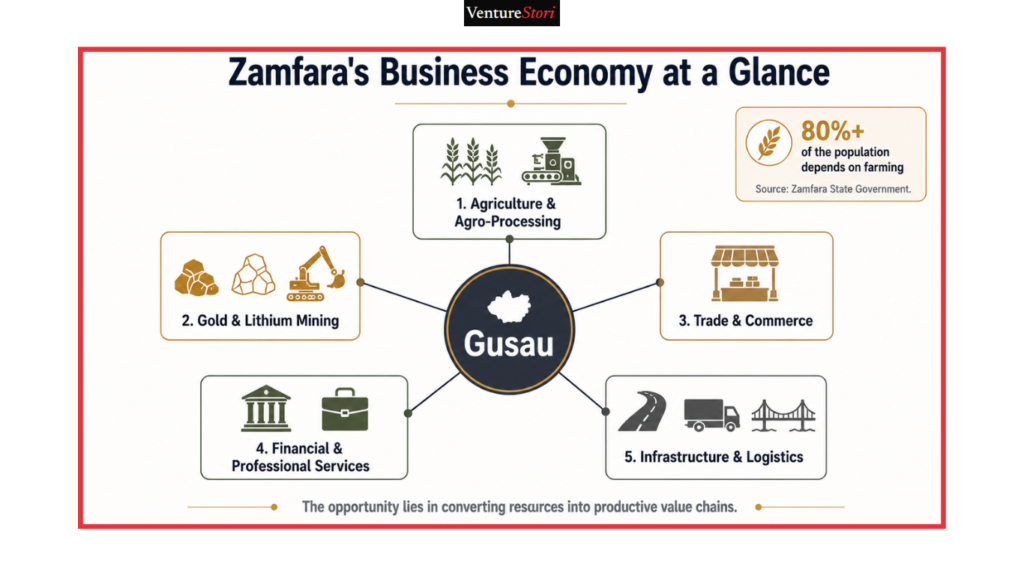
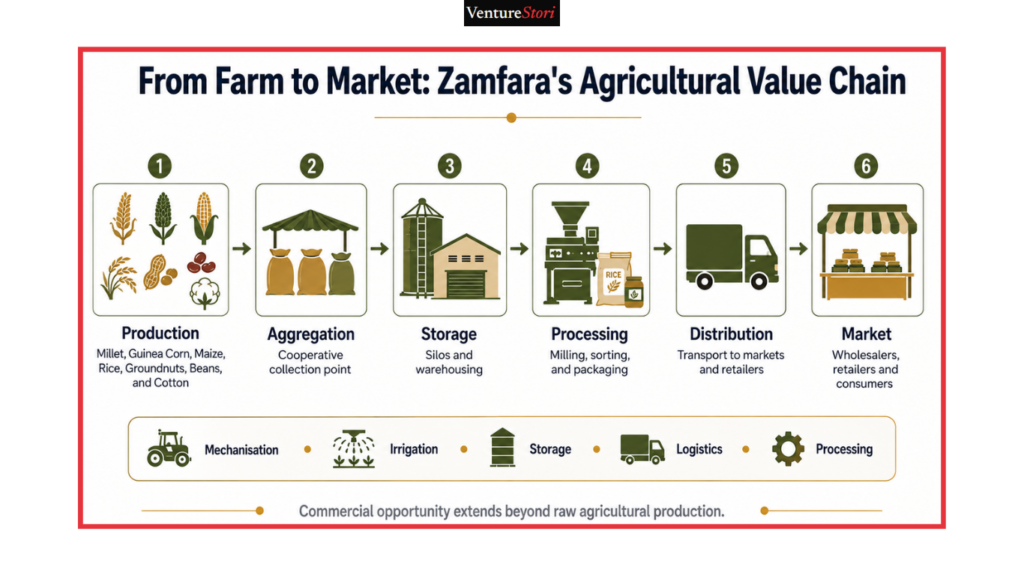
Zamfara is located in the northwestern region of Nigeria with Gusau as its capital. This state generates its major income from agriculture with a report shown by the state government reporting that more than 80% of its population depends on farming. Major crops include millet, guinea corn, maize, rice, groundnuts, cotton, tobacco and beans.
Historically, gold mining has been another major economic activity. And recently, lithium has been discovered and it is attracting substantial investment. This creates a major connection between extraction, processing, manufacturing and export.
The governor of Zamfara state. Governor Dauda Lawal has described the priorities of Zamfara’s to be around mining, agriculture and power. He has also been able to discover and acknowledge the central development problem of the state which is the substantial mineral wealth and arable land not yet being translated into broad-based prosperity.
This discovery is very important for investors. This is because having a mineral deposit is not equal to having a functioning industrial operation. So also, an agricultural programme does not automatically create a commercial value chain.
This means that Zamfara’s business environment has to be assessed through four separate questions: what business is already in operation? What business is currently expanding, what is government-supported, and what remains an investment opportunity.
Security is a factor that is considered for many businesses. However, Federal authorities have reported that there is intensified military and police operations against bandit groups across Zamfara and neighbouring states during 2026.
The security challenge is not everywhere . So, businesses that are considering operations outside established urban centres may need to possess location-specific security and logistics assessments.
The Active Sectors in Zamfara
Agriculture and agro-processing
Zamfara state produces cereals, legumes, rice, cotton and other crops. However, most of the agricultural activities are at subsistence level while the commercial opportunity requires mechanisation, irrigation, storage, aggregation and processing.
The state’s Ministry of Agriculture reported that it is focusing on productivity, food security, agro-processing and climate-smart agriculture. Government-backed programmes include FADAMA III, NG-CARES, SAPZ and other agricultural interventions. These programmes create opportunities for businesses that are into supplying farm machinery, inputs, storage systems, logistics and processing equipment.
There is also exploration of modern agritech. For example, government discussions have included greenhouse farming, modern dairy systems and tractor partnerships. However, all these should be viewed as propositions rather than evidence that large-scale commercial farming already dominates Zamfara.
Gold and Lithium mining
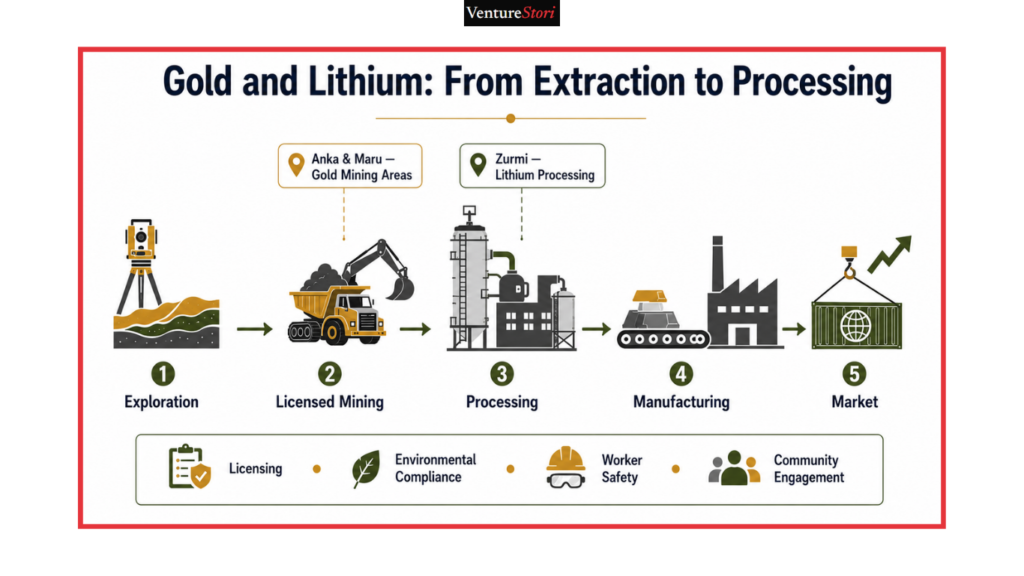
The most complex business opportunity in Zamfara is mining. The State has been mining gold for years, including artisanal and informal mining. The challenge this business is having is transitioning it into a regulated, environmentally responsible, and commercially productive activity.
The Nigerian Geological Survey Agency has geologically and geochemically surveyed and mapped the State of Zamfara and conducted exploration activities there which included gold and other minerals. It has a national mineral-information system that is designed to offer investors with geologic information to make well-informed decisions about exploration.
Lithium is just recently discovered and it is new in the investment story as Zamfara State unveiled a $200 million lithium mining and processing plant at Boko Village in Zurmi Local Government Area in July 2026. The government stated that the joint investment involves ZAM Mining Company Ltd, Bima Mines Ltd, Jinlide Mining Co. Ltd and other partners.
The significance of this is not in the amount to be invested but it opens Zamfara state to capture more value before minerals leave the state.
The Public-health Cost of Informal Mining
It is also important to address the risks that are involved with informal extraction or Zamfara gold and lithium mining. There was a time the state experienced a severe lead-poisoning outbreak linked to artisanal gold mining. WHO documented this record and recorded from investigations that the poisoning involved children in mining communities and contamination from ore and soil.
This means that production or capital expenditure alone is not the only reflection of formal mining.
Community involvement and responsible mineral processing, environmental controls and occupational safety are equally crucial. The state’s future mining economy will rest on the ability to distinguish between legitimate industrial mining and the unsafe and illegal extraction.
Trade and Commerce
The state’s main commercial and administrative centre is Gusau. Several businesses such as retailers, wholesalers, transport operators, financial institutions and service businesses support the demand generated by government, agriculture, mining and households.
The proposed redevelopment of Gusau’s Old Garage shopping district is a sign for formal retail development worth the ZIPA project document proposing a ₦200 billion private-finance structure for completing and operating the Gusau Shopping Mall.
However, this should be described as a proposition and not an already completed commercial development.
Financial and professional services
There are professional services such as banks, microfinance institutions, lawyers, accountants, consultants and other professional firms across Gusau.
Their services are likely to grow if there’s expansion in agricultural processing and formal mining. The businesses much needed in these sectors are financing, licensing, tax support, legal advice, accounting and compliance services.
Key Business Areas in Zamfara
Gusau
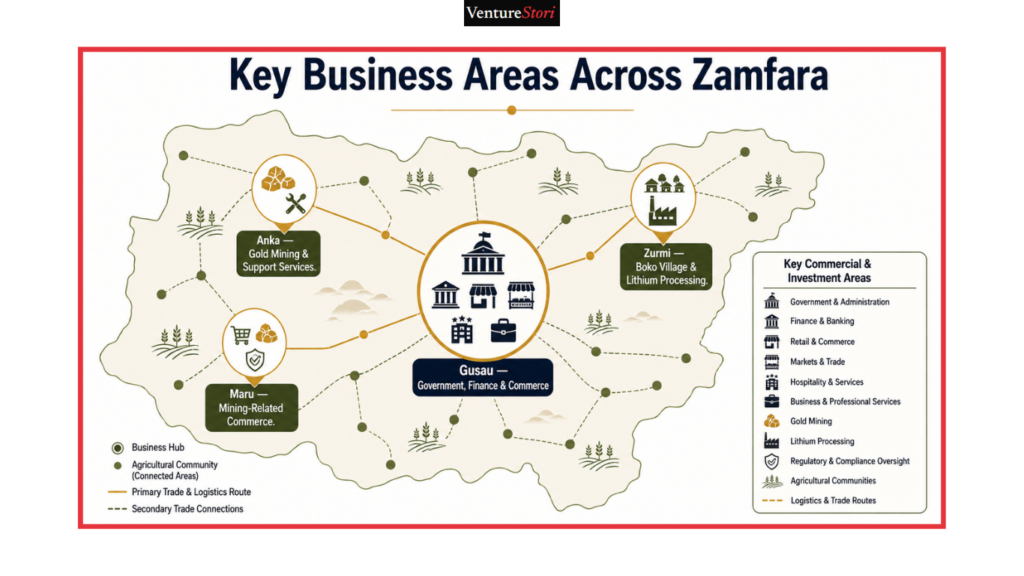
The administrative and commercial centre of Zamfara state is Gusau. With professional services, government institutions, banks,retail businesses, markets and hospitality establishments concentrated there.
The center part is serving the demand of customers everyday as they have access to what they need here while the wider city supports businesses connected to government contracts, agriculture, construction and services.
The prospect of the state to invest is also linked to having infrastructure. The state’s development plans have included the Gusau International Airport, airport access infrastructure, market improvements and transport facilities.
Anka and the wider mining belt
Anka is closely linked to the gold mining economy of Zamfara. But the factors that will determine if it will be a viable enterprise are: security, licensing, and environmental compliance
Maru
Maru is another important area that this linked to mining. It was researched and published by Good Governance Africa that the illicit gold activity in Zamfara occurred majorly around Maru, Anka, Zurmi and other LGAs. This makes the area commercially relevant, but also demonstrates why investors need careful due diligence.
Zurmi
This location has become significant as a result of the $200 million lithium mining and processing facility is located in Boko Village within the LGA. When this project commences, it could stimulate demand for transport, accommodation, equipment, engineering, security and other support services. However, it is sustained operations that will determine the commercial impact.
Investment and Development Activity in 2026
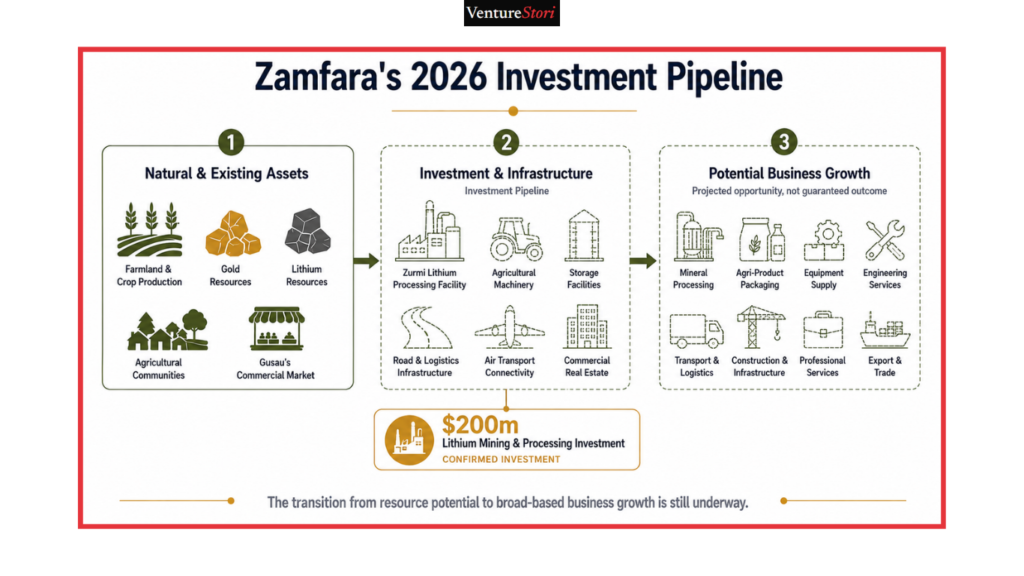
Investment in Zamfara became more solid in 2026 as a result of the commissioning of the lithium processing plant. Its reported $200 million investment makes it one of the state’s most significant recent industrial projects. Other participating companies include ZAM Mining Company, Bima Mines and Jinlide Mining.
There has also been engagement from the federal level . In July 2026, Minister Jumoke Oduwole, the Minister for Industry, Trade and Investment, visited Gusau. There were discussions on how investment could be attracted into the solid minerals of the state thereby increasing Zamfara’s participation in the 2026 Intra-African Trade Fair and connecting local manufacturers to AfCFTA opportunities.
This is important because agricultural production and mineral resources need to gain access to markets beyond the state.
The State has also undertaken general agricultural and industrial development. The agricultural machinery, as well as the projects related to agricultural livelihoods, are also covered in its budget performance documents for 2026, but budget allocation does not necessarily mean that investments have actually been made in the private sector.The other piece of the investment puzzle is infrastructure.
The project of Gusau International Airport and road infrastructure is supposed to provide better connectivity. In the meantime, the state has considered commercial projects including the PPP project of the Gusau Shopping Mall. In July, six Nigerian governors, including zamfara’s Dauda Lawal, also went to Glo-Djigbé Industrial Zone, Benin Republic. The visit was centered on lessons learnt on agro-industrial processing, infrastructure and private sector investment.
Reviewing this altogether, these developments show a state trying to move from resource potential toward value addition.
The evidence is strongest in mining and government-backed agricultural programmes. However, the broader private-sector ecosystem remains less developed than in Nigeria’s major commercial centres.
Who Is Building in Zamfara?
ZAM Mining Company, Bima Mines and Jinlide Mining
These are the companies that are among the investors backing the Zamfara Lithium Mining and Processing Plant in Zurmi. It is a case of private capital moving into Zamfara’s mineral-processing economy in 2026 by their involvement .
Zamfara Investment Promotion Agency
ZIPA is central to the state’s investment-promotion infrastructure. Its work includes developing PPP opportunities and positioning projects for private-sector participation. The Gusau Shopping Mall proposal is one example. (Zamfara State Government)
Zamfara agricultural enterprises
The state’s agricultural ecosystem includes farmers, cooperatives, processors, input suppliers and logistics operators. The more important commercial opportunity is connecting these participants into larger value chains rather than simply increasing raw production.
Understanding Zamfara’s Business Opportunity
Agriculture and mining should not be the only way of living in Zamfara.
The State’s economy is still dominated by agriculture and there is some potential for minerals as an industrial route. Investing in the lithium processing is a good sign of the possibilities of value add, but it’s only one element of the bigger transition.
The best prospects for businesses looking at Zamfara could be in the inter-sectoral space – agricultural processing, logistics, equipment supply, construction, professional services, mining support and infrastructure.
Meanwhile, investors have to differentiate between announced projects and running businesses and mineral potential from commercial production.
This is the reason the Zamfara business directory is helpful. It shouldn’t simply be a list of companies. It must enable businesses, investors and customers to know where the commercial activity is really happening and what sectors are growing.
Connect with Local Businesses Across Nasarawa State
Expanding your commercial reach or discovering verified service providers in North Central Nigeria requires reliable local data. Check out our comprehensive Nasarawa State Business Directory to explore top local enterprises, connect with verified vendors, and increase your business visibility.